|
Intake Manifold Pressure Sensor Circuit – Data Erratic, Intermittent, or Incorrect
|

Overview
| CODE | REASON | EFFECT |
| Fault Code: 2973 PID: P102 SPN: 102 FMI: 2/2 LAMP: MIL SRT: |
Intake Manifold Pressure Sensor Circuit – Data Erratic, Intermittent, or Incorrect. The electronic control module (ECM) has detected an intake manifold pressure signal that is too high or too low for present engine operating conditions. |
Malfunction indicator lamp (MIL) and/or low power complaint. |
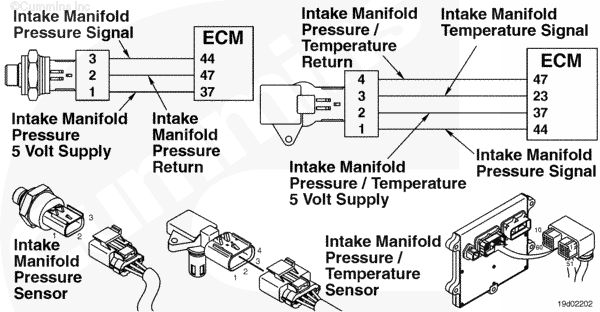 Intake Manifold Pressure Sensor Circuit
|
Circuit Description
The intake manifold pressure sensor monitors intake manifold pressure and passes information to the ECM through the engine harness. If the intake manifold pressure becomes too low or too high, it will cause a fault code.
Component Location
The intake manifold pressure/temperature, 1 sensor is located in the air intake manifold.
The barometric pressure sensor can be externally mounted on the engine or can be an internal component within the ECM. Check the engine wiring diagram for circuit details.
Conditions for Running the Diagnostics
Part 1 of this diagnostic runs a sensor rationality check when the keyswitch is initially turned ON. If the fault code became active at key ON only, it has failed the first check.
Part 2 of this diagnostic runs a boost pressure rationality check when the engine is running under normal conditions. The diagnostic runs a boost checkwhent:
- Good boost pressure is measuresd at 2000 rpm and above for 15 consecutive seconds.
- Boost pressure is measured at 1500 rpm in a motoring condition for 15 consecutive seconds.
The diagnostic can pass or fail any of the conditions above and does not have to fail both in order to set a fault code.
Conditions for Setting the Fault Codes
This diagnostic checks the value of the intake manifold pressure sensor at key ON and while the engine is running. If the value of the intake manifold pressure is not reading ambient pressure at key ON or is higher or lower than expected during normal engine operation, this fault code is logged.
Action Taken When the Fault Code is Active
- The ECM illuminates the MIL immediately when the diagnostic runs and fails twice.
- Follow troubleshooting tree and rectify the problem.
Conditions for Clearing the Fault Code
- Run the ECM Diagnostic as described above.
- Once the diagnostic has completed, the fault code will go inactive if it passes.
- As soon as the diagnostic has completed and passed one trip, the MIL will remain on but the fault code will be inactive.
- Once the fault code is inactive use “clear all faults” command using the latest version of INSITE™ electronic service tool.
NOTE: To clear the MIL without INSITE™ electronic service tool, you must run the full diagnostic a total of three times. Make sure a full ECM 30 second power down is completed between each cycle.
Shop Talk
The intake manifold pressure sensor monitors pressure in the intake manifold. This fault is set active when the intake manifold pressure is too high or too low for the present engine operating conditions. The ECM compares the intake manifold pressure reading to turbocharger speed (estimated by the ECM in some engines) to determine if the pressure reading is valid.
Possible causes of this fault are:
- A damaged intake manifold pressure sensor.
- A damaged barometric pressure sensor.
- Leaks in the air intake system between the turbocharger and intake manifold.
- Restriction in the charge-air cooler.
- A damaged turbocharger speed sensor.
- A damaged turbocharger compressor intake temperature sensor.
- A damaged engine wiring harness can cause intermittent fault codes due to intermittent resistances. Check the wiring diagram for shared supply and return circuit on sensors. It is possible that more than one sensor could be reading in range but incorrectly if a common supply/ground problem exists in the circuit. Use INSITE™ electronic service tool to log any fluctuation in sensor voltage/values when the harness is moved.
NOTE: Converting gauge pressure to absolute pressure may be required, depending on the engine you are troubleshooting.
- Barometric pressure is approximately 29.92 in-Hg at sea level. (Absolute Pressure)
- The intake manifold pressure is approximately 0 in-Hg when the engine is not running. (Gauge Pressure)
- 29.92 in-Hg = 1 atmosphere = 1.013 bar
Example: If the barometric (Absolute) pressure sensor reads (31) in-Hg and the intake manifold (Gauge) pressure reads -5 in-Hg then the difference can be calculated as follows:
1. Convert intake manifold (Gauge)
pressure to Absolute pressure = (-5 + 29) = 24 in-Hg.
2. Subtract the new 24 in-Hg from the original barometric value 31 in-Hg. (31 – 24) =
7
3. The difference is 7 in-Hg. Since the value is greater than the specification of 3 in-Hg, it will cause the fault to become active at key ON.
4. Use the Barometric Pressure at Altitude table in the following procedure to help understand ambient pressure at different altitudes. Refer to Procedure 018-028 in Section V.
Refer to Troubleshooting Fault Code t05-2973

;)
;)