Description
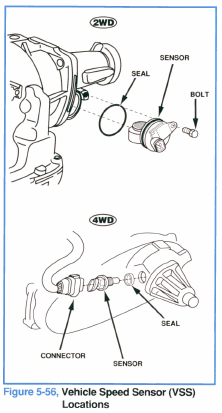
The transmission output speed/vehicle speed sensor is mounted on the driver’s side of the transmission case, near the rear (figure 5-56). The sensor consists of a permanent magnet surrounded by a coil of wire. It reads the rotation speed of a 40-toothed ring mounted to the rear carrier assembly on 4L80E models or to the output shaft on 4L60E models.
The sensor maintains a slight air gap (.045-.109 in.) between itself and the case. The sensor produces an AC signal voltage whose frequency varies with transmission speed:
• Low speed = low voltage signal frequency
(.5 volts at 100 rpm)
•High speed = high voltage signal frequency
(100 volts at 8,000 rpm)
2WD/4WD Differences
The sending of vehicle speed information to the PCM differs slightly between two-wheel-drive and four-wheel-drive configurations.
• Two-wheel-drive systems use either a transmission output speed sensor or a VSS.
The sensors perform essentially the same function. Each sensor’s signal is used by the buffer/DRAC module to inform the PCM of vehicle speed.
• Four-wheel-drive systems use both a transmission output speed sensor and a VSS sensor. The VSS is located on the transfer case.
Information from the transmission output and/or VSS sensors is used by the PCM for TCC application and release, line pressure control, shift timing control, and torque management control.