|
Cummins® natural gas engines provide a low emission alternative for various applications. In order for the engines to continually provide extremely low emission levels and provide the best durability and reliability, Cummins Inc. has developed several fuel standards. Operators of Cummins® natural gas engines should provide the standard or specification to the potential suppliers and request confirmation as to local availability.
For all Cummins® natural gas engines, the methane number based on SAE 922359, and the higher or lower heating value (as appropriate) must equal or exceed those shown in the table below. As new ratings are developed and released, these values may change based on engine ratings.
These specifications apply to fuel as it is delivered to the engine, regardless of whether its origin was liquid or gaseous. Liquefied Natural Gas (LNG) is an acceptable fuel, provided the on-board fuel storage and supply system delivers proper pressure, temperature, and complete vaporization to the engine fuel system inlet. These specifications are not intended to cover certification requirements. The fuel must not contain water, dust, sand, dirt, oils, or any other substance or component in an amount that is detrimental to the operation of the engine. More specifications and test methods are detailed in these standards.
Cummins® natural gas engines are designed and adjusted to meet performance and emissions standards with fuel meeting these specifications. The engine may operate on fuels possessing a wide range of properties, but performance and emissions will be affected. In extreme cases, fuel with characteristics outside of these specifications can cause engine reliability or durability issues. Cummins Inc. assumes no responsibility for the use of fuels that do not meet these specifications. Engine damage caused by fuel not meeting these specifications is not covered by warranty.
Operators must be alert for sudden changes in engine operation, power levels, or the presence of knock. Each of these issues can be a sign of substandard fuel. If an issue related to fuel quality is suspected, ask the fuel supplier to sample and analyze the fuel in the vehicle. Contact a Cummins® Authorized Repair Location for information regarding calculating methane numbers, higher heating values, and lower heating values.
For further details and discussion of fuels for Cummins® engines, refer to Bulletin 3379001, Fuels for Cummins® Engines.
|
Fuel Standards for Cummins® Natural Gas Engines
|
|
Standard
|
Engine Family
|
| |
B5.9 G, C8.3 G
|
ISB5.9 G
B Gas International,
B Gas Plus,
C Gas Plus,
L Gas Plus
|
ISL G
|
|
CES 14604
Minimum Methane Number: 80
Minimum Higher Heating Value: 975 BTU/Standard Cubic Feet
|
Yes
|
|
|
|
CES 14624
Minimum Methane Number: 75
Minimum Lower Heating Value: 37448.6 kJ/kg (16100 BTU/lbm)
|
|
|
Yes
|
|
CES 14608
Minimum Methane Number: 65
Minimum Lower Heating Value: 37448.6 kJ/kg (16100 BTU/lbm)
|
|
Yes
|
|
This table is an example using CES 14604 to determine if the fuel meets the fuel standards.
|
Test Fuel Data Input (See Notes at Right)
|
|
Location (Description)
|
Certified Fuel
|
Notes
|
|
Methane
|
CH4
|
90.20 percent
|
Fuel requirements for automotive spark-ignited gas engines only.
|
|
Ethane
|
C2H6
|
4.03 percent
|
Fuel as delivered to engine, regardless if liquid or gaseous.
|
|
Propane
|
C3H8
|
1.76 percent
|
The maximum allowable sulfur content is equal to 0.001 percent of the weight.
|
|
Butane
|
C4H10
|
0.01 percent
|
Fuel must not contain water, dust, sand, dirt, oils, or any substance that can harm the engine.
|
|
Pentane
|
C5H12
|
0.01 percent
|
|
|
Hexane
|
C6H14
|
0.00 percent
|
|
|
Heptane
|
C7H16
|
0.00 percent
|
|
|
Octane
|
C8H18
|
0.00 percent
|
|
|
Carbon Dioxide
|
CO2
|
0.00 percent
|
|
|
Nitrogen
|
N2
|
3.99 percent
|
|
|
Oxygen
|
O2
|
0.00 percent
|
|
|
Sum of Components
|
100 percent
|
|
|
Methane Number:
|
89.76
|
PASS (Minimum Methane Number: 80)
|
|
Higher Heating Value (BTU/Std. Cu. Ft.)
|
1024.50
|
PASS (Minimum Higher Heating Value is equal to 975 BTU/Std. Cu. Ft.)
|
NOTE: Both the methane number and higher heating value criteria must be met to pass a given fuel.
Liquefied Petroleum Gas
This section presents the specifications for liquefied petroleum gas (LPG) engines.
Cummins® Engineering Standards (CES) 14612 and 14613 have been developed as a specification for LPG fueled engines. Operators of Cummins® LPG engines must refer the standard/specification to the potential fuel suppliers and request confirmation as to the local availability.
The requirements apply to fuel as it is delivered to the engine. This specification is not intended to cover certification requirements. The fuel must not contain water, dust, sand, dirt, oils, or any other substance or component in an amount that is detrimental to the operation of the engine. More specifications and testing methods are detailed in the standard.
- B5.9 LPG engines require fuels which conform to CES 14612.
- B LPG Plus engines include knock sensing and control. Fuels conforming to CES 14612 or CES 14613 can be used with these engines.
|
Cummins® Engineering Standard (CES) 14612 Chemical Composition
|
|
Constituents
|
Requirements
|
Test Method
|
|
Propane (C3H8)
|
90.0 percent volume minimum
|
ASTM D 2163
|
|
Propylene (C3H6)
|
5.0 percent volume maximum
|
ASTM D 2163
|
|
Butane and Heavier (C4H10+)
|
2.5 percent volume maximum
|
ASTM D 2163
|
|
Hydrogen Sulfide (H2S)
|
Pass
|
ASTM D 2420
|
|
Sulfur (S)
|
123 parts per million weight (ppmw)
|
ASTM D 2784
|
|
Oxygen (O2)
|
0.5 percent weight maximum
|
ASTM D 1945
|
|
Carbon Dioxide and Nitrogen (CO2 + N2)
|
3.0 percent volume maximum
|
ASTM D 1945
|
|
Cummins® Engineering Standard (CES) 14613 Chemical Composition
|
|
Constituents
|
Requirements
|
Test Method
|
|
Propane (C3H8)
|
85.0 percent volume minimum
|
ASTM D 2163
|
|
Propylene (C3H6)
|
10.0 percent volume maximum
|
ASTM D 2163
|
|
Butane and Heavier (C4H10+)
|
5.0 percent volume maximum
|
ASTM D 2163
|
|
Hydrogen Sulfide (H2S)
|
Pass
|
ASTM D 2420
|
|
Sulfur (S)
|
80 parts per million weight (ppmw)
|
ASTM D 2784
|
Cummins® LPG engines are designed and adjusted to meet performance and emissions standards with fuel meeting these specifications. The engine may be able to operate on fuels possessing a wide range of properties, but performance and emissions will be affected, and in extreme cases, fuel with characteristics outside of these specifications can cause engine reliability or durability issues. Cummins Inc. assumes no responsibility for the use of fuels that do not meet this specification. Engine damage caused by fuel not meeting this specification is not covered under warranty.
The vehicle supply hose to the engine must be approved for use with liquid phase propane (CGA Type III Approved). Engine damage, service issues, or performance issues that occur due to the use of other products are not considered a defect in workmanship or material as supplied by Cummins Inc. and can not be compensated under the Cummins Inc. warranty.
Operators must be alert for sudden changes in engine operation, power levels, or pre-ignition. Each of these can be a sign of substandard fuel. If you suspect an issue related to fuel quality, ask your fuel supplier to sample and analyze the fuel in the vehicle, or contact a Cummins® Authorized Repair Location for assistance.
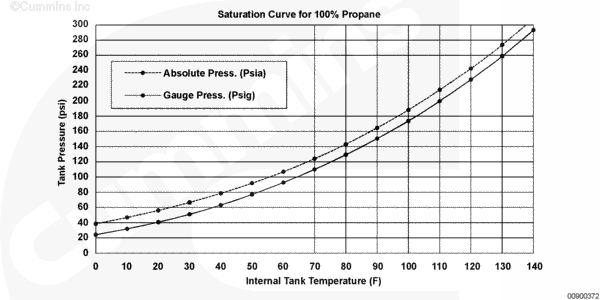
Fuel pressure control is vital to proper engine operation. Liquid phase propane must be supplied to the engine at a steady pressure (+/- 5 psi) under all conditions (temperature and fuel flow rates). Fuel pressure will vary as a function of temperature. Fluctuations can not occur rapidly. Go to the engine data sheet for pressure and flow requirements.
For cold weather environment operation (less than 2°C [35°F]), a pressure assist fuel system may be needed to meet the fuel pressure requirements. The figure: Vehicle LPG Tank – Cold Ambient Effects, shows the pressure/temperature correlation for 100 percent propane.
Vehicle LPG Tank – Cold Ambient Effects
|
;)
;)
