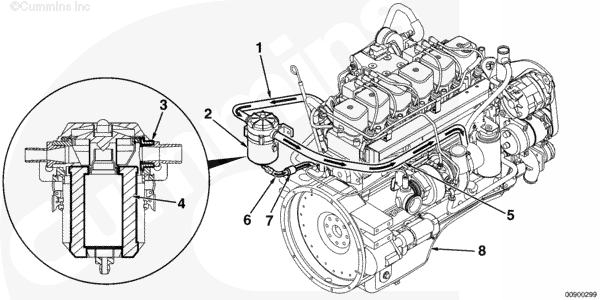
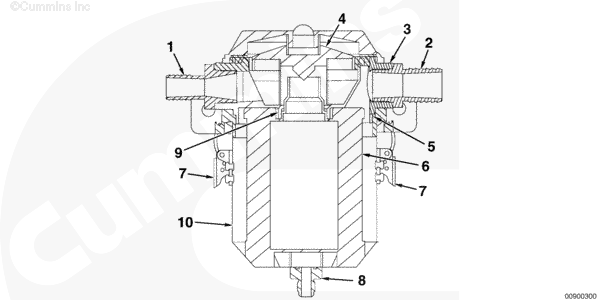
Crankcase vapors, or blowby gases, are gases that escape past the piston rings during engine cycling. These gases accumulate in the crankcase, and in an open system, vent into the atmosphere. Closed-crankcase ventilation incorporates a filter and pressure-regulator system. Blowby gases evacuate from the crankcase through a hose and travel toward the closed-crankcase ventilation unit. The unit then uses a pressure regulator to control crankcase pressure and a coalescing filter to remove the oil from the saturated crankcase vapors. The filtered gases return through the intake-air side of the turbocharger, while the filtered oil returns to the oil pan.
A crankcase pressure indicator is incorporated in the closed-crankcase ventilation housing. Once this pressure gauge reaches 0.515 in Hg [7 in H 2O], blowby gases begin to bypass the closed-crankcase ventilation filter. The closed-crankcase ventilation filter should be changed at a 6-month/28,968-km [18,000-mi] interval or when the pressure gauge reaches 0.515 in Hg [7 in H 2O], whichever occurs first.
To reduce the possibility of personal injury, avoid direct contact of hot oil with your skin.
WARNING
Some state and federal agencies have determined that used engine oil can be carcinogenic and cause reproductive toxicity. Avoid inhalation of vapors, ingestion, and prolonged contact with used engine oil. If not reused, dispose of in accordance with local environmental regulations.
NOTE: Refer to the Operation and Maintenance Manual, B5.9G (LPG Liquefied Petroleum Gas) Engines, Bulletin 3666213, for maintenance procedures.
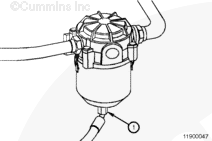
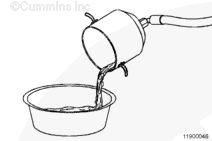
Before removing the closed-crankcase ventilation unit, drain the excess oil from the canister to prevent spilling during removal.
Some state and federal agencies have determined that used engine oil can be carcinogenic and cause reproductive toxicity. Avoid inhalation of vapors, ingestion, and prolonged contact with used engine oil. If not reused, dispose of in accordance with local environmental regulations.
Empty any excess oil in the bottom of the canister.
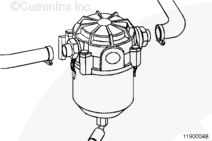
Attach the hoses into their proper positions, and secure them with the provided hose clamps.
NOTE: Make sure to note the flow arrows on the closed-crankcase ventilation cap for proper unit orientation. Arrows pointing into the unit are for breather inlet plumbing. Arrows pointing out of the unit are for breather return plumbing.
Hello, I'm Jack, a diesel engine fan and a blogger. I write about how to fix and improve diesel engines, from cars to trucks to generators. I also review the newest models and innovations in the diesel market. If you are interested in learning more about diesel engines, check out my blog and leave your feedback.
View all posts by Jack
 WARNING

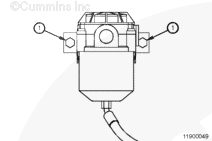
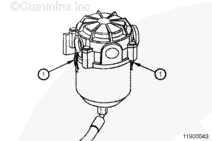
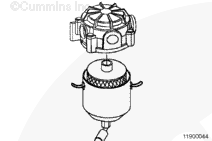
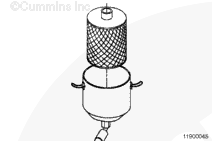

;)
;)
;)
;)
;)
;)
;)
;)
;)
;)
;)
;)
;)
;)
;)
;)
;)
;)
