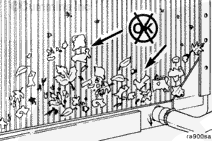
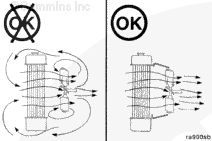
Air forced through the fins of the radiator by a fan cools the coolant pumped through the radiator. Environmental debris (paper, straw, lint, dust, etc.) can obstruct the fins and stop the flow of air which will reduce the cooling effect of the radiator.
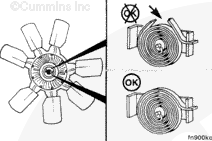
If the fan is belt driven, a slipping belt will result in a slower fan speed and reduced cooling. A malfunctioning automatic belt tensioner can be the problem.
NOTE: Check the bearings in the fan hub and other pulleys to make sure they are not causing excessive belt vibration and slippage.
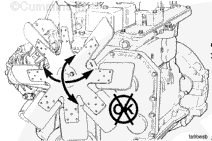
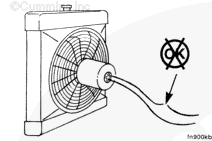
Some applications use thermatic fans. These fans operate only as needed to keep the coolant at the correct temperature. If the fan does not operate when the coolant temperature increases, the engine will run hot. If the fan does not shut off when coolant temperature decreases, the engine will run cold.
NOTE: Make sure that the coolant temperature sensor is functioning correctly.
Shutters are designed to control air flow across the radiator. If the shutters fail to open when needed, the engine can run hot. Failure of the shutters to close can result in too much air flow and the engine running cold.
NOTE: Make sure that the air temperature sensor is functioning correctly. Check the air operated shutter controls. Check for air leaks.
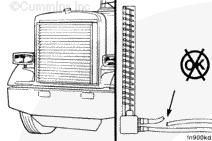
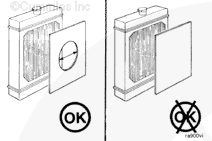
Winterfronts can be used on a charge air cooled engine, but must be designed to partially cover the frontal area of the cooling system. A minimum of 120 square inches of charge air cooled frontal area must be left open to air flow.
Hello, I'm Jack, a diesel engine fan and a blogger. I write about how to fix and improve diesel engines, from cars to trucks to generators. I also review the newest models and innovations in the diesel market. If you are interested in learning more about diesel engines, check out my blog and leave your feedback.
View all posts by Jack

;)
;)
;)
;)
;)
;)
;)
;)
;)
;)
;)
;)
;)
;)
