|
Centinel™ Oils, Filters, and Blend Rates
The Centinel™ systems that have a control module separate from the engine ECM are designed to be calibrated for two types of oil:
- Advanced calibration settings reduce total oil consumption when set for using Valvoline® Premium Blue® 2000 or equivalent synthetic or synthetic-blended API CH-4 engine oil. The advanced setting is not approved for heavy-duty engines with 1999 and later calibrations..
- Advanced calibration is also referred to as 0.25-percent blend rate. This rate uses 1 gallon of oil for each 400 gallons of fuel consumed (1/400
= 0.25-percent).
- Standard calibration is for premium mineral oils like Valvoline®
Premium Blue® or equivalent API CG-4 engine oil.
- Standard calibration is also referred to as 0.33-percent blend rate. This rate uses 1 gallon of oil for each 300 gallons of fuel consumed (1/300
= 0.33-percent).
For CELECT™ and CELECT™ Plus engines, the Centinel™
control module uses calibration plugs which are provided with the system to determine the oil blend rate. For Centinel™ systems that use a CM400 control module, the control module is programmed and does not
use calibration plugs.
For Centinel™ systems used on ISM, ISX, QSX15, QST30, QSK45, and QSK60 engines, the oil blend rates are fixed in the engine software and are not adjustable. These engines do not use calibration plugs.
Refer to Table 1 for engine-specific blend rates.
Refer to the appropriate engine Operation and Maintenance manual for the oil drain and filter change intervals for the various engine families. Table 1 is categorized by engine family, oil grade, and Centinel™
blend ratio.
| Table 1, Oil Blend Rates with Centinel™ System |
| Engine |
Centinel™ Setting (standard or advanced) |
Blend Rate (%) |
Oil Specification |
| ISM; 1998 |
Standard |
0.33 |
CG-4 |
| ISM; 1998 |
Advanced |
0.25 |
CH4, CES 20076 |
| ISM; 1999 and later |
N/A |
0.33 |
CES 20076 |
| ISM wastegated turbo |
N/A |
0.48 |
CES 20076 |
| ISM with EGR |
N/A |
0.33 |
CI-4 |
| L10/M11 |
Standard |
0.33 |
CG-4 |
| L10/M11 |
Advanced |
0.25 |
CH4, CES 20076 |
| N14; 1998 and earlier |
Standard |
0.33 |
CG-4 |
| N14; 1998 and earlier |
Advanced |
0.25 |
CH-4, CES 20076 |
| N14; 1999 and later |
N/A |
0.33 |
CES 20076 |
| ISX with EGR |
N/A |
0.33 |
CI-4 |
| QSX15 |
N/A |
0.33 |
CES20076 |
| K19, K38, K50 |
Standard |
0.33 |
CG-4 |
| K19, K38, K50 |
Advanced |
0.25 |
CH-4, CES 20076 |
| QST30 |
N/A |
0.33 |
CG-4, CH-4, CES 20076 |
| QSK19 |
Standard |
0.33 |
CG-4, CH-4, CES 20076 |
| QSK19 |
Advanced |
0.25 |
CH-4, CES 20076 |
| QSK45, QSK60 |
N/A |
0.33 |
CG4, CH4, CES 20076 |
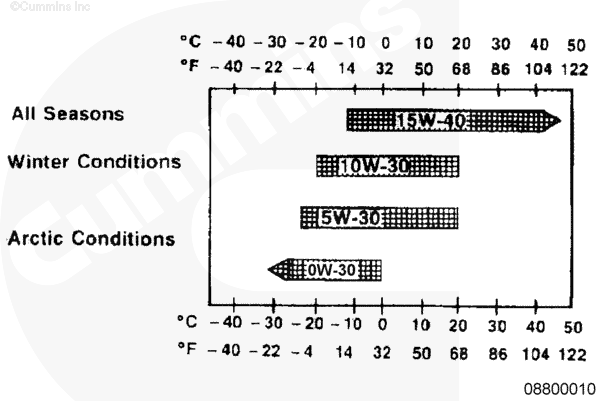
The primary recommendation is for multigrade oil of the viscosity grade indicated in Table 2. For normal ambient temperatures and operating conditions
(temperatures above -15°C [5°F]), SAE 15W-40 is preferred. The use
of multigrade oil reduces deposit formation, improves engine cranking in low-temperature conditions, and increases engine durability by maintaining lubrication during high-temperature operating conditions. Since multigrade oils have been shown to provide approximately 30-percent lower oil consumption, compared with monograde oils, it is important to use multigrade oils in order to make sure your engine will meet applicable emissions requirements. While the preferred viscosity grade is 15W-40, lower viscosity multigrade can be used in colder climates. (See Table 2.) Use 15W-40 when conditions permit.
|
|
| Table 2, Cummins-Recommended SAE Oil Viscosity Grades versus Ambient Temperatures |
Synthetic engine oils, API category III, are recommended for use in Cummins engines operating in ambient temperature conditions consistently below
-25°C [-13°F]. Above this temperature, it is recommended that mineral-oil-based multigrade lubricants be used. Synthetic 0W-30 oils, which meet the API category III, can be used in operations where the ambient temperature never exceeds 0°C [32°F]. 0W-30 oils do not offer the same level of protection for fuel dilution as do the higher multigrade oils. Higher cylinder wear can be experienced when using 0W-30 oils in high-load situations.
Rerefined lubricating oils can be used in Cummins engines if they have an API quality designation signifying they have been tested and meet the minimum
standards for that quality level. It is important to be certain these oils
are actually rerefined and not just reclaimed. Rerefined oils have been treated to remove additives and wear metal debris, distilled and refortified with additives.
Do not use friction-modified oil in Cummins diesel engines unless the oil supplier can provide evidence of satisfactory performance in
Cummins engines. Obtain the oil supplier’s commitment that will make sure
the oil is satisfactory or do not use that product.
|
;)
;)
