Cummins Inc. recommends the use of either a 50/50 mixture of good-quality water and fully-formulated antifreeze, or fully-formulated coolant when filling the cooling system. The fully-formulated antifreeze or coolant must meet TMC RP329 or TMC RP330 specifications.
Good-quality water is important for cooling system performance. Excessive levels of calcium and magnesium contribute to scaling problems, and excessive levels of chlorides and sulfates cause cooling system corrosion.
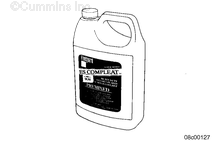
Cummins Inc. recommends the use of Fleetguard® ES COMPLEAT™. It is available in glycol forms (ethylene and propylene) and complies with TMC RP329 and RP330 standards.
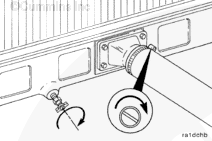
Opening the manual bleed valve or removing the pipe plug on applicable installations is critical. Failure to do so can result in engine damage.
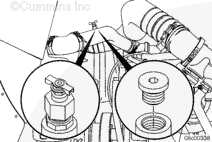
NOTE: Some applications can have a manual bleed valve or pipe plug that is required to be opened to properly fill the system. The upper radiator pipe is a common location.
NOTE: Some applications can have a pipe plug installed in place of the manual bleed valve.
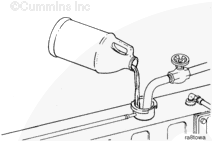
If applicable, open the manual bleed valve or remove the pipe plug before filling the cooling system.
NOTE: Refer to the OEM service manual for special coolant fill requirements. Special instructions may also be located near the cooling system access point or fill door on the vehicle.
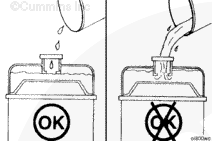
NOTE: The system has a designed fill rate of 19 liters [5 gal] per minute.
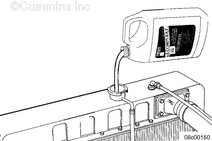
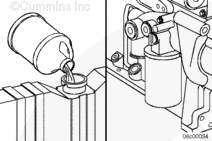
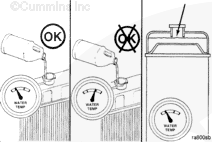
Fill the cooling system with heavy-duty coolant and install the correct service filter.
Identify the correct filter. For automotive applications, use the Signature™ and ISX Operation and Maintenance Manual, Bulletin 3666251.Refer to Procedure 018-004 in Section V.
For industrial applications, use the Industrial and Power Generation QSX15 Engines Operation and Maintenance Manual, Bulletin 3666423. Refer to Procedure 018-004 in Section V.
NOTE: All coolant shutoff valves should be returned to their open positions once the system has been refilled and the deaeration process is ready to begin. Refer to the OEM service manual for specific instructions.
Install the radiator cap or expansion tank fill cap.
Turn the cab heater temperature switch to high to allow maximum coolant flow through the heater core. The blower does not have to be on.
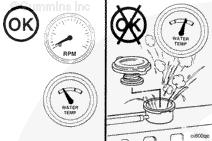
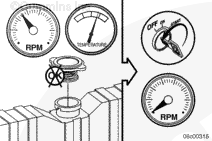
Operate the engine at HIGH IDLE until the thermostat opens, at least 93°C [200°F].
Operate the engine at LOW IDLE for 2 minutes before shutting it down. This allows adequate cool down of pistons, cylinders, bearings, and turbocharger components.
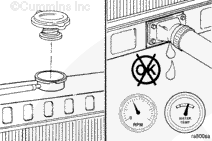
Do not remove the pressure cap from a hot engine. Wait until the coolant temperature is below 50°C [120°F] before removing the pressure cap. Heated coolant spray or steam can cause personal injury.
CAUTION
Do not add cold coolant to a hot engine. This can cause engine casting damage. Allow the engine to cool to below 50°C [120°F] before adding coolant.
NOTE: If all coolant drained from the system was collected, the same volume or more must go back into the system. If any drained coolant remains after filling, this is an indication of an air pocket which must be purged before returning the vehicle to service.
Remove the radiator or expansion tank fill cap and check the coolant level according to the OEM service manual.
Cummins Inc. recommends the use of either a 50/50 mixture of good-quality water and fully-formulated antifreeze, or fully-formulated coolant when filling the cooling system. The fully-formulated antifreeze or coolant must meet TMC RP329 or TMC RP330 specifications.
Good-quality water is important for cooling system performance. Excessive levels of calcium and magnesium contribute to scaling problems, and excessive levels of chlorides and sulfates cause cooling system corrosion.
Cummins Inc. recommends the use of Fleetguard® ES COMPLEAT™. It is available in glycol forms (ethylene and propylene) and complies with TMC RP329 and RP330 standards.
Opening the manual bleed valve or removing the pipe plug on applicable installations is critical. Failure to do so can result in engine damage.
NOTE: Some applications can have a manual bleed valve or pipe plug that is required to be opened to properly fill the system. The upper radiator pipe is a common location.
NOTE: Some applications can have a pipe plug installed in place of the manual bleed valve.
If applicable, open the manual bleed valve or remove the pipe plug before filling the cooling system.
NOTE: Refer to the OEM service manual for special coolant fill requirements. Special instructions may also be located near the cooling system access point or fill door on the vehicle.
NOTE: The system has a designed fill rate of 19 liters [5 gal] per minute.
Fill the cooling system with heavy-duty coolant and install the correct service filter.
Identify the correct filter. For automotive applications, use the Signature™ and ISX Operation and Maintenance Manual, Bulletin 3666251.Refer to Procedure 018-004 in Section V.
For industrial applications, use the Industrial and Power Generation QSX15 Engines Operation and Maintenance Manual, Bulletin 3666423. Refer to Procedure 018-004 in Section V.
Do not remove the pressure cap from a hot engine. Wait until the coolant temperature is below 50°C [120°F] before removing the pressure cap. Heated coolant spray or steam can cause personal injury.
WARNING
Coolant is toxic. Keep away from children and pets. If not reused, dispose of in accordance with local environmental regulations.
NOTE: All coolant shutoff valves should be returned to their open positions once the system has been refilled and the deaeration process is ready to begin. Refer to the OEM service manual for specific instructions.
Operate the engine at HIGH IDLE until the thermostat opens, at least 93°C [200°F].
Operate the engine at LOW IDLE for 2 minutes before shutting it down. This allows adequate cool down of pistons, cylinders, bearings, and turbocharger components.
Do not remove the pressure cap from a hot engine. Wait until the coolant temperature is below 50°C [120°F] before removing the pressure cap. Heated coolant spray or steam can cause personal injury.
CAUTION
Do not add cold coolant to a hot engine. This can cause engine casting damage. Allow the engine to cool to below 50°C [120°F] before adding coolant.
NOTE: If all coolant drained from the system was collected, the same volume or more must go back into the system. If any drained coolant remains after filling, this is an indication of an air pocket which must be purged before returning the vehicle to service.
Remove the radiator cap or expansion tank fill cap and check the coolant level according to the OEM service manual.
Add coolant if necessary. Do not overfill.
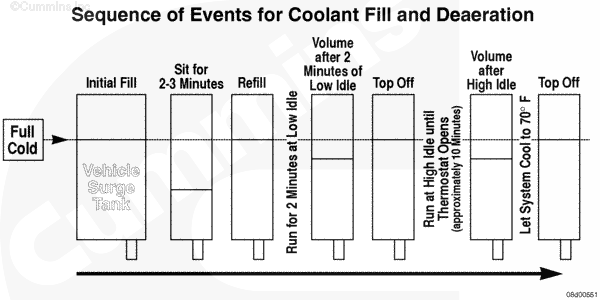
See Figure 1, illustrating the steps of the coolant fill and deaeration process.
Hello, I'm Jack, a diesel engine fan and a blogger. I write about how to fix and improve diesel engines, from cars to trucks to generators. I also review the newest models and innovations in the diesel market. If you are interested in learning more about diesel engines, check out my blog and leave your feedback.
View all posts by Jack

 CAUTION



 WARNING
;)
;)
;)
;)
;)
;)
;)
;)
;)
;)
;)
;)
;)
;)
;)
;)
;)
;)
;)
;)
;)
;)
;)
;)