Batteries can emit explosive gases. To reduce the possibility of personal injury, always ventilate the compartment before servicing the batteries. To reduce the possibility of arcing, remove the negative (-) battery cable first and attach the negative (-) battery cable last.
WARNING
Acid is extremely dangerous and can damage the machinery and can also cause serious burns. Always provide a tank of strong soda water as a neutralizing agent when servicing batteries. Wear goggles and protective clothing to avoid serious personal injury.
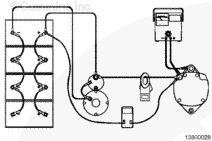
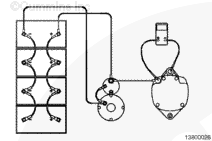
Systems that are 24 VDC must be connected into a temporary 12 VDC configuration.
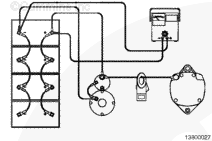
Attach the carbon-pile and clip-on ammeter as shown.
Adjust the load from the carbon-pile tester to the rated performance of the alternator.
Measure the voltage drop in both the positive and negative circuits.
Add these together and compare the sum to the table below.
System Voltage
Maximum Voltage Drop
12
0.5
24
1.0
Repair or replace the wiring as required to meet the above specifications.
The alternator must be turning at approximate rated speed.
Most heavy-duty alternators are rated at 5000 rpm. Check the manufacturer’s specifications for the specific alternator being tested.
Make sure that all vehicle electrical loads are turned off.
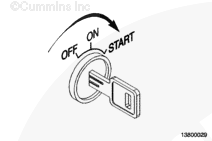
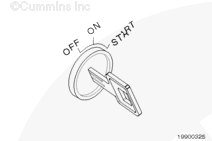
Start the engine and operate at high idle.
Check the speed of the alternator using a digital optical tachometer. A slipping alternator drive belt can result in a low output reading. The alternator output is directly related to the speed it is turning.
Batteries can emit explosive gases. To reduce the possibility of personal injury, always ventilate the compartment before servicing the batteries. To reduce the possibility of arching, remove the negative (-) battery cable first and attach the negative (-) battery cable last.
Remove the battery cables.
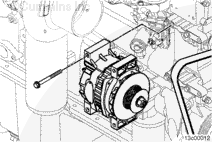
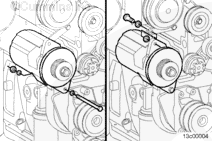
Remove the electrical connection from alternator.
Remove the cooling fan drive belt. Refer to Procedure 008-002.
Batteries can emit explosive gases. To reduce the possibility of personal injury, always ventilate the compartment before servicing the batteries. To reduce the possibility of arcing, remove the negative (-) battery cable first and attach the negative (-) battery cable last.
Disconnect the battery cables.
Disconnect the electrical connections from the alternator.
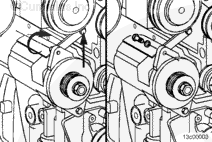
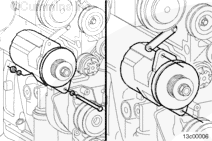
Remove the alternator drive belt. Refer to Procedure 013-005.
Batteries can emit explosive gases. To reduce the possibility of personal injury, always ventilate the compartment before servicing the batteries. To reduce the possibility of arcing, remove the negative (-) battery cable first and attach the negative (-) battery cable last.
Install the cooling fan drive belt. Refer to Procedure 008-002.
Batteries can emit explosive gases. To reduce the possibility of personal injury, always ventilate the compartment before servicing the batteries. To reduce the possibility of arcing, remove the negative (-) battery cable first and attach the negative (-) battery cable last.
Install the alternator drive belt. Refer to Procedure 013-005.
Install the electrical connections to the alternator.
Hello, I'm Jack, a diesel engine fan and a blogger. I write about how to fix and improve diesel engines, from cars to trucks to generators. I also review the newest models and innovations in the diesel market. If you are interested in learning more about diesel engines, check out my blog and leave your feedback.
View all posts by Jack
 WARNING







;)
;)
;)
;)
;)
;)
;)
;)
;)
;)
;)
;)
;)
;)
;)
;)
;)
;)
;)
;)
;)
;)