If the engine experiences a turbocharger failure or any other occasion where oil or debris is put into the charge-air cooler, the charge-air cooler must be cleaned.
Brush away any loose dirt from around the area of the air handling connections to avoid contamination of the interior of the engine.
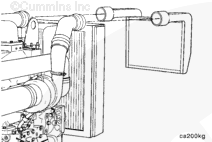
Remove the charge-air cooler piping and charge-air cooler from the vehicle. Refer to the OEM service manual.
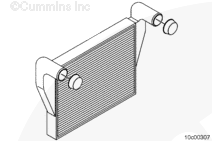
Cover all open points with caps from the Air Handling Clean Care Kit.
Do not use caustic cleaners to clean the charge-air cooler. Damage to the charge-air cooler will result.
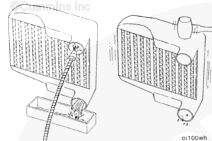
Flush the charge-air cooler internally with solvent in the opposite direction of normal airflow. Shake the charge-air cooler and lightly tap on the end tanks with a rubber mallet to dislodge trapped debris. Continue flushing until all debris or oil is removed.
NOTE: Make sure the tubes are in the vertical direction when flushing.
If the debris can not be totally removed from the charge-air cooler, the charge-air cooler must be replaced.
The charge-air cooler must be rinsed, dried, and free of solvent, oil, and debris or engine damage will result.
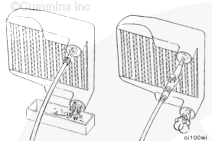
After the charge-air cooler has been thoroughly cleaned of all oil and debris with solvent, wash the charge-air cooler internally with hot soapy water to remove the remaining solvent. Rinse thoroughly with clean water.
Blow compressed air through the inside of the charge-air cooler in the opposite direction of normal air flow until the charge-air cooler is dry internally.
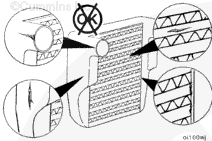
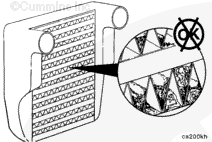
Inspect the charge-air cooler for cracks, holes, or other damage.
Inspect the tubes, fins,and welds for tears, breaks, or other damage. If any damage causes the charge-air cooler to not pass the air leak check mentioned earlier in this procedure, the charge-air cooler must be replaced.
Install the charge-air cooler and charge-air cooler piping on the vehicle. Refer to the OEM service manual.
NOTE: Always clean and inspect the charge-air cooler piping and hoses prior to installation.
To prevent possible injury if either plug blows off during the test, secure safety chains on the test plugs to any convenient capscrew on the radiator assembly. This test must not be performed without securely fastened safety chains.
To check the charge-air cooler for cracked tubes or header, remove the inlet and outlet hoses from the cooler. The charge-air cooler does not have to be removed from the chassis.
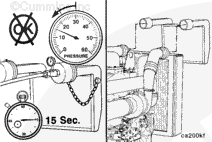
Install a plug or cap over the outlet side of the cooler. Install a pressure gauge and a regulated shop air supply line with a shutoff valve to the inlet side of the cooler.
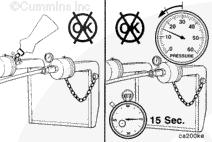
Determine if the pressure drop is caused by a leak in the charge-air cooler or from a leaky connection. Use a spray bottle filled with soapy water applied to all hose connections, and watch for bubbles to appear at the location of the leak.
If the pressure drop is caused by a leaky connection, repair the connection, and repeat the test. If the leak is within the charge-air cooler, repeat the test to verify the accuracy of the pressure drop measurement. Similar pressure drop readings must be obtained at least three consecutive tests before the reading can be considered accurate.
NOTE: If a charge-air cooler leaks more than 34 kPa [5 psi] in 15 seconds, it will appear as a major leak in a leak tank.
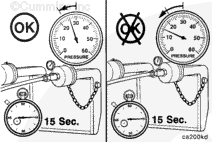
If the pressure drop is greater than 34 kPa [5 psi] in 15 seconds, the charge-air cooler must be replaced.
Refer to the manufacturer’s repair manual for replacement instructions.
NOTE: Charge-air coolers are not designed to be 100-percent leak free. If the pressure drop is less than 34 kPa [5 psi] in 15 seconds, then the charge-air cooler does not need to be replaced.
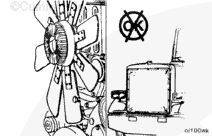
Inspect the charge-air cooler fins for obstructions to airflow. Remove obstructions such as a winterfront or debris. Manually lock shutters in the open position if equipped.
Lock the fan drive in the ON mode to prevent erratic test results. This can be done by installing a jumper wire across the temperature switch.
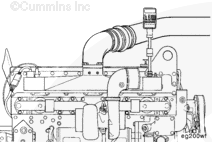
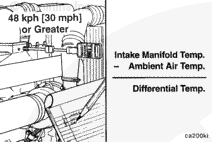
Install Fluke digital thermometer, Part Number 3822666, and thermocouple wire kit, Part Number 3822988, into the intake manifold at the 1/8-inch NPT tap near the air horn connection with the intake manifold.
Install another thermocouple at the air cleaner inlet to measure ambient air temperature.
If the temperature differential is greater than the specifications, check the charge-air cooler for dirt and debris on the fins and clean as necessary. If the problem still exists, check the charge-air cooler for debris in the fins or between the charge-air cooler and radiator. Confirm full fan engagement.
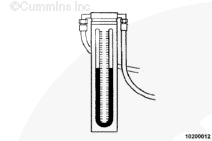
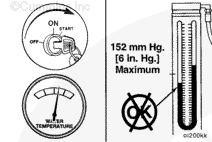
Operate the engine at rated rpm and load. Record the readings on the manometer.
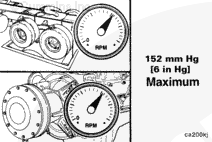
If the differential pressure is greater than 152 mm Hg [6 in Hg], check the charge-air cooler and associated piping for plugging. Clean or replace if necessary.
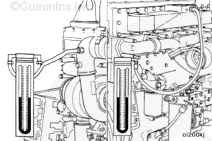
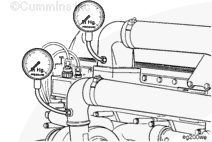
Operate the engine at rated rpm and load. Record the readings on the two gauges.
If the differential pressure is greater than 152 mm Hg [6 in Hg], check the charge-air cooler and associated piping for plugging, restrictions, or damage.
Clean or replace if necessary.
If damage resulted in coolant, oil, excessive fuel or excessive black smoke entering the exhaust system, the aftertreatment system must be inspected. Refer to Procedure 014-013 in Section 14.
Hello, I'm Jack, a diesel engine fan and a blogger. I write about how to fix and improve diesel engines, from cars to trucks to generators. I also review the newest models and innovations in the diesel market. If you are interested in learning more about diesel engines, check out my blog and leave your feedback.
View all posts by Jack


 CAUTION


 WARNING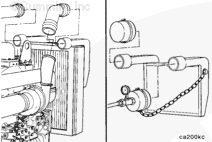


;)
;)
;)
;)
;)
;)
;)
;)
;)
;)
;)
;)
;)
;)
;)
;)
;)
;)
;)
;)
;)
;)
;)
;)
;)
;)
;)
;)
;)
;)
;)
;)
;)
;)
;)
;)