Batteries can emit explosive gases. To reduce the possibility of personal injury, always ventilate the compartment before servicing the batteries. To reduce the possibility of arcing, remove the negative (-) battery cable first and attach the negative (-) battery cable last.
WARNING
Coolant is toxic. Keep away from children and pets. If not reused, dispose of in accordance with local environmental regulations.
WARNING
Do not remove the pressure cap from a hot engine. Wait until the coolant temperature is below 50°C [120°F] before removing the pressure cap. Heated coolant spray or steam can cause personal injury.
CAUTION
Use caution when draining coolant that coolant is not spilled or drained into the bilge area. Do not pump the coolant overboard. If the coolant is not reused, it must be discarded in accordance with local environmental regulations.
Disconnect the batteries. Refer to Procedure 013-009.
Drain the engine coolant. Refer to Procedure 008-018.
Disconnect the keel cooler inlet and outlet connections. Refer to the OEM service manual.
Disconnect the coolant vent line from the thermostat housing. Refer to Procedure 008-017.
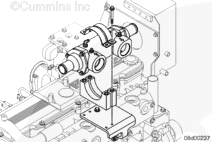
Disconnect the thermostat housing coolant inlet and outlet hoses.
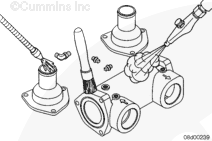
The engine thermostat and thermostat seal must operate properly in order for the engine to operate in the most efficient heat range. Overheating or overcooling will shorten engine life.
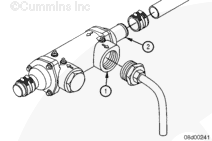
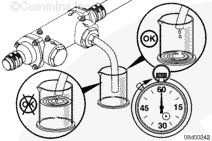
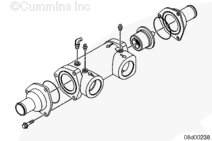
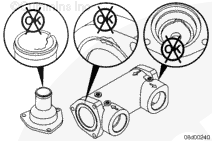
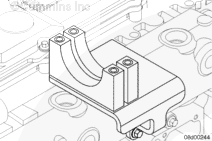
Fabricate a test fixture to seal all of the water outlet connections except the outlet port to the keel cooler and the inlet port of the thermostat housing.
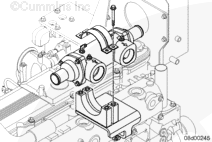
For the outlet port to the keel cooler (1), install a hose long enough to reach a remote, dry container used to collect water. Place the open end of the hose in the dry container.
Connect a water hose to the inlet port (2) of the thermostat housing capable of regulating 152 kPa [22 psi] of filtered tap water.
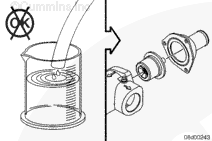
If more than 100 cc [3.4 fl oz] of coolant is collected, the thermostat or thermostat seal is leaking and must be replaced. Refer to Procedure 008-016 to replace the thermostat seal.
Hello, I'm Jack, a diesel engine fan and a blogger. I write about how to fix and improve diesel engines, from cars to trucks to generators. I also review the newest models and innovations in the diesel market. If you are interested in learning more about diesel engines, check out my blog and leave your feedback.
View all posts by Jack

 WARNING
  CAUTION








;)
;)
;)
;)
;)
;)
;)
;)
;)
;)
;)
;)
;)
;)
;)
;)
;)
;)
;)
;)
;)
;)
;)
;)