Batteries can emit explosive gases. To reduce the possibility of personal injury, always ventilate the compartment before servicing the batteries. To reduce the possibility of arcing, remove the negative (-) battery cable first and attach the negative (-) battery cable last.
The belt tensioner is spring-loaded and must be pivoted away from the drive belt. Pivoting in the wrong direction can result in damage to the belt tensioner.
CAUTION
Applying excessive force in the opposite direction of windup or after the tensioner has been wound to the positive stop can cause the tensioner arm to crack or break.
CAUTION
The use of a socket extension is not recommended because it can cause axial twisting damage to the belt tensioner.
Lift the tensioner to remove the refrigerant compressor drive belt.
NOTE: If a socket extension is necessary, support the head of the ratchet with one hand to prevent the belt tensioner arm from unintended loading.
The belt tensioner is spring-loaded and must be pivoted away from the drive belt. Pivoting in the wrong direction can result in damage to the belt tensioner.
Lift and hold the belt tensioner.
Install the drive belt and release the tensioner.
NOTE: Due to the availability of different belt run configurations, this procedure is meant to be generic. Reference the application manufacturer’s manuals for the correct belt run.
Batteries can emit explosive gases. To reduce the possibility of personal injury, always ventilate the compartment before servicing the batteries. To reduce the possibility of arcing, remove the negative (-) battery cable first and attach the negative (-) battery cable last.
Hello, I'm Jack, a diesel engine fan and a blogger. I write about how to fix and improve diesel engines, from cars to trucks to generators. I also review the newest models and innovations in the diesel market. If you are interested in learning more about diesel engines, check out my blog and leave your feedback.
View all posts by Jack
 WARNING

 CAUTION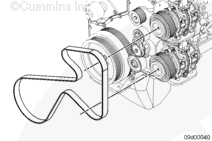


;)
;)
;)
;)
;)
;)
;)
;)
