The aftertreatment diesel particulate filter differential pressure sensor measures pressure across the aftertreatment diesel particulate filter.
Due to the number of various differential pressure sensor mounting arrangements, this procedure has been written to be generic. Not all illustrations within this procedure will represent the application that is being worked on.
Batteries can emit explosive gases. To reduce the possibility of personal injury, always ventilate the compartment before servicing the batteries. To reduce the possibility of arcing, remove the negative (-) battery cable first and attach the negative (-) battery cable last.
CAUTION
Do not allow the wire harness or electrical connectors to make contact with the outside of the aftertreatment canister. Contact with the outside or the canister can result in damage to the wire harness or connectors.
Disconnect the vehicle batteries. Reference the following procedure in the ISM, ISMe and QSM11 Service Manual, Bulletin 3666322, or the Signature, ISX and QSX15 Service Manual, Bulletin 3666239. Refer to Procedure 013-009 in Section 13.
Remove the differential pressure sensor tubes. Reference the following procedure in the in the ISM, ISMe and QSM11 Service Manual, Bulletin 3666322, or the Signature, ISX and QSX15 Service Manual, Bulletin 3666239. Refer to Procedure 011-041 in Section 11.
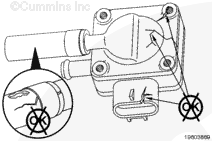
Squeeze the locking tab and pull the connector apart to disconnect the pressure sensor wiring harness connector.
NOTE: On some applications, one of the flexible hoses will remain on the aftertreatment diesel particulate filter differential pressure sensor when it is removed. This hose is attached with a non-reusable clamp. Do not remove the non-reusable clamp.
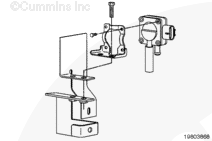
Remove the two bolts holding the aftertreatment diesel particulate filter differential pressure sensor from the differential pressure sensor mounting bracket.
Remove the differential pressure sensor with the L-shaped bracket and heat shield attached, if applicable.
Inspect the hoses for cuts or holes. Replace the hoses if damage is found.
Inspect the inside of the hoses for plugging or soot accumulation. If plugging or soot accumulation is seen, the tubes must be cleaned. Reference the following procedure in the in the ISM, ISMe and QSM11 Service Manual, Bulletin 3666322, or the Signature, ISX and QSX15 Service Manual, Bulletin 3666239, for cleaning instructions. Refer to Procedure 011-041 in Section 11.
Inspect the differential pressure sensor electrical connector for damage.
Inspect the differential pressure sensor for cracks or body damage.
Replace the differential pressure sensor if damage is found.
Batteries can emit explosive gases. To reduce the possibility of personal injury, always ventilate the compartment before servicing the batteries. To reduce the possibility of arcing, remove the negative (-) battery cable first and attach the negative (-) battery cable last.
CAUTION
Do not allow the wire harness or electrical connectors to make contact with the outside of the aftertreatment canister. Contact with the outside or the canister can result in damage to the wire harness or connectors.
Squeeze the locking tab and pull the connector apart to disconnect the pressure sensor wire harness connector.
Install the differential pressure sensor tubes. Reference the following procedure in the in the ISM, ISMe and QSM11 Service Manual, Bulletin 3666322, or the Signature, ISX and QSX15 Service Manual, Bulletin 3666239. Refer to Procedure 011-041 in Section 11.
Connect the vehicle batteries. Reference the following procedure in the ISM, ISMe and QSM11 Service Manual, Bulletin 3666322, or the Signature, ISX and QSX15 Service Manual, Bulletin 3666239. Refer to Procedure 013-009 in Section 13.
Hello, I'm Jack, a diesel engine fan and a blogger. I write about how to fix and improve diesel engines, from cars to trucks to generators. I also review the newest models and innovations in the diesel market. If you are interested in learning more about diesel engines, check out my blog and leave your feedback.
View all posts by Jack


 WARNING
  CAUTION




;)
;)
;)
;)
;)
;)
;)
;)
