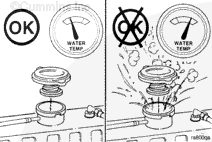
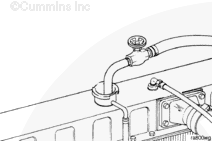
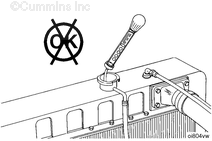
Do not remove the pressure cap from a hot engine. Wait until the coolant temperature is below 50°C [120°F] before removing the pressure cap. Heated coolant spray or steam can cause personal injury.
WARNING
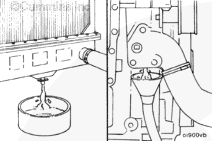
Coolant is toxic. Keep away from children and pets. If not reused, dispose of in accordance with local environmental regulations.
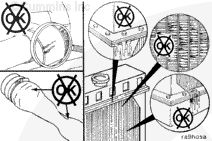
Check for damaged hoses and loose or damaged hose clamps. Replace as required. Check the radiator for leaks, damage, and buildup of dirt. Clean and repair as required.
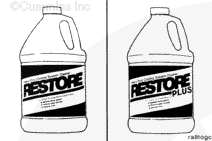
NOTE: The performance of RESTORE™ is dependant on time, temperature, and concentration levels. An extremely scaled or flow restricted system, for example, may require higher concentrations of cleaners, higher temperatures, or longer cleaning times, or the use of RESTORE PLUS™. RESTORE™ can safely be used up to twice the recommended concentration levels. RESTORE PLUS™ must be used only at its recommended concentration level. Extremely scaled or fouled systems may require more than one cleaning.
Do not remove the pressure cap form a hot engine. Wait until the coolant temperature is below 50°C [120°F] before removing the pressure cap. Heated coolant spray or steam can cause personal injury.
Fleetguard® RESTORE™ contains no antifreeze. Do not allow the cooling system to freeze during the cleaning operation.
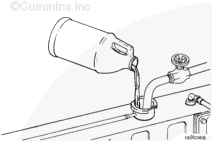
Immediately add 3.8 liters [1 U.S. gallon] of Fleetguard® RESTORE™, RESTORE PLUS™, or equivalent for each 38 to 57 liters [10 to 15 gallons] of cooling system capacity, and fill the system with plain water.
Turn the heater temperature switch to high to allow maximum coolant flow through the heater core. The blower does not have to be on.
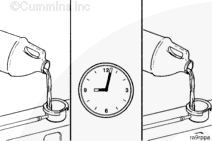
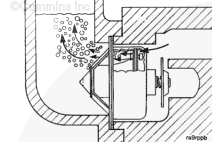
During filling, air must be vented from the engine coolant passages. The system must be filled slowly to prevent air locks. Wait 2 to 3 minutes to allow air to be vented then add mixture to bring the level to the top.
Never use water alone for coolant. Damage from corrosion can be the result of using water alone for coolant.
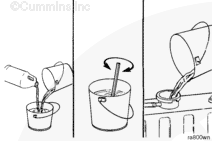
NOTE: A 50/50 mixture of antifreeze and water must be premixed before filling the system. The ability of antifreeze to remove heat from the engine is not as good as water, so pouring antifreeze into the engine first could contribute to an overheated condition before the liquids completely intermix.
Refer to Procedure 018-004 (Coolant Recommendations and Specifications) in Section V for correct concentration of coolant.
The system must be filled slowly to prevent air locks. During filling, air must be vented from the engine coolant passages. Wait 2 to 3 minutes to allow air to be vented, then add coolant to bring the level to the top.
Close all drain valves and fill the system. Use a mixture of 50-percent water and 50-percent antifreeze to provide freeze protection to -36°C [-33°F].
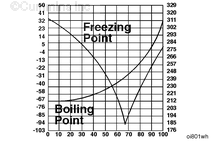
Low-silicate antifreeze must be mixed with quality water at a 50/50 ratio (40 to 60 percent working range). A 50/50 mixture of antifreeze and water gives a -37°C [-34°F] freeze point and a boiling point of 109°C [228°F].
The actual lowest freeze point of ethylene glycol antifreezes is at 68 percent. Using higher concentrations of antifreeze will raise the freeze point of the solution and increase the possibility of a silicate gel problem.
Refer to Procedure 018-004 (Coolant Recommendations and Specifications) in Section V.
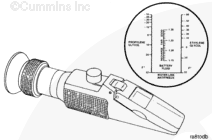
The Fleetguard™ refractometer, Part Number C2800, provides a reliable and easy-to-read measurement of the freeze point protection and glycol (antifreeze) concentration.
The freeze point protection must be checked if the coolant is added to the cooling system. Refer to the manufacturer’s instructions for correct operation.
Hello, I'm Jack, a diesel engine fan and a blogger. I write about how to fix and improve diesel engines, from cars to trucks to generators. I also review the newest models and innovations in the diesel market. If you are interested in learning more about diesel engines, check out my blog and leave your feedback.
View all posts by Jack
 WARNING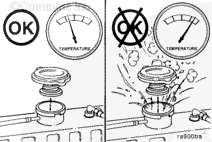

 CAUTION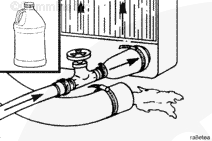



;)
;)
;)
;)
;)
;)
;)
;)
;)
;)
;)
;)
;)
;)
;)
;)
;)
;)
;)
;)
;)
;)
;)
;)
;)
;)
;)
;)
;)
;)
;)
;)
;)
;)