N14 Base Engine Troubleshooting and Repair Manual – 010-024   Air Leaks, Air Intake and Exhaust Systems

Table of Contents

Maintenance Check

Maintenance Check

TOC

 CAUTION 

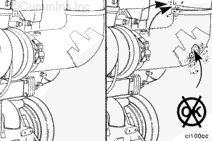
Engine intake air must be filtered to prevent dirt and debris from entering the engine. If intake air piping is damaged or loose, unfiltered air will enter the engine and cause premature wear.

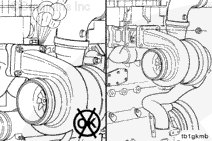
Visually inspect for loose clamps or damage between the intake air piping, air cleaner, turbocharger, CAC, and intake manifold.

Replace damaged pipes, and tighten loose clamps.

Torque Value:  8.5  n.m  [75 in-lb]

SMALL | MEDIUM | LARGE


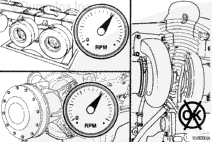
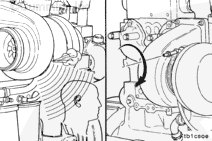
Operate the engine at full throttle and maximum load and check for air leaks. Listen for whistling noise caused by high pressure air leaks.

 
SMALL | MEDIUM | LARGE


The noise can be caused by an air leak from the following:

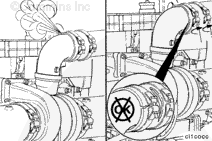
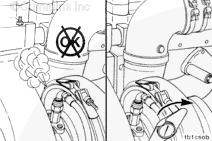
Turbocharger to CAC elbow connection.

  • Inspect the connection and o-ring seal for damage.
  • Tighten the V-band clamps.
Torque Value:  8.5  n.m  [75 in-lb]

SMALL | MEDIUM | LARGE


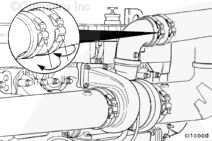
Any CAC piping or connecting hose.

  • Inspect the hose and piping for damage.
  • Tighten the hose clamps.
Torque Value:  8.5  n.m  [75 in-lb]

SMALL | MEDIUM | LARGE


Turbocharger to exhaust manifold mounting gasket.

SMALL | MEDIUM | LARGE


Turbine housing sealing surface air leak.

  • Tighten the V-band clamp.
Torque Value:  8.5  n.m  [75 in-lb]
  • Check for an air leak.
  • If an air leak is still present, remove and replace the turbocharger. Refer to Procedures

    010-033-002 and

    010-033-026.

SMALL | MEDIUM | LARGE


Compressor housing sealing surface air leak.

  • Tighten the V-band.
Torque Value:  8.5  n.m  [75 in-lb]
  • Check for an air leak.
  • If an air leak is still present, remove and replace the turbocharger. Refer to Procedures

    010-033-002 and

    010-033-026.

SMALL | MEDIUM | LARGE
Last Modified:  12-May-2003