B5.9G, B5.9LPG – Troubleshooting and Repair Manual – 001-047   Piston Rings

General Information

TOC

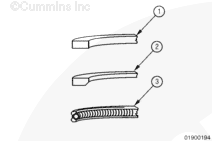
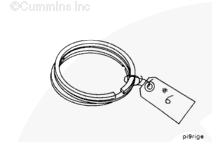
The piston rings for naturally aspirated and turbocharged engines differ.

  Turbocharged
(B)
1 Top
2 Intermediate
3 Oil Control
 
SMALL | MEDIUM | LARGE

Failure Analysis Inspection

TOC

Check the cylinder liners for wear. For those cylinders with no obvious damage, check the following conditions that can cause loss of sealing:

  1. Piston rings installed incorrectly
  2. Worn or damaged piston rings.

SMALL | MEDIUM | LARGE


Inspect the piston rings for the following:

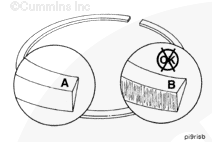
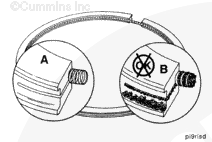
  • Abrasive wear.

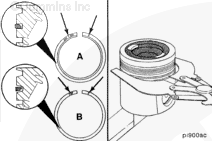
NOTE: Abrasive wear is indicated by concentrated vertical scratches (B). The chromium plate is worn through and the face of the ring has a brighter finish compared to the dull satin finish of a new ring (A).

Abrasive wear can be caused by:

  1. Ingested abrasive material
  2. Inadequate cleaning during a previous repair
  3. Particles embedded in the liner
  4. Scuffing and scoring.

SMALL | MEDIUM | LARGE


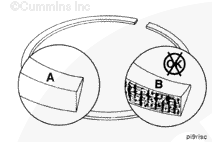
NOTE: Scuffing and scoring are indicated by heavy scratches, metal discoloration, and voids (B).

Scuffing and scoring can be caused by:

  1. Engine overheating
  2. Oil dilution
  3. Improper maintenance of the lubrication system
  4. Piston cooling nozzle malfunction
  5. Oil ring plugged by deposits.

NOTE: Scuffing and scoring on the piston rings indicate a breakdown of the oil film on the cylinder liner wall, causing transfer of material from the piston ring face to the cylinder liner.

SMALL | MEDIUM | LARGE


NOTE: Oil ring plugging is indicated by deposits on the oil ring grooves (B).

Oil ring plugging can be caused by:

  1. Low engine operating temperatures – long periods of idling or a cooling system malfunction
  2. Extended oil change intervals
  3. Use of the wrong type of engine oil
  4. Use of a poor-quality engine oil.

NOTE: Plugging of the oil ring drains restricts oil drainback, which floods the piston ring belt area, resulting in a loss of oil control.

 
SMALL | MEDIUM | LARGE


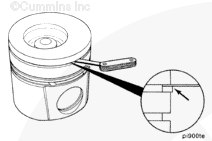
Use a new piston ring to measure the clearance in the ring groove.

Ring Clearance
mm in
Top 0.075 MIN 0.003
  0.150 MAX 0.006
Intermediate 0.085 MIN 0.003
  0.150 MAX 0.006
Oil Control 0.040 MIN 0.0016
  0.130 MAX 0.0051

SMALL | MEDIUM | LARGE


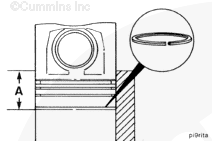
Position each ring in the cylinder 89 mm [3.5 in] below the top deck (A), and use a piston to square it with the bore.

SMALL | MEDIUM | LARGE


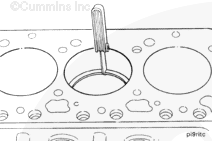
Use a feeler gauge to measure the gap.

Ring Gap
mm in
Top 0.25 MIN 0.0108
  0.55 MAX 0.0217
Intermediate 0.25 MIN 0.0108
  0.55 MAX 0.0217
Oil Control 0.25 MIN 0.0108
  0.55 MAX 0.0217

SMALL | MEDIUM | LARGE


Identify the ring sets for installation in the cylinder where the end gap was measured.

SMALL | MEDIUM | LARGE
   

Install

TOC

 CAUTION 

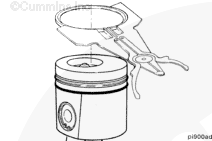
If a ring expander tool is being used, be careful not to overexpand the ring.

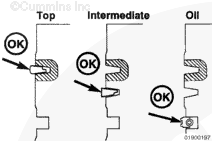
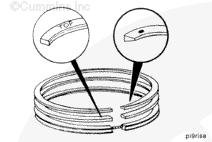
The top surface of the top and intermediate rings is identified as illustrated.

The oil control ring can be assembled with either side up.

 
SMALL | MEDIUM | LARGE


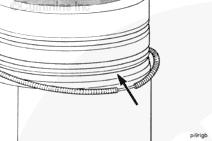
Position the oil ring expander in the control ring groove.

SMALL | MEDIUM | LARGE


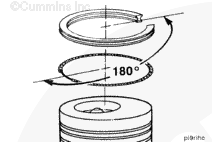
Install the oil control ring with the end gap 180 degrees from the ends of the expander.

SMALL | MEDIUM | LARGE


Piston Ring Expander, Part Number 3823137

Install the intermediate ring.

NOTE: Make certain that the dot and the word TOP are facing up when installing the ring.

SMALL | MEDIUM | LARGE


Install the top ring.

SMALL | MEDIUM | LARGE


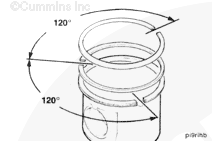
Position the rings so the ring gaps are 120 degrees apart from one another.

SMALL | MEDIUM | LARGE
Last Modified:  03-Apr-2002