Centinel System – Repair Manual – 010-113   Turbocharger, Variable Geometry Actuator

View Related Topic


General Information

TOC

Variable Geometry


The purpose of the variable geometry turbocharger is:

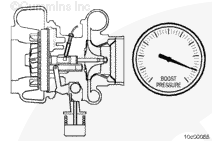
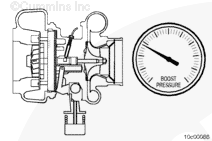
When the EGR flow is commanded, the variable geometry turbocharger will close the nozzle in the turbine housing to create more back pressure in the exhaust manifold to force exhaust gas back into the engine.

 
SMALL | MEDIUM | LARGE


The turbocharger also functions to improve engine performance by building boost more quickly during acceleration.

 
SMALL | MEDIUM | LARGE


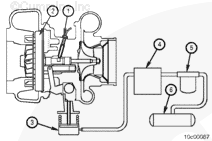
The variable geometry turbocharger functions as a standard turbocharger with the addition of the following:

  • A speed sensor (1) in the bearing housing to monitor turbocharger operation.
  • Water-cooled bearing housings (in addition to oil lubrication)
  • The sliding nozzle (2) is actuated by a pneumatic actuator attached to the vehicle (brake) air supply system
  • The pneumatic actuator (3) operated by an air control valve (4)
  • On some engines, a filter and shutoff valve (5) are used in the air line between the control valve (4) and the air supply tank (6)
  • When the variable geometry turbocharger mechanism opens, a noise can be heard as air is released from the actuator (3) through the control valve (4).
 
SMALL | MEDIUM | LARGE
   

Preparatory Steps

TOC

Variable Geometry


 CAUTION 

The keyswitch must be in the OFF position to make sure no air pressure is present at the actuator.
  • Remove the air line from the actuator.

SMALL | MEDIUM | LARGE
   

Remove

TOC

Variable Geometry


 CAUTION 

The keyswitch must be in the OFF position to make sure no air pressure is present at the actuator.

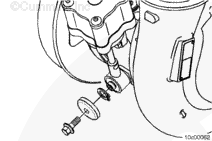
Remove the capscrew holding the actuator rod to the turbocharger cross-shaft.

Remove the snap ring from the cross-shaft.

SMALL | MEDIUM | LARGE


 WARNING 

Keep fingers and hands away from the actuator link to reduce the possibility of personal injury as a result of sudden movement when air is supplied.

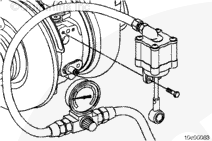
Loosen the two capscrews holding the actuator to the turbocharger bearing housing.

Use coupling, Part Number 3824843, to apply 414 kPa [60 psi] regulated air pressure to the actuator air inlet, to reduce the spring load at the linkage.

Remove the two loosened capscrews and actuator.

SMALL | MEDIUM | LARGE
   

Inspect for Reuse

TOC

Variable Geometry


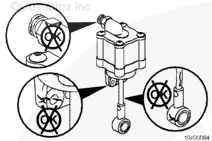
Inspect the actuator mounting bracket, rod, and body.

If the actuator is bent or cracked, it
must be replaced.

Inspect the bushing in the actuator rod end that attaches to the turbocharger cross-shaft for wear, scoring, or other damage.

Replace the actuator if damage is found.

SMALL | MEDIUM | LARGE


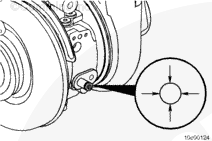
Inspect the outside diameter of the turbocharger cross-shaft pin.

Replace the turbocharger if wear is found.

SMALL | MEDIUM | LARGE
   

Test

TOC

Variable Geometry


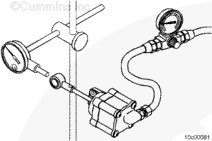
Attach a dial indicator as shown, so the shaft is in line with the actuator rod.

Set the dial indicator to zero, with no air pressure applied to the actuator.

Connect clean, regulated air pressure and a pressure gauge to the actuator.

Apply a minimum of 414 kPa [60 psi] to make sure the actuator is functioning properly.

The rod
must move without any sticking.

Actuator Movement Range
mm in
12 MIN 0.472

Air
must not be heard leaking through a functional actuator.

Spray soapy water on the actuator housing to check for air leaks.

Replace the actuator housing if leaks are found.

Replace the actuator if no movement of the actuator rod is detected, the actuator is sticking, or an air leak is found.

This test can be performed with the actuator removed or installed on the turbocharger.

SMALL | MEDIUM | LARGE
   

Install

TOC

Variable Geometry


 WARNING 

Keep fingers and hands away from the actuator link to reduce the possibility of personal injury as a result of sudden movement when air is supplied.

Use coupling, Part Number 3824843, to apply 414 kPa [60 psi] regulated air pressure to the actuator.

Install the actuator on the turbocharger bearing housing.

Install and tighten the two capscrews.

Torque Value:  17  n.m  [150 in-lb]

SMALL | MEDIUM | LARGE


Install the actuator rod to the turbocharger cross-shaft.

Install the snap ring.

Install and tighten the capscrew.

Torque Value:  23  n.m  [17 ft-lb]

SMALL | MEDIUM | LARGE
   

Finishing Steps

TOC

Variable Geometry


  • Install actuator air line.
  • Start and operate the engine.
  • Verify proper operation and check for air leaks.

If a failure resulted in coolant, oil, excessive fuel, or excessive black smoke entering the exhaust system, the aftertreatment system
must be inspected. Refer to Procedure
014-013.

SMALL | MEDIUM | LARGE
Last Modified:  23-Apr-2007