Fuel is flammable. Keep all cigarettes, flames, pilot lights, arcing equipment, and switches out of the work area and areas sharing ventilation to reduce the possibility of severe personal injury or death when working on the fuel system.
WARNING
Do not vent the fuel system on a hot engine; this can cause fuel to spill onto a hot exhaust manifold, which can cause a fire.
The low-pressure fuel system for Cummins diesel installed in the vehicle
consists of the fuel tank, lines between tank and engine, transfer pump and
lines, and fuel filter and lines. Air or bubbles at the injection pump can
cause no or erratic engine operation and/or subsequent malfunction of the
fuel injection pump. Air can be introduced by leaks in the fuel system prior
to the transfer pump since fuel pressure is a vacuum. Bubbles can result from
any number of restrictions in the system:
Plugged fuel filter
Crimped fuel line
Stopped-up tank module
Inoperative transfer pump.
If sufficient fuel reaches the injection pump from the low-pressure
system, then solutions to engine operational problems are elsewhere. The following
steps will aid in evaluating low-pressure fuel system performance in absence
of fault codes.
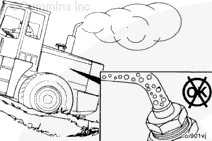
NOTE: For cold-start/performance problems, perform the following steps:
Leave vehicle outside in cold environment for at least 12 hours.
Perform outlined test.
If the system fails to meet test criteria, replace the fuel lift
pump.
A replacement of fuel supply lines, fuel filters, fuel injection pump,
high-pressure fuel lines, and injectors will let air enter the fuel system.
Air in the system will make the engine hard to start, run rough, misfire,
produce low power, and can cause excessive smoke and a fuel knock.
Since the fuel lift pump provides positive pressure through the fuel
filter and supply line to the fuel injection pump, loose connections or defective
seals can show as a fuel leak, not as an air leak.
NOTE: If an excessive amount of air has entered into the system, the system
will need to be vented.
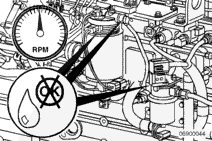
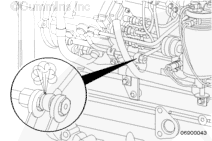
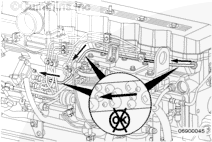
Loosen the return banjo fitting on the fuel lift pump. Run the fuel
lift pump until all the air has been vented. When all the air has been vented,
retighten the fitting.
NOTE: To run the fuel pump for 25 seconds, crank the engine for a split second,
and leave the key in the ON position.
If air continues to bubble out of the system for several minutes, then
an air leak is present.
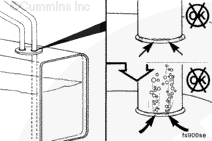
An often overlooked source from which air can enter the fuel system
is between the inlet of the fuel transfer pump and the suction tube in the
tank. Fuel tanks that have the outlet fitting at the top will have a suction
tube that extends to the bottom of the tank. Cracks or pin holes in the weld
that join the tube to the fitting can let air enter the fuel system.
Also, check to make sure all the fittings from the fuel supply line
on the tank to the inlet of the fuel transfer pump are tight.
Use a sight glass at the fuel lift pump inlet to check for air in the
fuel supply lines.
Since the fuel pump provides a positive pressure through the fuel filter
and supply line to the fuel injection pump, loose connections or defective
seals should show as a fuel leak, not as an air leak.
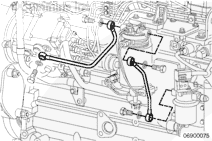
A stuck-open injector can also blow combustion gas back into the pump
and cause air to be present in the overflow. If the engine seems to be misfiring
or running rough, break all the injector supply lines loose at the pump end.
Crank the engine, and observe the lines. If combustion gas seems to be blowing
back through the line, the injector is stuck open. Remove the injector. Take
the vehicle to an Authorized Cummis Repair Facility/Dealer Location for testing.
Torque Value: 24 n.m [212 in-lb]
NOTE: Use two wrenches when loosening the lines at the fuel pump: One to hold
the delivery valve and one to loosen the fuel line.
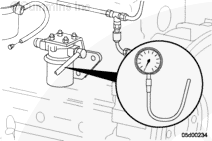
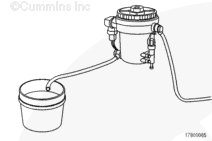
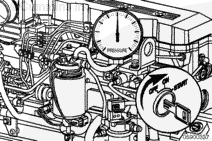
Attach a preferably clear hose to the outlet of the fuel filter. (Do not use pressure test fitting.) Place a pressure gauge on the inlet
side of the fuel filter and a vacuum gauge on the inlet side to the transfer
pump.
Operate the fuel lift pump by bumping the starter. (The lift pump should
run for 25 to 30 seconds.) Check for bubbles in fuel.
Record filter inlet pressure and transfer pump inlet restriction.
If filter inlet pressure is greater than 34.8 kPa [5 psi], the filter
element must be replaced. Repeat test.
If inlet restriction is greater than 152.4 mm Hg [6 in Hg] or 155.1
mm Hg [3 psi], then excessive restriction exists between fuel in the tank
and the transfer pump, which must be repaired (e.g., fuel line
or tank module). Repeat test.
If bubbles are present, check for air leaks in the fuel supply circuit.
Measure the amount of fuel in the container. If more than 1.33 liters
[45 fl oz] are collected and the fuel is bubble-free, then it is unlikely
the low-pressure fuel system is the cause of engine operational problems.
Reconnect the lift pump that is retaining the fuel filter pressure connections.
Running engine at high idle, the filter inlet pressure should be greater than
42.3 kPa [6 psi]; otherwise, there is a fuel lift pump malfunction.
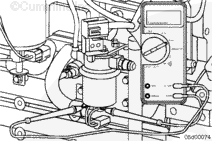
If the fuel transfer pump does not run, check electrical
circuits, and verify voltage is present at lift pump connector.
NOTE: When an engine is not running, with key on,
the lift pump will run less than 2 seconds (varies with ECM calibration);
with starter bump, about 25 to 30 seconds. If voltage is present, replace
fuel transfer pump. Resistance measurement across the transfer pump terminals
can be made for confirmation of pump malfunction. Resistance greater than
200 ohms or less than 0.2 ohm does confirm an electrical fault when voltage
is present but the fuel pump is not running.
Hello, I'm Jack, a diesel engine fan and a blogger. I write about how to fix and improve diesel engines, from cars to trucks to generators. I also review the newest models and innovations in the diesel market. If you are interested in learning more about diesel engines, check out my blog and leave your feedback.
View all posts by Jack
 WARNING






;)
;)
;)
;)
;)
;)
;)
;)
;)
;)
;)
;)
;)
;)
;)
;)
;)
;)
;)
;)
;)
;)
