|
Engine Cylinder 1 Knock – Data Valid, but Above Normal Operational Range – Moderately Severe Level.
|

Overview
| CODE | REASON | EFFECT |
| Fault Code: 1643 PID: S90 SPN: 1352 FMI: 0 LAMP: Amber SRT: |
Engine Cylinder Number 1 Knock – Data Valid, but Above Normal Operational Range – Moderately Severe Level. |
Engine power derate. |
|
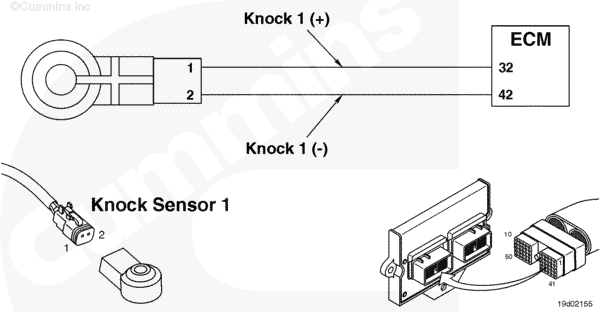
Knock Sensor Circuit |
 |
Circuit Description
The knock sensor is an accelerometer which measures high frequency vibrations.
The electronic control module (ECM) processes the voltage signals from the knock sensor to check for an elevated signal during the combustion cycle for each cylinder. In this way, one sensor can be used for multiple cylinders.
Component Location
Knock sensor 1 is located on the side of the engine, on the block, above the air compressor on C and L engines. The B series engine has the knock sensor located on the cylinder head intake cover capscrew. The front knock sensor mounting surface on the C and L engine block has two identically sized holes.
The knock sensor is mounted on the lower hole and the top hole is used on some products for p-clip mounting.
Shop Talk
The knock sensors are located on the cylinder block and cylinder head. There are two sensors. Knock sensor 1 monitors cylinders 1, 2, and 3; and knock sensor 2 monitors cylinders 4, 5, and 6. The vehicle keyswitch
must be cycled before full power will be restored after a knock induced derate.
The knock sensors measure the high frequency vibration of the engine due to combustion knock. Knock can occur if the engine is supplied low quality fuel or if it is operated at excessive temperature. Other sources of high frequency vibration can cause knock faults to be logged. Examples include gear driven accessories such as air compressors or hydraulic pumps, driveline vibration, or a rough running engine due to low fuel pressure.
When the conditions exist, knock faults typically occur when operated at full power such as during wide open throttle acceleration or during a stall test with an automatic transmission. Because of this, faults will likely be inactive at idle.
Troubleshooting Steps
| STEPS | SPECIFICATIONS | |
|---|---|---|
| STEP 1. | Check for fault codes. | |
| STEP 1A. Check for existing fault codes other than Fault Codes 1643, 1644, 1645, 1646, 1647 or 1648. | Active fault codes? | |
| STEP 1B. Check the knock sensor. | Any knock sensor damage? | |
| STEP 1C. Check for ignition problems. | Ignition system operating properly? | |
| STEP 1D. Check the overhead adjustment. | Valve adjustment within specification? | |
| STEP 1E. Check for in-cylinder damage. | Evidence of damage? | |
| STEP 2. | Clear the fault codes. | |
| STEP 2A. Disable the fault code. | Fault Code 1643 inactive? | |
| STEP 2B. Clear the inactive fault codes. | All fault codes cleared? | |
Guided Step 1 – Check for fault codes.
| Guided Step 1A – Check for existing fault codes other than Fault Codes 1643, 1644, 1645, 1646, 1647 or 1648. | |
|---|---|
Conditions
ActionCheck for existing fault codes other than Fault Code 1643, 1644, 1645, 1646, 1647 or 1648. Use INSITE™ electronic service tool to read for active fault codes. |
|
|
Active fault codes? |
|
| YES | NO |
| No Repair | No Repair |
|
Troubleshoot applicable fault code(s)
|
|
| Guided Step 1B – Check the knock sensor. | |
|---|---|
Conditions
ActionInspect the knock sensor for the following:
|
|
|
Any knock sensor damage? |
|
| YES | NO |
|
Replace the sensor or correct the mounting. |
No Repair |
| Guided Step 1C – Check for ignition problems. | |
|---|---|
Conditions
ActionCheck for an ignition-related problem.
|
|
|
Ignition system operating properly? |
|
| YES | NO |
| No Repair |
Repair or replace the damaged components.
|
| Guided Step 1D – Check the overhead adjustment. | |
|---|---|
Conditions
ActionCheck the overhead adjustment.
|
|
|
Valve adjustment within specification? |
|
| YES | NO |
| No Repair |
Adjust the overhead.
|
| Guided Step 1E – Check for in-cylinder damage. | |
|---|---|
ConditionsTurn keyswitch OFF. ActionCheck for the following possible cylinder damage:
|
|
|
Evidence of damage? |
|
| YES | NO |
|
Replace the affected components. Refer to the Troubleshooting and Repair Manual C Gas, C Gas Plus, and L Gas Plus Engines, Bulletin |
No Repair |
Guided Step 2 – Clear the fault codes.
| Guided Step 2A – Disable the fault code. | |
|---|---|
Conditions
ActionDisable the fault code.
|
|
|
Fault Code 1643 inactive? |
|
| YES | NO |
| No Repair |
Return to the troubleshooting steps or contact a Cummins® Authorized Repair Location if all steps have been completed and checked again. |
| Guided Step 2B – Clear the inactive fault codes. | |
|---|---|
Conditions
ActionClear the inactive fault codes.
|
|
|
All fault codes cleared? |
|
| YES | NO |
| No Repair |
Troubleshoot any remaining active fault codes. |
|
Repair complete
|
Appropriate troubleshooting charts
|

;)
;)