This procedure applies to QSL9 engines only. The expansion tank on the QSC8.3 engine is part of the heat exchanger component. Refer to Procedure 008-053.
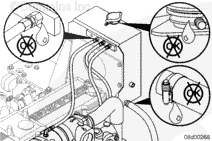
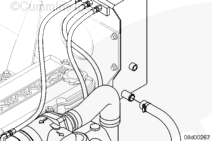
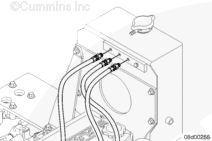
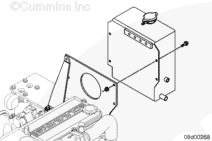
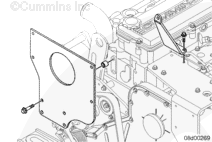
The graphics in this procedure are of the QSL9 engine with keel cooling. The expansion tank and mounting bracket on the QSL9 engine with sea water cooling (heat exchanger) is different; however, all of the hose and vent line connections are the same.
Batteries can emit explosive gases. To reduce the possibility of personal injury, always ventilate the compartment before servicing the batteries. To reduce the possibility of arcing, remove the negative (-) battery cable first and attach the negative (-) battery cable last.
WARNING
Coolant is toxic. Keep away from children and pets. If not reused, dispose of in accordance with local environmental regulations.
WARNING
Do not remove the pressure cap from a hot engine. Wait until the coolant temperature is below 50°C [120°F] before removing the pressure cap. Heated coolant spray or steam can cause personal injury.
CAUTION
Use caution when draining coolant that coolant is not spilled or drained into the bilge area. Do not pump the coolant overboard. If the coolant is not reused, it must be discarded in accordance with local environmental regulations.
Disconnect the batteries. Refer to Procedure 013-009.
Drain the engine coolant. Refer to Procedure 008-018.
Disconnect the coolant level sensor connector. Refer to Procedure 019-017 in Troubleshooting and Repair Manual, ISB, QSB4.5, QSB5.9, QSB6.7, ISC, QSC8.3, ISL, QSL9 Engines, CM850 Electronic Control System, Bulletin 4021416, or Procedure 019-017 in Troubleshooting and Repair Manual, ISC, QSC8.3, ISL and QSL9 Engines, Bulletin 3666271.
Hello, I'm Jack, a diesel engine fan and a blogger. I write about how to fix and improve diesel engines, from cars to trucks to generators. I also review the newest models and innovations in the diesel market. If you are interested in learning more about diesel engines, check out my blog and leave your feedback.
View all posts by Jack


 WARNING
  CAUTION



;)
;)
;)
;)
;)
;)
;)
;)
;)
;)
;)
;)
;)
;)
;)
;)
;)
;)
