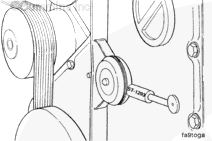
Use belt tensioner gauge, Part Number ST-1293, to measure the tension in the drive belt.
Belt Tension
n
lbf
356
MIN
80
534
MAX
120
If the measurement is out of the specified range, replace only the belt and perform the tension test again. If the measurement is still outside of the specified rang after the new belt has been installed, replace the belt tensioner.
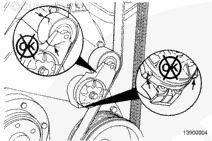
With the belt installed, verify that neither tensioner arm stop is in contact with the spring casing stop. If either stop is touching, replace the drive belt. Refer to Procedure 008-002 in Section 8.
After replacing the belt, if the tensioner arm stops are still in contact with the spring case stop, replace the tensioner.
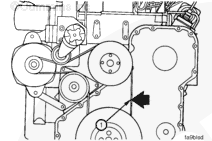
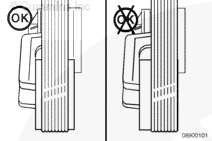
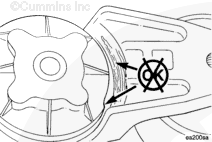
Check the location of the drive belt on the belt tensioner pulley. The belt must be centered on, or close to the middle of, the pulley. Misaligned belts, either too far forward or backward, can cause belt wear, belt roll-off failures, or increase uneven tensioner bushing wear.
With the belt removed, verify that the tensioner arm stop is in contact with the spring case stop. If they are not touching, the tensioner must be replaced.
Batteries can emit explosive gases. To reduce the possibility of personal injury, always ventilate the compartment before servicing the batteries. To reduce the possibility of arcing, remove the negative (-) battery cable first and attach the negative (-) battery cable last.
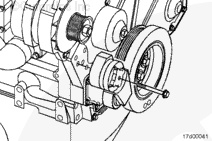
Remove the capscrew and belt tensioner from the bracket.
NOTE: Most belt tensioners are mounted to the water inlet connection. Some belt tensioners are mounted to a separate mounting bracket and use internal fasteners for clearance.
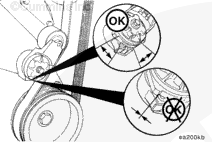
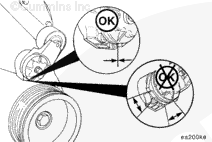
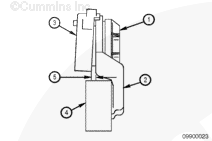
Measure the clearance between the tensioner spring case and the tensioner arm to verify tensioner wear-out and uneven bearing wear. If the clearance at the measurement point 5 exceeds 3 mm [0.12 in], the tensioner is damaged and must be replaced as a complete assembly.
Tensioners generally will show a larger clearance gap near the lower portion of the spring case, resulting in the upper portion rubbing against the tensioner arm.
Tensioner cap
Tensioner arm
Spring case
Tensioner pulley
Clearance gap.
NOTE: Always replace the belt when a tensioner is replaced. However, it is not always necessary to replace a tensioner when a belt is replaced.
Inspect the tensioner for evidence of the tensioner arm contacting the tensioner cap. If there is evidence of the two areas making contact, the pivot tube bushing has failed and the tensioner must be replaced.
Service Tip: If difficulty is experienced installing the drive belt or if the belt seems too short, position the belt over the grooved pulleys first. Then, while holding the tensioner up, slide the belt over the water pump pulley.
Hello, I'm Jack, a diesel engine fan and a blogger. I write about how to fix and improve diesel engines, from cars to trucks to generators. I also review the newest models and innovations in the diesel market. If you are interested in learning more about diesel engines, check out my blog and leave your feedback.
View all posts by Jack




 WARNING


;)
;)
;)
;)
;)
;)
;)
;)
;)
;)
;)
;)
;)
;)
;)
;)
;)
;)
;)
;)
