 |
|
Aftertreatment Exhaust Gas Temperature 2 – Data Valid but Above Normal Operational Range – Moderately Severe Level
|

Overview
| CODE | REASON | EFFECT |
| Fault Code: 1968 PID: SPN: 3249 FMI: 0/16 LAMP: Amber SRT: |
Aftertreatment Exhaust Gas Temperature 2 – Data Valid but Above Normal Operational Range – Moderately Severe Level. The aftertreatment diesel particulate filter inlet temperature sensor reading has exceeded the maximum temperature limit. |
Active aftertreatment diesel particulate filter regeneration will be disabled. |
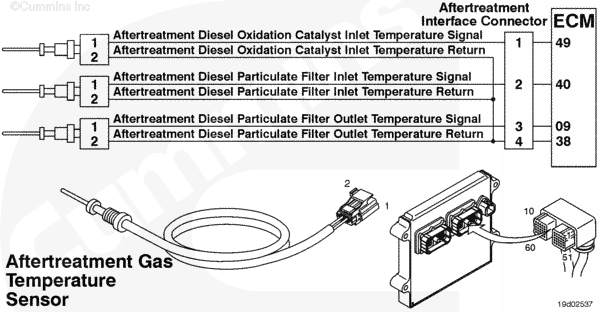 ISB, ISC, and ISL – Aftertreatment Exhaust Gas Temperature Sensors
|
Circuit Description
The aftertreatment exhaust gas temperature sensors are used by the electronic control module (ECM) to monitor the exhaust temperatures in the aftertreatment system. The aftertreatment exhaust gas temperature sensors are thermistors and change resistance based on the temperature being measured. The ECM provides a 5 volt reference voltage to the sensor. The ECM monitors the change in signal voltage and converts this to a temperature value.
When the exhaust temperature is cold, the sensor or thermistor resistance is high. The ECM signal voltage only pulls down a small amount through the sensor to ground. Therefore, the ECM senses a high signal voltage or low temperature. When the exhaust gas temperature is hot, the sensor resistance is low. The signal voltage pulls down a large amount. Therefore, the ECM senses a low signal voltage, or a high temperature.
Component Location
The aftertreatment diesel particulate filter inlet temperature sensor is located in the aftertreatment system. It is located at the outlet of the aftertreatment diesel oxidation catalyst and before the aftertreatment diesel particulate filter.
Refer to the OEM service manual for the location of the vehicle aftertreatment system.
Conditions for Running the Diagnostics
This diagnostic runs continuously when the engine is running and active regeneration of the aftertreatment diesel particulate filter is occurring.
Conditions for Setting the Fault Codes
The aftertreatment diesel particulate filter inlet temperature sensor reading exceeds 649°C [1200°F] for 5 seconds and then returns below 550°C [1022°F]. This must occur 5 times before the fault code is logged.
Action Taken When the Fault Code is Active
- The ECM illuminates the amber CHECK ENGINE lamp immediately after the diagnostic runs and fails.
- Active and stationary (parked) regeneration will be disabled.
- The exhaust gas recirculation (EGR) valve operation will be disabled.
Conditions for Clearing the Fault Code
The ECM will turn off the amber CHECK ENGINE lamp and the fault code will be set to inactive when the keyswitch is cycled.
Shop Talk
This fault code is logged when the ECM has detected a high temperature condition in the aftertreatment system and active regeneration of the aftertreatment diesel particulate filter is occurring. The fault code indicates that a secondary fuel source is entering the aftertreatment system and is creating a temperature increase across the aftertreatment diesel oxidation catalyst and/or aftertreatment diesel particulate filter.
Possible causes of this fault code include:
- Excessive engine oil or diesel fuel being introduced into the exhaust system from the engine
- A damaged engine fuel injector causing unburned diesel fuel to enter the exhaust system
- The aftertreatment diesel particulate filter inlet temperature sensor failed in-range
- An in-range engine sensor malfunction has occurred, causing excessive fuel to enter the exhaust system.
The aftertreatment system must be inspected after making the appropriate repair outlined in this fault code troubleshooting tree. Progressive damage to the aftertreatment system may have occurred. Remove the exhaust aftertreatment system from the vehicle to inspect it for potential damage and reuse. For ISB CM2150 engines, use the following procedure in the ISB CM2150 Service Manual, Bulletin 4021578. Refer to Procedure 014-013 in Section 14. For ISC and ISL CM2150 engines, use the following procedure in the ISC and ISL CM2150 Service Manual, Bulletin 4021569. Refer to Procedure 014-013 in Section 14.
Refer to Troubleshooting Fault Code t05-1968

;)
;)