Liquefied petroleum gas is normally treated with an odor-producing chemical, so that users will be able to smell gas leaks. Always be alert for the smell of gas. If you enter a room or approach a vehicle and a smell of gas is present, immediately shut off all engines and ignition sources and avoid sparks, arcing switches and equipment, cigarettes, pilot lights, flames, and other sources of ignition in the area and in areas with common ventilation. Provide extra ventilation to the area and do not start the equipment or nearby equipment until the leak is corrected and the area is ventilated. Avoid leaving liquefied petroleum gas-fueled equipment in unvented rooms overnight or for extended periods. Store and service liquefied petroleum gas-fueled equipment in large, well-ventilated areas or outside.
WARNING
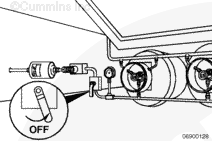
To reduce the possibility of severe personal injury or death when working on the fuel system, turn off the fuel supply at the vehicle’s main gas shutoff valve before removing any component.
WARNING
Liquefied petroleum gas is heavier than air and can accumulate near the floor, in sumps, and in low-lying areas.
NOTE: On B LPG Plus, Fault Code 2119 (Low Fuel Pressure, Primary), Fault Code 482 (Low Fuel Pressure, Secondary), and Fault Code 2219 (Oxygen Sensor in Range Failure) may log.
Liquefied petroleum gas is normally treated with an odor-producing chemical, so that users will be able to smell gas leaks. Always be alert for the smell of gas. If you enter a room or approach a vehicle and a smell of gas is present, immediately shut off all engines and ignition sources and avoid sparks, arcing switches and equipment, cigarettes, pilot lights, flames, and other sources of ignition in the area and in areas with common ventilation. Provide extra ventilation to the area and do not start the equipment or nearby equipment until the leak is corrected and the area is ventilated. Avoid leaving liquefied petroleum gas-fueled equipment in unvented rooms overnight or for extended periods. Store and service liquefied petroleum gas-fueled equipment in large, well-ventilated areas or outside.
WARNING
Liquefied petroleum gas is heavier than air and can accumulate near the floor, in sumps, and in low-lying areas.
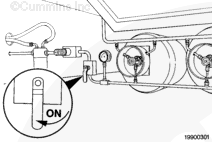
Turn the ignition keyswitch to the ON position only (do not engage the starting motor) and check all connections for gas leaks using a gas detector, Part Number 3823984, or a soap solution.
Liquefied petroleum gas is normally treated with an odor-producing chemical, so that users will be able to smell gas leaks. Always be alert for the smell of gas. If you enter a room or approach a vehicle and a smell of gas is present, immediately shut off all engines and ignition sources and avoid sparks, arcing switches and equipment, cigarettes, pilot lights, flames, and other sources of ignition in the area and in areas with common ventilation. Provide extra ventilation to the area and do not start the equipment or nearby equipment until the leak is corrected and the area is ventilated. Avoid leaving liquefied petroleum gas-fueled equipment in unvented rooms overnight or for extended periods. Store and service liquefied petroleum gas-fueled equipment in large, well-ventilated areas or outside.
WARNING
Liquefied petroleum gas is heavier than air and can accumulate near the floor, in sumps, and in low-lying areas.
Turn the ignition keyswitch to the ON position only (do not engage the starting motor) and check all connections for gas leaks using a gas detector, Part Number 3823984, or a soap solution.
NOTE: It is possible to see pressure spikes exceed 207 kPa [30 psi] during a throttle “snap” event, but they should never remain above 207 kPa [30 psi].
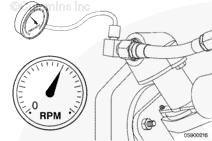
Check fuel pressures:
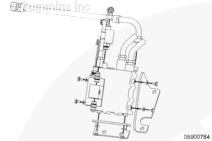
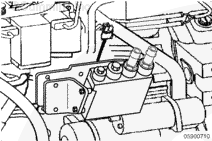
Check fuel pressure on the OEM side. This pressure should never fall below 241 kPa [35 psi] or rise above 1724 kPa [300 psi at coolant temperatures above 21°C [70°F].
Check fuel pressure on the engine side. This pressure will vary depending on the engine coolant temperature. At coolant temperatures below 21°C [70°F], the pressure is regulated to approximately 103 kPa [15 psi].
This pressure should slowly increase to 131 to 207 kPa [19 to 30 psi] as the coolant temperature increases at idle. Under full load with the coolant temperature at rated conditions, the pressure can drop to 131 to 172 kPa [19 to 25 psi].
NOTE: It is possible to see pressure spikes exceed 276 kPa [40 psi] during a throttle “snap” event, but they should never remain above 276 kPa [40 psi].
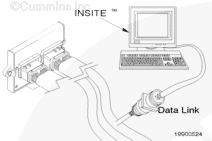
Check fuel pressures:
Use INSITE™ to check fuel pressure (fuel pressure sensor, primary) on the original equipment manufacturer (OEM) side. This pressure should never fall below 276 kPa [40 psi] or rise above 1724 kPa [300 psi] at coolant temperatures above 21°C [70°F].
Use INSITE™ to check the fuel pressure (fuel pressure sensor, secondary). This pressure will vary depending on the engine coolant temperature. At coolant temperatures below 21°C [70°F], the pressure is regulated to approximately 145 kPa [21 psi].
This pressure should slowly increase to 159 to 221 kPa [23 to 32 psi] as the coolant temperature increases at idle. Under full load with the coolant temperature at rated conditions, the pressure can drop to 172 to 193 kPa [25 to 28 psi].
Hello, I'm Jack, a diesel engine fan and a blogger. I write about how to fix and improve diesel engines, from cars to trucks to generators. I also review the newest models and innovations in the diesel market. If you are interested in learning more about diesel engines, check out my blog and leave your feedback.
View all posts by Jack
 WARNING







;)
;)
;)
;)
;)
;)
;)
;)
;)
;)
;)
;)
;)
;)
;)
;)
;)
;)
;)
;)
;)
;)
;)
;)
;)
;)
;)
;)