Air is pulled into the engine through an air filter. Clean air is very important to the life of the engine. Ingested dust and dirt can very quickly damage the cylinders.
Make sure that an excellent-quality air cleaner is used and that it is periodically replaced according to the manufacturer’s recommendations.
Intake air is drawn into the turbocharger inlet, compressed by the turbine wheel and delivered to the charge air cooler.
NOTE: The long-term integrity of the charge air cooling system is the responsibility of the vehicle and component manufacturers.
From the charge air cooler, the intake air is directed to the air inlet connection. Optional connection configurations are available for the B5.9G and B5.9LPG engines. From the inlet connection, the air is directed to the mixer where the intake air is combined with the natural gas or liquefied petroleum gas. The amount of air/fuel mixture permitted into the cylinder is controlled by the throttle plate. After combustion, energy from the exhaust gases is utilized by flowing the exhaust through the exhaust side of the turbocharger to drive the turbine wheel. By utilizing a wastegate turbocharger, the engine is provided with improved low-speed torque without overboosting at high speeds. Exhaust from the turbocharger is then routed through an optional catalytic converter/muffler before being released to the atmosphere.
CAUTION
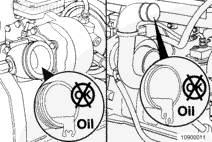
Lubricating oil is vital to the turbocharger life; therefore, clean engine oil must be added through the oil supply fitting anytime a new turbocharger is installed.
CAUTION
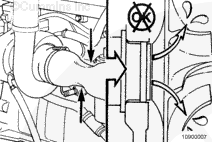
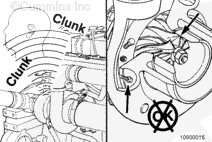
The turbocharger must not be tampered with since it is a performance part. The wastegate bracket is an integral part of the turbocharger. Tampering with the wastegate components can reduce durability by increasing cylinder pressure and thermal loading due to incorrect inlet and exhaust manifold pressures. Poor fuel economy and failure to meet regulatory emission laws can result. Increasing the turbocharger boost will not increase engine power.
Wastegate operation is controlled by an actuator that senses compressor pressure and balances it against a preset spring load. The wastegate valve is located in the turbine inlet passage. When open, it diverts a portion of the exhaust gas away from the turbine wheel, thereby controlling the shaft speed and boost.
The turbine and compressor wheels and shaft are supported by two rotating bearings in the bearing housing. Passages within the bearing housing direct filtered, pressurized engine oil to the shaft bearings and thrust bearing. The oil is used to lubricate and cool the rotating components to provide for smooth operation. The oil then drains from the bearing housing to the engine sump through the oil drain line. A restricted or damaged oil drain line can cause the turbocharger bearing housing to be pressurized, causing oil to leak past the seals.
The B5.9G engine and B5.9LPG engine have a higher average exhaust temperature than a diesel engine. Consequently, the turbocharger is subjected to higher average operating temperatures. To withstand the higher exhaust temperatures at shutdown, a water-cooled bearing housing is used on the B5.9G and B5.9LPG engine turbocharger. Coolant lines are connected to the outlet after the thermostat.
An adequate supply of good filtered oil is very important to the life of the turbocharger. Make sure that an excellent-quality gas engine lubricating oil is used and that it and the oil filter are changed according to the maintenance recommendations.
CAUTION
A catalyst is installed on all ULEV-certified automotive applications. It will plug up and eventually damage the catalyst. No welding or modifications of the catalyst are permitted without permission of catalyst manufacturer.
Malfunctioning Turbocharger
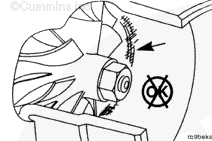
Failure of the internal components of the turbocharger can reduce its effectiveness and also cause excessive smoke and low power. A bearing failure can produce friction, which will slow the speed of the rotor assembly. Failed bearings can also allow the blades of the rotor assembly to rub the housings, thus reducing the rotor assembly speed.
Malfunctioning turbocharger wastegate failure or miscalibration of the turbocharger wastegate can result in excessively high or low boost pressures. Low boost pressures can cause excessive smoke and low power. High boost pressures can cause major engine damage.
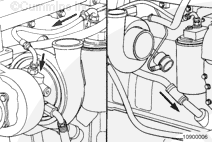
Engine lubricating oil is used to lubricate the bearings and provide some cooling for the turbocharger. The lubricating oil supplied to the turbocharger through the supply line is at engine operating pressure. A return line connected to the bottom of the turbocharger routes the lubricating oil back to the engine lubricating oil pan.
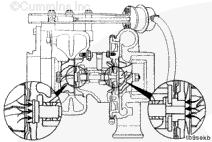
Seal rings are used on each end of the rotor assembly. The primary function of the seals is to prevent exhaust gases and compressed air from entering the turbocharger housing. Lubricating oil leakage from the seals is rare, but it can occur.
NOTE: Excessive crankcase pressure will not allow the oil to drain from the turbocharger. This will load the bearing housing and allow lubricating oil to leak past the compressor seals and into the engine.
If turbine seal leakage into the exhaust occurs on engines with a catalyst, check the exhaust restriction during the repair.
A restricted or damaged lubricating oil return line will cause the turbocharger housing to be pressurized, causing lubricating oil to migrate past the seals.
Additionally, high intake or exhaust restrictions can cause a vacuum between the compressor and the turbocharger housing, resulting in oil leaking past the seals.
To verify lubricating oil leakage past the seals, remove the exhaust pipe and crossover tube and look for lubricating oil in the turbine casing and the crossover tube. Locate and correct the restriction as previously discussed.
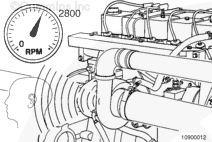
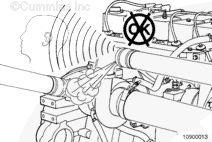
It is normal for the turbocharger to emit a “whining” sound that varies in intensity, depending on engine speed and load. The sound is caused by the very high rotational speed of the rotor assembly. Consequently, the sound will be more audible at full speed.
It is normal to hear the turbocharger “flutter” after a sudden release of the throttle pedal.
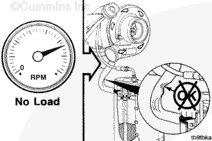
NOTE: If possible, operate the engine at full speed to verify the noise level.
Hello, I'm Jack, a diesel engine fan and a blogger. I write about how to fix and improve diesel engines, from cars to trucks to generators. I also review the newest models and innovations in the diesel market. If you are interested in learning more about diesel engines, check out my blog and leave your feedback.
View all posts by Jack
 CAUTION
;)
;)
;)
;)
;)
;)
;)
;)
;)
;)
;)
;)
;)
;)
;)
;)
;)
;)
;)
;)
