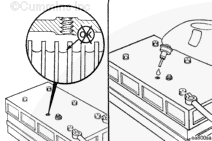
If conventional batteries (not maintenance-free batteries) are used, check the electrolyte level in each cell. If it is low, add distilled water to bring the level up to the top of all plates. Refer to the battery manufacturer’s specifications.
NOTE: If water is added to the battery, the battery must be charged before any testing can be accomplished.
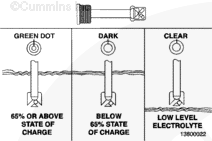
With conventional batteries, check the electrolyte specific gravity with a hydrometer. To check the specific gravity, the battery temperature will be 26.67°C [80°F]. All cells will not be less than 1.230. The difference between high and low readings will not exceed 0.050. If the readings indicate a difference of more than 0.050, replace the battery. If the readings indicate less than 0.050 difference but one or more cells indicate less than 1.230, recharge the battery.
NOTE: For conventional batteries, remove the vent caps prior to removing surface charge. If a blue haze is observed in any cell while removing the surface charge, replace the battery. After the surface charge has been removed, install all vent caps.
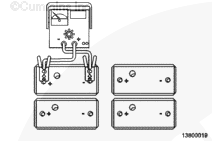
Remove the surface charge by attaching the battery to a 300-amp load for 15 seconds for heavy-duty batteries.
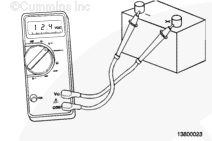
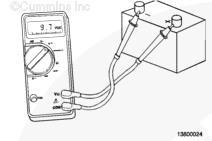
Remove the load and wait 1 minute; if the battery voltage is greater than or equal to 12.4 VDC, continue testing. If the voltage is below 12.4 VDC, recharge or replace the battery.
Hello, I'm Jack, a diesel engine fan and a blogger. I write about how to fix and improve diesel engines, from cars to trucks to generators. I also review the newest models and innovations in the diesel market. If you are interested in learning more about diesel engines, check out my blog and leave your feedback.
View all posts by Jack




;)
;)
;)
;)
;)
;)
;)
;)
;)
;)
