Resistance Check
TOC
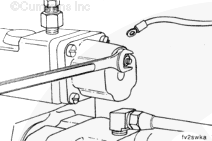
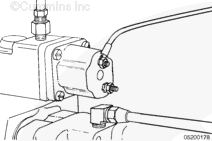
Remove the wire.
Make sure the remaining wire connection nut is tight. Tighten the nut, if required.
Torque Value: 3 n.m [27 in-lb]
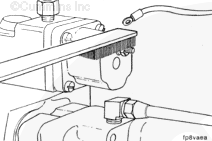
Make sure the post is tight and secure in the coil.
NOTE : Only single post coils can be used on the fuel system. Two post coils will interfere with the cooling line.
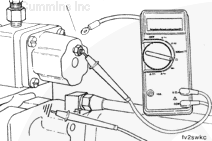
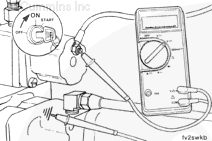
Make sure the coil wire is not connected before checking the coil resistance.
Measure the coil resistance with a multimeter, Part Number 3377161, or equivalent.
Fuel System Shutoff Valve Solenoid Specifications
Voltage
Resistance Minimum (Ohms)
Resistance Maximum (Ohms)
6 VDC
1
5
12 VDC
6
15
24 VDC
24
50
32 VDC
42
80
36 VDC
46
87
48 VDC
92
145
74 VDC
315
375
115 VAC
645
735
NOTE : If the solenoid resistance is 0 ohms, there is an electrical short in the coil.
Replace the coil if the resistance does not meet the specifications.
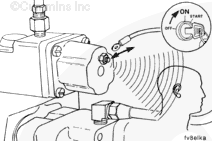
Turn the vehicle keyswitch to the ON position.
Touch the wire to the coil terminal.
Listen for the valve to click when the wire is touched to the coil terminal. If the valve does not click, repair or replace the fuel shutoff valve.
Voltage Check
TOC
CAUTION
To avoid damage to the ECM, connect only one wire to the fuel shut off solenoid.
Connect the wire.
The coil voltage and part number are cast into the terminal connection end of the coil.
Turn the vehicle keyswitch to the ON position.
Check the voltage to the coil with a multimeter, Part Number 3377161 or equivalent.
The voltage must be greater than 10.5 VDC.
Turn the vehicle keyswitch to the OFF position.
Remove
TOC
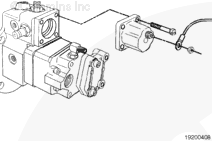
Clean the fuel shutoff valve and surrounding area.
Disconnect the fuel shutoff valve signal wire from the actuator harness.
Remove the mounting capscrews.
Remove the fuel shutoff valve.
Install
TOC
Install a new o-ring on the fuel shutoff valve.
Install the fuel shutoff valve and the capscrews.
Torque Value: 4 n.m [35 in-lb]
Connect the fuel shutoff valve to the actuator harness.
Torque Value: 3 n.m [27 in-lb]
Last Modified: 24-Aug-2010
Published by Jack
Hello, I'm Jack, a diesel engine fan and a blogger. I write about how to fix and improve diesel engines, from cars to trucks to generators. I also review the newest models and innovations in the diesel market. If you are interested in learning more about diesel engines, check out my blog and leave your feedback.
View all posts by Jack






 CAUTION
;)
;)
;)
;)
;)
;)
;)
;)
;)
;)
;)
;)
;)
;)
