The use of quality engine lubricating oils, combined with appropriate oil drain and filter change intervals, is a critical factor in maintaining engine performance and durability.
Cummins Engine Standard Classifications (CES)
American Petroleum Institute Classification (API)
European Classification (ACEA)
Comments
API CD API CE
ACEA E-1
ACEA E-2
OBSOLETE. DO NOT USE.
CES-20075
API CF-4/SG
API CG-4/SH
ACEA E-3
Minimum acceptable oil classification for Midrange engines. See note above.
CES-20071
CES-20072
CES-20076
CES-20077
API CH-4/SJ
ACEA E-5
Good oil classification for Midrange engines without EGR.
CES-20078
API CI-4/SK
Excellent oil for Midrange engines.
A sulfated ash limit of 1.0 mass percent is suggested for optimum valve and piston deposit, and oil consumption control. The sulfated ash must not exceed 1.85 mass percent.
Special “break-in” oils are not recommended for use in new or rebuilt Cummins® engines. Use the same lubricating oil that will be used in normal engine operations.
Use of “synthetic engine oils” (those made with API group 3 or group 4 base stocks) is permitted subject to the same performance and viscosity limitations of petroleum (mineral) based engine oils. The same oil change intervals must be applied to synthetic oils that are applied to petroleum (mineral) based engine oils.
For further details and discussion of engine lubricating oils for Cummins® engines, refer to Cummins Engine Oil Recommendations, Bulletin 3810340.
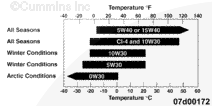
Cummins Inc. primary recommendation is for the use of 15W-40 multigrade for normal operation at ambient temperatures above -15°C [5°F]. The use of multigrade oil reduces deposit formation, improves engine cranking in low temperature conditions and increases engine durability by maintaining lubrication during high temperature operating conditions. Since multigrade oils have been shown to provide approximately 30 percent lower oil consumption, compared with monograde oils, it’s important to use multigrade oils to be certain your engine will meet applicable emissions requirements. While the preferred viscosity grade is 15W-40, lower viscosity multigrades can be used in colder climates. Refer to the accompanying chart.
Oils meeting API CI-4 and a 10W30 viscosity grade, must meet a minimum High Temperature / High Shear viscosity of 3.5 cSt., and ring wear / liner wear requirements of Cummins® and Mack tests. Thus, they can by used over a wider temperature range than 10W30 oils meeting older API performance classifications. As these oils will have directionally thinner oil films than 15W40 oils, top quality Fleetguard® filters must be used above 20°C [70°F]. Some oil suppliers might claim better fuel economy for these oils. Cummins Inc. can neither approve nor disapprove any product not manufactured by Cummins Inc. These claims are between the customer and oil supplier. Obtain the oil supplier’s commitment that the oil will give satisfactory performance in Cummins® engines or do not use the oil.
CAUTION
An SAE 10W30 designation on a product is a viscosity designation only. This designation alone does not imply that the product meets Cummins® requirements. Only 10W30 oils with diesel performance credentials listed in table above can be used in Cummins® engines if the reduced ambient temperature indicated in chart above is observed. Only 10W30 oils meeting CES 20078 (API CI-4) can be used in the ambient temperature range similar to 15W40 oils.
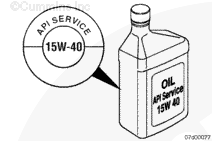
An example of the API service symbols are shown in the accompanying illustration. The upper half of the symbol displays the appropriate oil categories.
The center section identifies the SAE oil viscosity grade.
Hello, I'm Jack, a diesel engine fan and a blogger. I write about how to fix and improve diesel engines, from cars to trucks to generators. I also review the newest models and innovations in the diesel market. If you are interested in learning more about diesel engines, check out my blog and leave your feedback.
View all posts by Jack
 CAUTION

;)
;)
;)
;)