Electronic Control System Gas Plus Engines – 019-166   Data Link Circuit, SAE J1587

General Information

TOC

The J1587 data link circuit is located in the OEM wiring harness.

The purpose of this data link is to allow the ECM to communicate to the vehicle control operated systems such as the transmission controllers, anti-slip reduction system, etc. The J1587 data link includes the SAE J1587 data link positive (+) and the SAE J1587 data link negative (-) wires in the OEM wiring harness.

NOTE: Typical SAE 1587 connectors will either be 2 or 6-pin connectors.

6-Pin Connector
Position A Data link positive (+)
Position B Data link negative (-)
Position C Battery (12/24 VDC)
Position D Open
Position E Engine block ground
Position F Not used

SMALL | MEDIUM | LARGE

Resistance Check

TOC

 CAUTION 

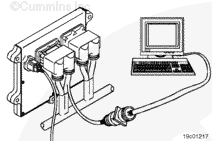
Use test lead, Part Number 3822758, on the ECM connector, and test lead, Part Number 3823993, on the 6-pin Deutsch connector.

Turn the keyswitch to the OFF position. Disconnect the OEM harness connector from the ECM.

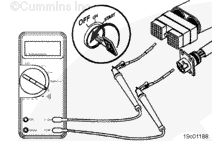
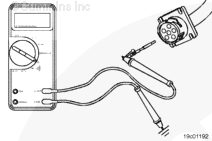
Insert a test lead into the SAE J1587 data link positive (+) pin of the OEM harness connector and connect to a multimeter probe. Insert the other test lead into the SAE J1587 data link positive (+) pin of the 6-pin connector and connect it to the other multimeter probe. Measure the resistance. The multimeter must show a closed circuit (10 ohms or less).

If the circuit is not closed, repair or replace the OEM harness. Refer to the OEM troubleshooting and repair manual.

Remove the test lead from the SAE J1587 data link positive (+) pin and insert it into the SAE J1587 data link negative (-) pin. Remove the other test lead from the SAE J1587 data link positive (+) pin and insert it into the SAE J1587 data link negative (-) pin of the 6-pin connector. Measure the resistance. The multimeter must show a closed circuit (10 ohms or less).

If the circuit is not closed, repair or replace the OEM harness. Refer to the OEM troubleshooting and repair manual.

SMALL | MEDIUM | LARGE


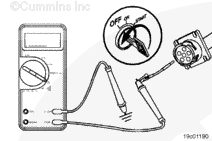
Remove the test lead from the SAE J1587 data link negative (-) pin and insert it into the battery negative (-) pin of the 6-pin Deutsch connector. Remove the test lead from the SAE J1587 data link negative (-) pin and disconnect it from the multimeter probe. Touch the multimeter probe to the engine block ground. Measure the resistance. The multimeter must show a closed circuit (10 ohms or less).

If the circuit is not closed, repair or replace the OEM harness. Refer to the OEM troubleshooting and repair manual.

SMALL | MEDIUM | LARGE


 WARNING 

Batteries can emit explosive gases. To reduce the possibility of personal injury, always ventilate the compartment before servicing the batteries. To reduce the possibility of arcing, remove the negative (-) battery cable first and attach the negative (-) battery cable last.
 CAUTION 

Use test lead, Part Number 3823993, for the 6-pin Deutsch connector.

Disconnect the batteries.

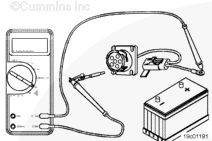
Measure the resistance from the positive (+) battery terminal to battery positive (+) of the 6-pin Deutsch connector. The multimeter must show a closed circuit (10 ohms or less).

If the circuit is not closed, repair or replace the OEM battery supply circuit. Refer to the OEM troubleshooting and repair manual for the procedures.

If the values are correct, the circuit must still be checked for a short circuit to ground and a short circuit from pin to pin.

SMALL | MEDIUM | LARGE
   

Check for Short Circuit to Ground

TOC

 WARNING 

Batteries can emit explosive gases. To reduce the possibility of personal injury, always ventilate the compartment before servicing the batteries. To reduce the possibility of arcing, remove the negative (-) battery cable first and attach the negative (-) battery cable last.
 CAUTION 

Use test lead, Part Number 3823993, for the 6-pin Deutsch connector to reduce the possibility of damage to the connector pins.

Disconnect the batteries.

Disconnect the OEM harness connector from the ECM.

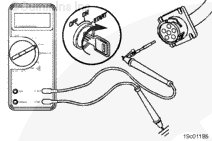
Insert a test lead into the SAE J1587 data link positive (+) pin of the 6-pin connector and connect it to a multimeter probe. Touch the other multimeter probe to the engine block ground. Measure the resistance. The multimeter must show an open circuit (100k ohms or more).

If the circuit is not open, repair or replace the OEM harness. Refer to the OEM troubleshooting and repair manual.

Remove the test lead from the SAE J1587 data link positive (+) pin and insert it into the SAE J1587 data link negative (-) pin of the 6-pin connector. Touch the other multimeter probe to the engine block ground. Measure the resistance from the SAE J1587 data link negative (-) pin of the 6-pin connector to the engine block ground. The multimeter must show an open circuit (100k ohms or more).

If the circuit is not open, repair or replace the OEM harness. Refer to the OEM troubleshooting and repair manual.

SMALL | MEDIUM | LARGE
   

Check for Short Circuit from Pin to Pin

TOC

 CAUTION 

Use test lead, Part Number 3822758, for the 50-pin Deutsch connector to reduce the possibility of damage to the connector pins.

Disconnect the OEM harness connector from the ECM.

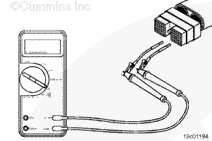
Insert a test lead into the SAE J1587 data link positive (+) pin of the OEM harness connector and connect it to the multimeter probe. Insert the other test lead into the brake pedal position switch signal pin and connect it to the other multimeter probe. Measure the resistance. The multimeter must show an open circuit (100k ohms or more).

If the circuit is not open, repair or replace the OEM harness. Refer to the OEM troubleshooting and repair manual.

Remove the lead from the brake pedal position switch signal pin and measure the resistance from the SAE J1587 data link positive (+) pin of the OEM harness connector to all other pins in the connector, one at a time. The multimeter must show an open circuit (100k ohms or more).

If the circuit is not open, repair or replace the OEM harness. Refer to the OEM troubleshooting and repair manual.

Remove the test lead from the SAE J1587 data link positive (+) pin of the OEM harness connector and insert it into the SAE J1587 data link negative (-) pin. Measure the resistance from the SAE J1587 data link negative (-) pin to all other pins in the connector. The multimeter must show an open circuit (100k ohms or more) at all pins.

If the circuit is not open, repair or replace the OEM harness. Refer to the OEM troubleshooting and repair manual.

Connect all components after repairs are completed.

SMALL | MEDIUM | LARGE
   

Voltage Check

TOC

Locate the data link connector on the OEM harness. The location will depend on the OEM installation procedures.

The data link circuit is shown.

SMALL | MEDIUM | LARGE


 CAUTION 

Use test lead, Part Number 3823993, to reduce the possibility of damage to the connector pins.

Turn the keyswitch to the ON position. Adjust the multimeter to measure VDC.

Insert a test lead into the SAE J1587 data link positive (+) pin of the 6-pin connector and connect it to a multimeter probe. Touch the other multimeter probe to engine block ground. Measure the voltage.

The multimeter must read 3.5 to 5 VDC for the voltage check from the SAE J1587 data link positive (+) pin of the data link connector to ground.

Remove the test lead from the SAE J1587 data link positive (+) pin and insert it into the SAE J1587 data link negative (-) pin of the 6-pin Deutsch connector. Touch the other multimeter probe to engine block ground. Measure the voltage.

The multimeter must read 0 to 2.5 VDC for the voltage check from the SAE J1587 data link negative (-) pin of the data link connector to ground.

Remove the test lead from the SAE J1587 data link negative (-) pin and insert it into battery positive (+) pin of the 6-pin connector. Touch the other multimeter probe to engine block ground. Measure the voltage.

The multimeter must read battery voltage for the voltage check from pin C of the data link connector to ground.

Remove the test lead from the battery positive (+) pin and insert it into the battery negative (-) pin of the 6-pin connector. Touch the other multimeter probe to engine block ground. Measure the voltage.

The multimeter must read 0 voltage for the voltage check from the battery negative (-) pin of the data link connector to ground.

SMALL | MEDIUM | LARGE
Last Modified:  13-Jul-2004