 |
|
Aftertreatment Particulate Filter Differential Pressure – Data Valid but Above Normal Operational Range – Least Severe Level
|

Overview
| CODE | REASON | EFFECT |
| Fault Code: 1981 PID: S324 SPN: 3251 FMI: 0/15 LAMP: Amber SRT: |
Aftertreatment Particulate Filter Differential Pressure – Data Valid but Above Normal Operational Range – Least Severe Level. The aftertreatment differential pressure has exceeded the maximum operating limits or the diesel particulate filter is plugged. |
EGR valve operation will be disabled. Active regeneration will be disabled. |
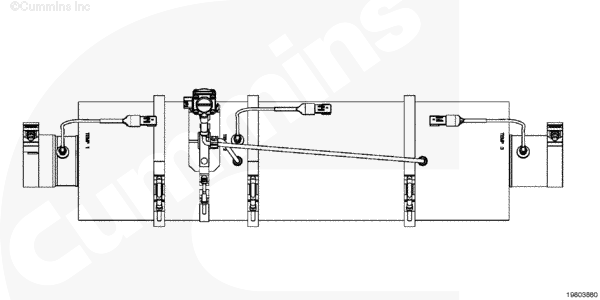 ISX and ISM – Aftertreatment Differential Pressure
|
Circuit Description
The engine aftertreatment system monitors the soot load in the aftertreatment diesel particulate filter. Under normal operating conditions the aftertreatment diesel particulate filter is self-cleaning, where soot is converted to carbon dioxide, nitrogen, and water. Under light load operating conditions, it can be necessary to perform a stationary regeneration of the aftertreatment diesel particulate filter. The soot load in the aftertreatment diesel particulate filter is estimated, using the aftertreatment differential pressure sensor and the calculated soot output of the engine.
Component Location
The aftertreatment diesel particulate filter is located in the exhaust system and is installed by the original equipment manufacturer (OEM). Refer to the OEM service manual.
Conditions for Running the Diagnostics
This diagnostic runs continuously when the engine speed is greater than 500 rpm and when the calculated exhaust flow is above a calibratible value.
Conditions for Setting the Fault Codes
The electronic control module (ECM) detects that the aftertreatment diesel particulate filter is plugged or that the differential pressure across the aftertreatment diesel particulate filter is above the maximum limits.
Action Taken When the Fault Code is Active
- The ECM will illuminate the amber CHECK ENGINE light after the diagnostic runs and fails.
- The exhaust gas recirculation (EGR) valve operation will be disabled.
- Active and stationary (parked) regeneration will be disabled.
Conditions for Clearing the Fault Code
The ECM will turn off the amber CHECK ENGINE light after the differential pressure across the aftertreatment diesel particulate filter has dropped below the maximum severity level, when the calculated exhaust flow is above a calibratible value.
Shop Talk
Verify the electronic control module (ECM) calibration is correct. Check the calibration revision history found on QuickServe™ Online for applicable changes to the calibration stored in the ECM. If necessary, calibrate the ECM. Refer to Procedure 019-032 in Section 19.
An engine torque derate for extended EGR valve closed operation exists for this fault code. The engine torque derate for extended EGR valve closed operation operates on a time based system. The time based system will count up anytime a fault code that closes the EGR valve is active. Once the timer reaches 20 hours, an engine torque derate of approximately 15 percent will be applied.
The engine torque derate will be removed as soon as the fault code goes inactive, and the timer will begin to count down. If the fault code reoccurs within the next 20 hours of engine operation, the engine torque derate will immediately be applied, and the timer will then reset to 20 hours. The engine must operate for 20 hours with no active faults that close the EGR valve for the timer to clear. After the timer has cleared, the engine must then operate for another 20 hours with an active fault code that closes the EGR valve to apply the derate.
This fault code indicates that the soot load inside the aftertreatment diesel particulate filter has reached the maximum level. Regeneration of the aftertreatment diesel particulate filter at this stage is not possible. The aftertreatment diesel particulate filter must be inspected. If it meets the inspection criteria, it can be cleaned using an SPX air pulse cleaning machine (or equivalent machine). If it does not meet the inspection criteria, it must be replaced.
Possible causes of this fault code include:
- The aftertreatment diesel particulate filter can be plugged with soot.
- The engine has been operating in light load conditions that prevent exhaust temperatures from being high enough to actively regenerate the aftertreatment particulate filter.
- The aftertreatment wiring harness connectors could be connected to the wrong aftertreatment exhaust gas temperature sensor.
- The aftertreatment wiring harness or aftertreatment exhaust gas temperature sensor connector pin installation could be incorrect.
- The aftertreatment diesel particulate filter differential pressure sensor has malfunctioned.
- An engine malfunction that is elevating the engine smoke output.
- The aftertreatment diesel particulate filter can accumulate an excessive amount of ash in a short time period. This can be due to excessive oil consumption or due to non-combustible elements such as, but not limited to, iron, potassium, or calcium contained in fuel additives.
Refer to Troubleshooting Fault Code t05-1981

;)
;)