 |
|
Exhaust Gas Recirculation (EGR) System – Condition Exists
|

Overview
| CODE | REASON | EFFECT |
| Fault Code: 2774 PID: S391 SPN: 3058 FMI: 11/31 LAMP: Amber SRT: |
Exhaust Gas Recirculation (EGR) System – Condition Exists. Plugged EGR differential pressure sensor tubes have been detected. |
EGR valve operation will be disabled. |
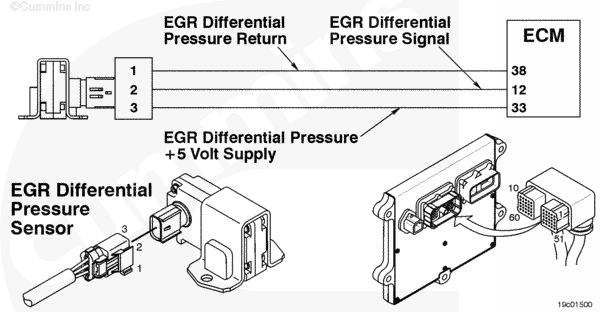 ISX – Differential Pressure Sensor Circuit
|
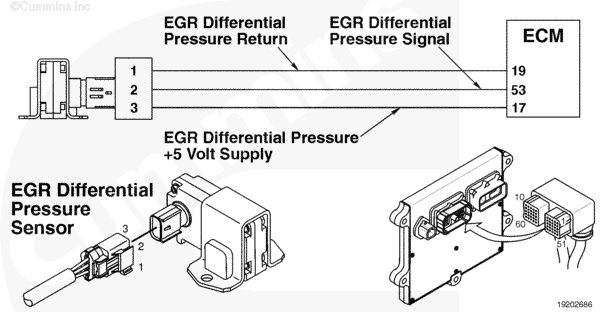 ISM – Differential Pressure Sensor Circuit
|
Circuit Description
The EGR differential pressure sensor has two ports that sense exhaust pressure. The sensor outputs a voltage which represents the pressure difference between the two ports. The electronic control module (ECM) uses this pressure to determine how much exhaust gas is flowing through the EGR connection tube to the intake manifold. This information is used to control the EGR valve for correct emission levels.
The ECM provides a 5 volt supply to the EGR differential pressure sensor on the sensor supply circuit. The ECM also provides a ground on the sensor return circuit. The EGR differential pressure sensor provides a signal to the ECM on the EGR differential pressure sensor signal circuit. This sensor signal voltage changes, based on the differential pressure in the EGR crossover tube.
The EGR differential pressure sensor measures the exhaust gas pressure drop across the EGR differential pressure orifice. This pressure drop is used to calculate the amount of EGR flow into the intake manifold.
This diagnostic checks the EGR differential pressure tubes for plugging.
Component Location
The EGR differential pressure sensor is located near the fuel inlet to the integrated fuel system module. A high EGR differential pressure tube and a low EGR differential pressure tube extend from the EGR differential pressure orifice and connect to the EGR differential pressure sensor. The high EGR differential pressure tube connects to the EGR connection tube rearward of the EGR differential pressure orifice and connects to the front port of the EGR differential pressure sensor. The low EGR differential pressure tube connects to the EGR connection tube frontward of the EGR differential pressure orifice and connects to the rear port of the EGR differential pressure sensor. Refer to Procedure 100-002 (Engine Diagrams) in Section E for a detailed component location view.
Conditions for Running the Diagnostics
This diagnostic runs continuously when the engine is running.
Conditions for Setting the Fault Codes
This diagnostic monitors intake manifold pressure and EGR differential pressure to determine if the EGR differential pressure tubes are plugged.
Action Taken When the Fault Code is Active
- The ECM illuminates the amber CHECK ENGINE light immediately when the diagnostic runs and fails.
- EGR valve operation will be disabled.
Conditions for Clearing the Fault Code
The ECM will turn off the amber CHECK ENGINE light immediately after a keyswitch cycle.
Shop Talk
Verify the electronic control module (ECM) calibration is correct. Check the calibration revision history found on QuickServe® Online for applicable fixes to the calibration stored in the ECM. If necessary, recalibrate the ECM. Refer to Procedure 019-032 (ECM Calibration Code) in Section 19 in the corresponding Troubleshooting and Repair Manual for the engine being serviced.
Possible causes of this fault code include:
- A plugged or leaking low or high EGR differential pressure tube
- Carbon buildup inside the EGR venturi tube blocking the opening to the EGR differential pressure tubes.
Refer to Troubleshooting Fault Code t05-2774

;)
;)
;)
;)