 |
|
Injector Metering Rail 1 Pressure – Data Valid but Below Normal Operational Range – Moderately Severe Level
|

Overview
| CODE | REASON | EFFECT |
| Fault Code: 559 PID: P157 SPN: 157 FMI: 18 LAMP: Yellow SRT: |
Injector Metering Rail 1 Pressure – Data Valid but Below Normal Operational Range – Moderately Severe Level. The ECM has detected that fuel pressure is lower than commanded pressure. |
Possibly hard to start or low power. Engine could possibly not start. |
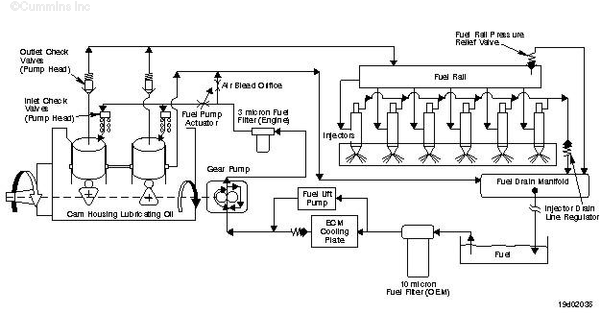 Fuel Flow
|
Circuit Description
The pressure control loop relies on fuel pressure supplied to the high-pressure pump by the fuel gear pump. The electronic control module (ECM) monitors rail fuel pressure and engine operating conditions and changes the flow command to maintain the proper rail fuel pressure. Changes to the flow command result in opening (or closing) of the fuel pump actuator to supply more (or less) fuel to the high-pressure pump.
Component Location
Use the following procedure for a detailed component location view. Refer to Procedure 100-002 in Section E.
Conditions for Running the Diagnostics
This diagnostic runs continuously when the engine is running.
Conditions for Setting the Fault Codes
The ECM has detected the measured fuel rail pressure is below the commanded fuel rail pressure by at least 250 bar [3625 psi] for 7 seconds.
Action Taken When the Fault Code is Active
The ECM illuminates the amber CHECK ENGINE light immediately when the diagnostic runs and fails.
Conditions for Clearing the Fault Code
The ECM will turn off the amber CHECK ENGINE light immediately after the diagnostic runs and passes.
Shop Talk
The fuel system is designed to run on clean fuel. It has two fuel filters to maintain this cleanliness. Carelessness in handling and storage of fuel system components during the repair can subject the precision components to damaging debris. Before servicing any fuel system components (such as fuel lines, fuel pump, injectors, etc.), clean the fittings, mounting hardware, and the area around the component to be removed. Store the components in a clean environment. Keep all fuel port openings and line ends covered so that no dirt can enter. Use the following procedure in the ISC and ISL CM2150 Service Manual, Bulletin 4021569, or the ISLe CM2150 Service Manual, Bulletin 4021630. Refer to Procedure 000-009 in Section 0.
Fault Code 559 sets when the engine is running and measured rail fuel pressure remains at least 250 bar [3625 psi] less than commanded pressure. Once detected, Fault Code 559 will remain active until the engine is turned OFF or until the measured rail fuel pressure matches the commanded rail fuel pressure. When a condition exists that causes Fault Code 559 to become active, it is typical for the fault code to become active when the engine is heavily loaded and become inactive when the engine is lightly loaded.
If Fault Code 559 is inactive and there are not any existing performance complaints, it is possible the vehicle was run out of fuel or the fault became active if the engine was not primed following fuel filter replacement. However, if the customer reports that the fault code becomes active during engine operation, the steps in this fault code diagnostic tree can be used to identify the cause and make a repair.
If the engine will not start and Fault Code 559 becomes active during cranking, and no speed sensor fault codes exist, it is most likely that the engine is not developing rail pressure during cranking. Possibly, the engine is not primed, gear pump pressure is too low, or the high-pressure fuel system components have excessive leakage to drain. The procedures referred to in this troubleshooting tree also have checks for engine no start conditions.
The steps of this fault code tree assume that the fault condition is repeatable (this does not necessarily mean that the fault code is active with the engine at idle). The troubleshooting has been designed to isolate the problem into four categories:
1. Other more precise fault codes exist (example: electrical circuits faults).
2. Isolate the high-pressure system; determine if the high-pressure system has high leakage.
3. Isolate the low pressure system; determine if the low pressure system works correctly. The system must first be primed. Then, it is important to note that checks of gear pump pressure and inlet restriction involves using a special service tool that causes the flow rate to increase to a rated flow. Fuel gear pump pressure and/or inlet restriction can not be accurately measured without a method of increasing the flow (i.e. using the special service tool or operating the engine at full power).
4. Symptom based troubleshooting; If the initial checks of the high-pressure system (leakage) and low pressure system (prime and gear pump pressure) do not reveal a problem, this troubleshooting will recommend further checks that are most appropriate, based on the reported symptoms. The repair recommendation at this point requires that the condition under which the fault code activates be known (for example: under full power, during motoring/deceleration, or if the complaint is an engine surge at idle).
Verify the electronic control module (ECM) calibration is correct. Check the calibration revision history found on QuickServe™ Online for applicable fixes to the c
Refer to Troubleshooting Fault Code t05-559

;)
;)