To reduce the possibility of personal injury, avoid direct contact of hot oil with your skin.
WARNING
Some state and federal agencies have determined that used engine oil can be carcinogenic and cause reproductive toxicity. Avoid inhalation of vapors, ingestion and prolonged contact with used engine oil. If not reused, dispose of in accordance with local environmental regulations.
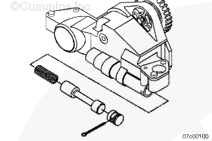
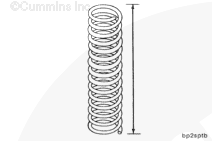
The high pressure relief valve is under compression. Apply pressure to the cover while removing the capscrews. Slowly release the pressure to reduce the possibility of personal injury.
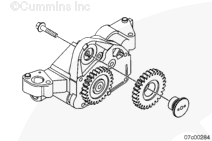
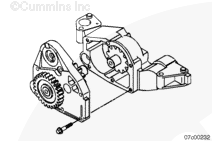
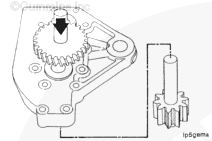
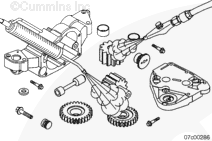
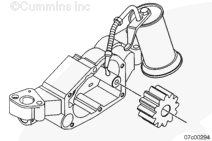
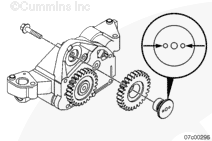
Remove the six assembly capscrews and the lube pump cover.
When using solvents, acids, or alkaline materials for cleaning, follow the manufacturer’s recommendations for use. Wear goggles and protective clothing to reduce the possibility of personal injury.
WARNING
Some solvents are flammable and toxic. Read the manufacturer’s instructions before using.
CAUTION
Do not allow dirt or gasket material to enter the oil passages. Bearing damage can result.
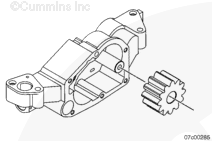
Clean the lubricating oil pump components with solvent.
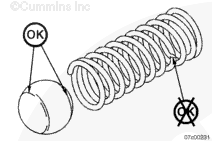
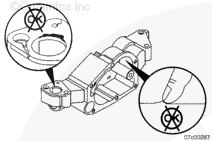
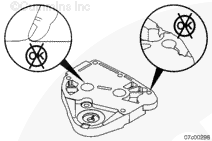
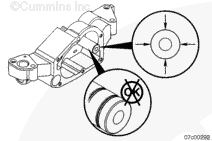
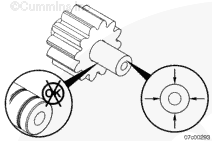
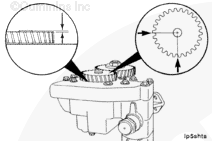
Inspect the pressure regulator spool for scuffing.
Minor spool scuff is acceptable. If the scuff can be felt by a fingernail, the spool will need to be replaced.
Insert the spool in the bore and check for smooth movement in and out of the bore. If any hesitation is felt, the spool must be replaced and the bore inspected for burrs.
Remove any burrs found in the bore before installing a new spool.
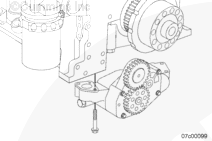
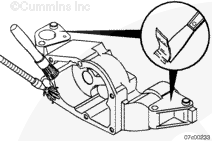
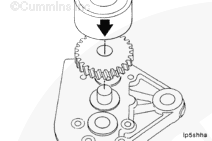
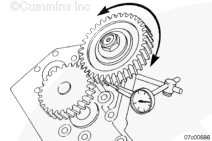
Measure the gear backlash by mounting a dial indicator. Position the dial indicator contact point onto the lubricating oil pump external idler gear teeth.
With the external drive gear locked into place and the dial indicator contact in place, rotate the external idler gear clockwise and counterclockwise to measure the backlash.
Use the backlash measurement to classify and mark the pump per the following table.
Improper gear lash can cause damage to the gear train and the lubricating oil pump.
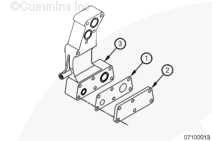
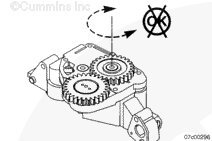
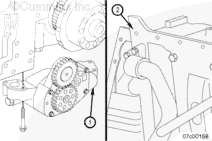
Shims will be available in six different thicknesses in order to provide correct lash. The various thicknesses are identified by the color of the shim. Identify the number stamped on the pump (1) and the letter on the block (2). Use the following table to determine which shim should be used according to the stamped number and letter.
If a lube pump or cylinder block is replaced, the block and pump will not be stamped. In that instance, a shim must be chosen and installed. The oil pump idler gear backlash must be checked. If the backlash is not within the specification, choose another size shim and recheck the backlash. Do this until the backlash is within specification.
Block
Pump
A
B
C
D
1
0.000 mm [0.000 in]-None-
0.45 mm [0.018 in]-Black-
0.55 mm [0.022 in]-Purple-
0.35 mm [0.014 in]-Yellow-
2
0.45 mm [0.018 in]-Black-
0.65 mm [0.026 in]-Red-
0.75 mm [0.030 in]-Blue-
0.55 mm [0.022 in]-Purple-
3
0.55 mm [0.022 in]-Purple-
0.75 mm [0.030 in]-Blue-
0.85 mm [0.033 in]-Green-
0.65 mm [0.026 in]-Red-
4
0.35 mm [0.014 in]-Yellow-
0.55 mm [0.022 in]-Purple-
0.65 mm [0.026 in]-Red-
0.45 mm [0.018 in]-Black-
If the lubricating oil pump is not within specifications, the shims must be changed to proper thickness to give proper backlash.
Hello, I'm Jack, a diesel engine fan and a blogger. I write about how to fix and improve diesel engines, from cars to trucks to generators. I also review the newest models and innovations in the diesel market. If you are interested in learning more about diesel engines, check out my blog and leave your feedback.
View all posts by Jack
 WARNING

 CAUTION









;)
;)
;)
;)
;)
;)
;)
;)
;)
;)
;)
;)
;)
;)
;)
;)
;)
;)
;)
;)
;)
;)
;)
;)
;)
;)
;)
;)
;)
;)
;)
;)
;)
;)
;)
;)
;)
;)
;)
;)
;)
;)
;)
;)
;)
;)
;)
;)
;)
;)
;)
;)
;)
;)
;)
;)
;)
;)
;)
;)
;)
;)
;)
;)
;)
;)
;)
;)