Signature, ISX, and QSX engines use two engine coolant thermostats.
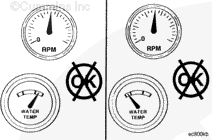
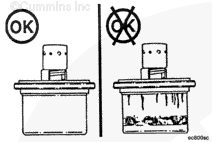
The engine thermostat and thermostat seal must operate properly in order for the engine to operate in the most efficient heat range. Overheating or overcooling will shorten engine life.
Refer to Procedure 008-016 to inspect the thermostat seal.
Do not remove the pressure cap from a hot engine. Wait until the coolant temperature is below 50°C [120°F] before removing the pressure cap. Heated coolant spray or steam can cause personal injury.
WARNING
Coolant is toxic. Keep away from children and pets. If not reused, dispose of in accordance with local environmental regulations.
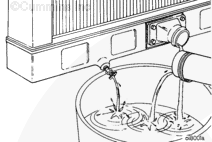
Drain the coolant to a level below the vent line in the thermostat housing.
Disconnect and plug the vent line hose. Refer to Procedure 008-017.
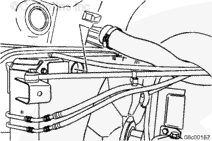
Remove the radiator hose from the radiator top tank.
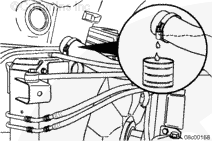
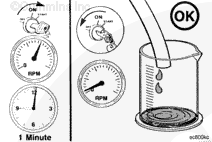
The radiator hose must be at the point of overflowing before the engine is run. Small amounts of leakage will not be detected if the hose is not pre-filled.
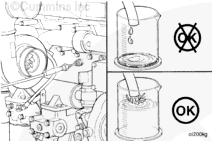
Fill the radiator hose with coolant until coolant is just about ready to flow out of the hose.
NOTE: An electronic service tool can also be used to monitor the thermostat opening temperature without removing the radiator hose.
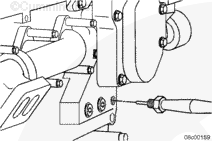
Remove the coolant temperature sensor and install a thermocouple or temperature gauge, which is known to be accurate, on the engine side of the thermostat housing.
Do not remove the pressure cap from a hot engine. Wait until the coolant temperature is below 50°C [120°F] before removing the pressure cap. Heated coolant spray or steam can cause personal injury.
WARNING
Coolant is toxic. If not reused, dispose of in accordance with local environmental regulations.
Drain the cooling system. Refer to Procedure 008-018.
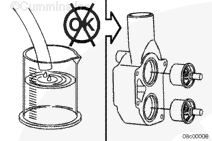
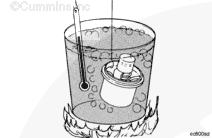
Suspend the thermostat and a 100°C [212°F] thermometer into a container of water. Do not allow the thermostat or the thermometer to touch the sides of the container.
Heat the water.
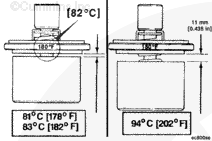
Record the temperatures at which the thermostat begins to open and when it is fully open.
Hello, I'm Jack, a diesel engine fan and a blogger. I write about how to fix and improve diesel engines, from cars to trucks to generators. I also review the newest models and innovations in the diesel market. If you are interested in learning more about diesel engines, check out my blog and leave your feedback.
View all posts by Jack

 WARNING







;)
;)
;)
;)
;)
;)
;)
;)
;)
;)
;)
;)
;)
;)
;)
;)
;)
;)
;)
;)
;)
;)
;)
;)
;)
;)
;)
;)
;)
;)
;)
;)
;)
;)