|
Gas Mass Flow Sensor Circuit – Shorted Low.
|

Overview
| CODE | REASON | EFFECT |
| Fault Code: 454 PID: P183 SPN: 183 FMI: 4 LAMP: Amber SRT: |
Gas Mass Flow Sensor Circuit – Shorted Low. Open circuit or short to ground detected on the sensor signal pin at the ECM. |
Possible reduced performance. |
|
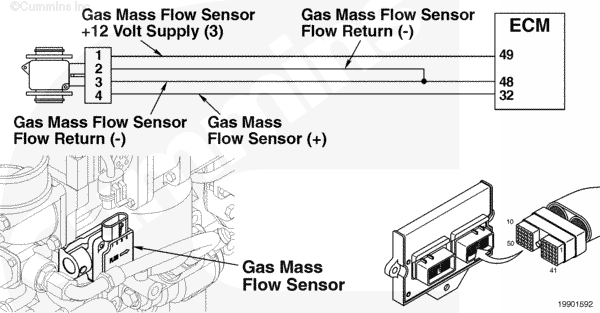
Gas Mass Flow Sensor Circuit |
 |
Circuit Description
The electronic control module (ECM) uses the gas mass flow sensor to measure fuel entering the engine and to adjust the fuel control valve based on this measurement.
Component Location
The gas mass flow sensor is located on the fuel housing.
Shop Talk
Make sure the screen located in the fuel housing is free from debris and oil.
When connecting and disconnecting electronic components, be sure the keyswitch is
OFF unless otherwise specified in the procedure.
The voltage supply for the C Gas Plus engine must be maintained at or above +13.5-VDC for proper sensor operation. On the B Gas Plus and B LPG engines the voltage must be maintained above +12.0-VDC for proper sensor operation. This can be monitored in the INSITE™ electronic service tool use the 14 Volt Sensor Supply parameter (3).
Cautions and Warnings
 CAUTION CAUTION To reduce the possibility of damaging a new ECM, all other active fault codes must be investigated prior to replacing the ECM. |
|
CAUTION To reduce the possibility of pin and harness damage, use the following test lead when taking a measurement: |
Troubleshooting Steps
| STEPS | SPECIFICATIONS | |
|---|---|---|
| STEP 1. | Read the fault codes and verify engine options. | |
| STEP 1A. Read the fault codes. | Fault Code 454 active? | |
| STEP 1B. Check for sensor supply voltage converter. | Voltage converter present? | |
| STEP 2. | Check the sensor. | |
| STEP 2A. Check system voltage. | Voltage between +13.5 and +15.0-VDC? | |
| STEP 2B. Check sensor supply voltage. | Voltage between +13.5 and +15.0-VDC? | |
| STEP 2C. Check the circuit response. | Fault code 454 inactive and fault code 453 active? | |
| STEP 2D. Read the fault codes and verify sensor condition. | Fault code 454 active? | |
| STEP 3. | Check the harnesses. | |
| STEP 3A. Inspect the engine harness and gas mass flow sensor connector pins. | Dirty or damaged pins? | |
| STEP 3B. Inspect the engine harness, OEM harness and ECM connector pins. | Dirty or damaged pins? | |
| STEP 3C. Check for an open circuit in the engine harness. | Less than 10 Ohms? | |
| STEP 3D. Check for a pin-to-pin short in the engine harness. | Greater than 100k Ohms? | |
| STEP 3E. Check for a pin short circuit to ground. | Greater than 100k Ohms? | |
| STEP 3F. Check for an inactive fault code. | Fault code 454 inactive? | |
| STEP 4. | Clear the fault codes. | |
| STEP 4A. Disable the fault code. | Fault Code 454 inactive? | |
| STEP 4B. Clear the inactive fault codes. | All fault codes cleared? | |
Guided Step 1 – Read the fault codes and verify engine options.
| Guided Step 1A – Read the fault codes. | |
|---|---|
Conditions
ActionRead the fault codes.
|
|
|
Fault Code 454 active? |
|
| YES | NO |
| No Repair | No Repair |
| Guided Step 1B – Check for sensor supply voltage converter | |
|---|---|
Conditions
ActionCheck for the presence of a sensor supply voltage converter.
|
|
|
Voltage converter present? |
|
| YES | NO |
| No Repair | No Repair |
|
Refer to appropriate fault code for application.
|
|
Guided Step 2 – Check the sensor.
| Guided Step 2A – Check system voltage. | |
|---|---|
Conditions
ActionCheck system voltage.
Voltage range is +13.5 to +15.0-VDC. |
|
|
Voltage to specifications? |
|
| YES | NO |
| No Repair |
Troubleshoot the vehicle’s charging system.
|
| Guided Step 2B – Check sensor supply voltage. | |
|---|---|
Conditions
ActionCheck the sensor supply voltage.
Voltage should be between +13.5 and +15.0 VDC. |
|
|
Voltage to specifications? |
|
| YES | NO |
| No Repair | No Repair |
| Guided Step 2C – Check the circuit response. | |
|---|---|
Conditions
ActionCheck for the appropriate circuit response after 30 seconds.
|
|
|
Fault Code 453 active and Fault Code 454 inactive? |
|
| YES | NO |
| No Repair | No Repair |
| Guided Step 2D – Read the fault codes and verify sensor condition. | |
|---|---|
Conditions
ActionRead the fault codes.
|
|
|
Fault Code 454 active? |
|
| YES | NO |
|
Replace the gas mass flow sensor. |
No Repair |
Guided Step 3 – Check the engine harness.
| Guided Step 3A – Inspect the engine harness and gas mass flow sensor connector pins. | |
|---|---|
Conditions
ActionInspect the engine harness and gas mass flow sensor connector pins for the following:
Refer to the circuit diagram or wiring diagram for component pin identification. |
|
|
Dirty or damaged pins? |
|
| YES | NO |
|
Repair the damaged pins. Repair or replace the engine harness, OEM harness, or replace the ECM , whichever has the damaged pins.
|
No Repair |
| Guided Step 3B – Inspect the engine harness OEM harness and ECM connector pins. | |
|---|---|
Conditions
ActionInspect the engine harness, OEM harness and ECM connector pins for the following:
Refer to the circuit diagram or wiring diagram for component pin identification. |
|
|
Dirty or damaged pins? |
|
| YES | NO |
|
Repair the damaged pins. Repair or replace the engine harness, OEM harness, or replace the ECM, whichever has the damaged pins.
|
No Repair |
| Guided Step 3C – Check for an open circuit in the engine harness. | |
|---|---|
Conditions
ActionCheck for an open circuit.
Refer to the circuit diagram or wiring diagram for component pin identification. |
|
|
Less than 10 ohms? |
|
| YES | NO |
| No Repair |
Repair or replace the engine harness.
|
| Guided Step 3D – Check for a pin-to-pin short circuit in the engine harness. | |
|---|---|
Conditions
ActionCheck for a pin-to-pin short circuit.
Refer to the circuit diagram or wiring diagram for component pin identification. |
|
|
Greater than 100k ohms? |
|
| YES | NO |
| No Repair |
Repair or replace the engine harness connector or pins.
|
| Guided Step 3E – Check for a pin short circuit to ground. | |
|---|---|
Conditions
ActionCheck for a pin short circuit to ground.
Refer to the circuit diagram or wiring diagram for component pin identification. |
|
|
Greater than 100k Ohms? |
|
| YES | NO |
| No Repair |
Repair or replace the engine harness connector or pins.
|
| Guided Step 3F – Check for an inactive fault code. | |
|---|---|
Conditions
ActionCheck for appropriate circuit response after 30 seconds.
|
|
|
Fault code 454 inactive? |
|
| YES | NO |
| No Repair |
|
Guided Step 4 – Clear the fault codes.
| Guided Step 4A – Disable the fault code. | |
|---|---|
Conditions
ActionDisable the fault code.
|
|
|
Fault Code 454 inactive? |
|
| YES | NO |
| No Repair | No Repair |
| Guided Step 4B – Clear the inactive fault codes. | |
|---|---|
Conditions
ActionClear the inactive fault codes.
|
|
|
All fault codes cleared? |
|
| YES | NO |
| No Repair |
Troubleshoot any remaining active fault codes. |
|
Repair complete
|
Appropriate troubleshooting charts.
|

;)
;)