B5.9G, B5.9LPG, B Gas Plus, B LPG Plus, B Gas International, ISB5.9 G, and L10G
WARNING
The ignition system produces high voltage. To reduce the possibility of personal injury from electrical shock, do not touch any ignition wires or components while the engine is operating. Always use suitably insulated tools.
WARNING
The engine must not be running and the ignition or key switch must be in the OFF position when installing or removing the ignition generator. To reduce the possibility of personal injury or equipment damage, do not touch the pins on the ignition generator when the engine is operating. Always use suitably insulated tools.
CAUTION
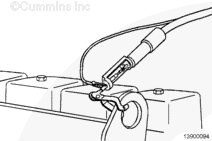
The alligator clip must be grounded for the tool to function. If the tool is not grounded, arcing can result from the high voltage being applied to the alligator clip.
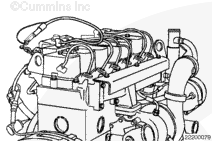
Crank the engine or start the engine and let it idle.
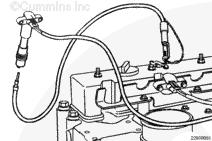
Observe the spark gap inside the observation window. If a steady spark is observed, the ignition coil is acceptable; if no spark is observed, replace the ignition coil and test again.
Stop the engine.
Remove the ignition coil tester from the ignition coil and disconnect the alligator clip.
Connect the spark plug wire onto the ignition coil.
The ignition system produces high voltage. To reduce the possibility of personal injury from electrical shock, do not touch any ignition wires or components while the engine is operating. Always use suitably insulated tools.
WARNING
The engine must not be running and the ignition or key switch must be in the OFF position when installing or removing the ignition generator. To reduce the possibility of personal injury or equipment damage, do not touch the pins on the ignition generator when the engine is operating. Always use suitably insulated tools.
CAUTION
The alligator clip must be grounded for the tool to function. If the tool is not grounded, arcing can result from the high voltage being applied to the alligator clip.
Crank the engine or start the engine and let it idle.
Observe the spark gap inside the observation window. If a steady spark is observed, the ignition coil is acceptable; if no spark is observed, replace the ignition coil and test again.
Stop the engine.
Remove the ignition coil tester from the ignition coil and disconnect the alligator clip.
B5.9G, B5.9LPG, B Gas Plus, B LPG Plus, B Gas International, ISB5.9 G, and L10G
WARNING
The ignition system produces high voltage. To reduce the possibility of personal injury from electrical shock, do not touch any ignition wires or components while the engine is operating. Always use suitably insulated tools.
The ignition system produces high voltage. To reduce the possibility of personal injury from electrical shock, do not touch any ignition wires or components while the engine is operating. Always use suitably insulated tools.
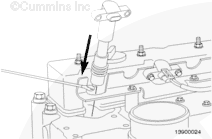
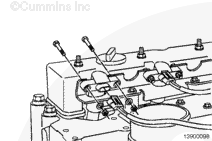
Disconnect the ignition wiring harness from the ignition coil.
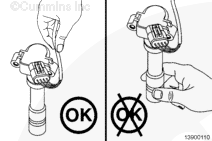
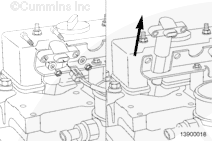
Remove the ignition coil from the bracket. Remove the ignition coil by pulling directly upward.
Do not force the ignition coil back and forth during removal. This can cause damage to the spark plug,, spark plug boot, or ignition coil.
B5.9G, B5.9LPG, B Gas Plus, B LPG Plus, B Gas International, ISB5.9 G, and L10G
NOTE: This step does not apply to the ISB5.9 G engine.
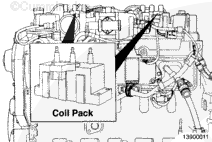
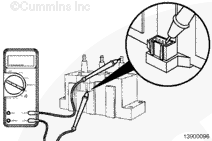
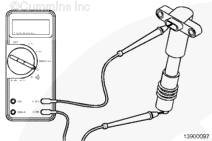
Measure the secondary winding resistance to check for open circuits. Connect the digital multimeter leads between pin 4 of the 4-pin coil connector and each of the three high-voltage towers of the ignition coil pack. The resistance measured must be less than 10k ohms.
If the resistance is not less than 10k ohms, then the ignition coil has an open secondary winding or coil, and must be replaced.
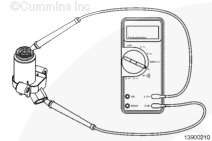
Measure the secondary winding resistance to check for open circuits. Connect the digital multimeter leads between the 4-pin coil connector and the spark plug connection.
The resistance measured must be less than 20k ohms.
Do not clean boots on an ISL G application. These boots are pre-greased.
CAUTION
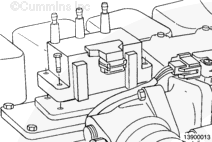
The ignition coils must be installed individually to the coil brackets already mounted on the engine. Failure to do so can damage the ignition coil, spark plug boot, or spark plug.
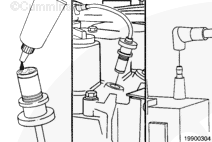
A new boot must be installed when new spark plugs are installed, or when the boot has been damaged during removal.
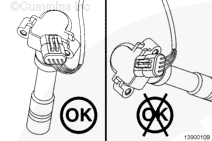
Carefully align the opening in the spark plug boot with the top of the spark plug.
Press the coil down onto the spark plug until the coil mounting holes align with the mounting slots in the coil bracket.
Connect the ignition wiring harness to the ignition coil.
If there is difficulty installing the ignition coil onto the spark plug, the following suggestions may be helpful:
Verify that the angle the coil is being installed is approximately 30 degrees from vertical and similar to the angle of the coil bracket or the angle of the other coils that are already installed.
Position the spark plug boot on the ignition coil against the cylinder head in the spark plug well prior to pushing down on the ignition coil.
Hello, I'm Jack, a diesel engine fan and a blogger. I write about how to fix and improve diesel engines, from cars to trucks to generators. I also review the newest models and innovations in the diesel market. If you are interested in learning more about diesel engines, check out my blog and leave your feedback.
View all posts by Jack
 WARNING
  CAUTION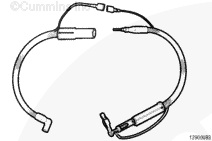







;)
;)
;)
;)
;)
;)
;)
;)
;)
;)
;)
;)
;)
;)
;)
;)
;)
;)
;)
;)
;)
;)
;)
;)
;)
;)
;)
;)
;)
;)
;)
;)
;)
;)
;)
;)