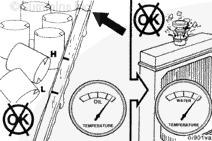
When you troubleshoot overheating, remember that too much oil in the oil pan can cause additional heat from friction when the rod journals are submerged in oil.
Overfilling with oil raises the oil temperature that is transferred to the coolant system at the oil cooler.
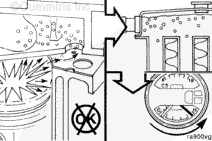
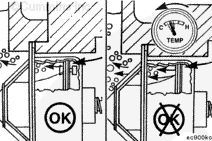
The engine coolant passages must be completely filled with coolant.
During operation, entrapped air mixes with the coolant, which results in cavitation corrosion and poor heat transfer. Highly aerated coolant can cause localized overheating of the cylinder head and block, which can result in a cracked head, scored cylinder, or blown head gasket.
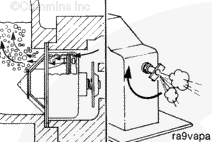
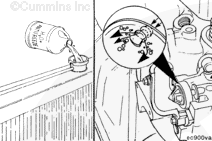
During filling, air must be vented from the engine coolant passages. The air vents through the “jiggle pin” openings to the top radiator hose and out the fill opening.
NOTE: Adequate venting is provided for a fill rate of 14 liters per minute
[3.7 gal per minute].
NOTE: Excess air in the cooling system can lead to overheating and low coolant levels.
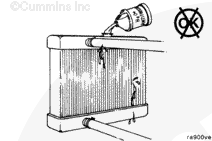
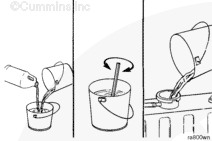
NOTE: A half-and-half mixture of antifreeze and water must be premixed before filling the system. The ability of antifreeze to remove heat from the engine is not as good as water, so pouring antifreeze into the engine first could contribute to an overheated condition before the liquids completely intermix.
A mixture of 50-percent water and ethylene-glycol-base antifreeze is required for operation of the engine in temperature environments above -37°C
[-35°F]. A mixture of 40-percent water and 60-percent antifreeze is recommended for temperatures below -37°C [-35°F]. Never use more than 60-percent antifreeze.
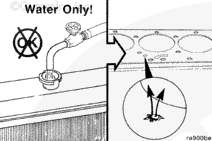
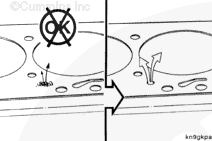
Never use water alone for coolant. Damage from corrosion can be the result of using water alone for coolant. The small holes in the head gasket are especially susceptible to plugging. These holes are orifices and their size is critical. Do not enlarge the size of the orifices. To do so will disturb the coolant flow and will not solve an overheating problem.
Water will cause rust formation, reducing the flow in the smaller coolant passages.
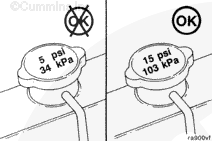
Air in the coolant can result in loss of coolant from the overflow when the aerated coolant is hot. The heated air expands, increasing the pressure in the system, causing the cap to open.
Similarly, coolant can be displaced through the overflow if the head gasket leaks compression gases to the coolant system.
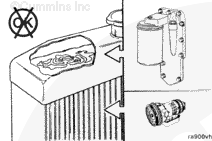
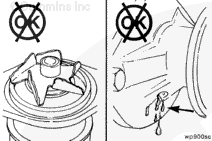
The operating pressure of the coolant system and the lubricating system can result in the mixing of the fluids if there is a leak between the systems:
Head gasket, oil cooler, etc. (Refer to the Lubricating Oil System – Section
7.)
NOTE: Transmission fluid can also leak into the coolant through radiator bottom tank transmission oil coolers. Refer to the OEM service manual.
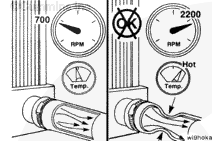
The water pump pulls coolant from the bottom of the radiator and pumps it through the engine and back to the top of the radiator for cooling. Reduced or interrupted flow will result in the engine running hot.
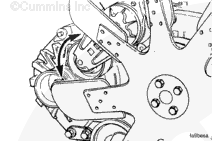
The pump is belt-driven from the crankshaft pulley. An automatic belt tensioner is used to prevent the belt from slipping on the pump pulley. A malfunction of the tensioner will cause the water pump impeller to rotate at a slower speed, reducing the amount of coolant flow.
The coolant flow can also be reduced if the inlet hose to the water pump collapses. A hose will usually not collapse while the engine is running at low speed. Check the hose while the engine is running at rated speed.
NOTE: Be sure the engine is warm, a minimum of 95°C [203°F], so the thermostat is open.
A worn or malfunctioning water pump will not produce the flow required to prevent the engine from running hot. However, be sure to check the other possibilities indicated in the Troubleshooting Logic before checking the flow or replacing the pump. Refer to Procedure 008-062.
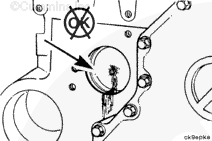
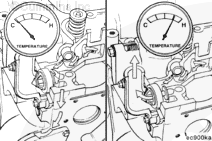
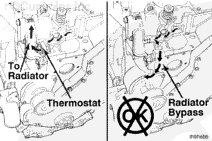
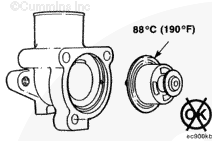
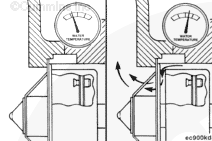
The thermostat controls the coolant temperature. When the coolant temperature is below the operating range, coolant is bypassed back to the inlet of the water pump. When the coolant temperature reaches the operating range, the thermostat opens, sealing off the bypass, forcing coolant to flow to the radiator.
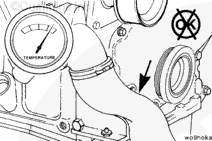
Never operate the engine without a thermostat. Without a thermostat the path of least resistance for the coolant is through the bypass to the pump inlet. This will cause the engine to overheat.
With the jiggle pins sealing the openings, the flow to the radiator is controlled by the thermostat opening in response to the engine coolant temperature.
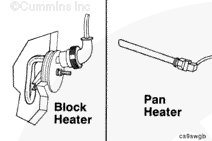
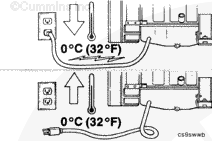
Some heaters will operate continuously when plugged into the correct voltage electrical socket. Operate them only when the ambient temperature is below 0°C [32°F].
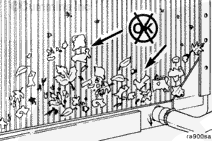
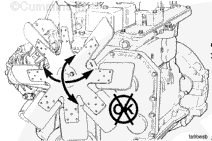
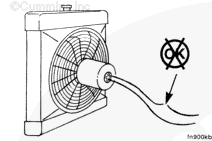
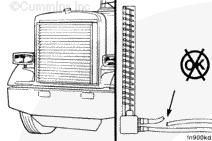
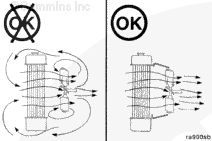
Air forced through the fins of the radiator by a fan cools the coolant pumped through the radiator. Environmental debris (paper, straw, lint, dust, etc.) can obstruct the fins and stop the flow of air, which will reduce the cooling effect of the radiator.
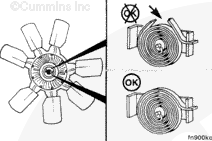
If the fan is belt-driven, a slipping belt will result in slower fan speed and reduced cooling. A malfunctioning automatic belt tensioner can be the problem.
NOTE: Check the bearings in the fan hub and other pulleys to make sure they are not causing excessive belt vibration and slippage. A cracking belt can also cause slippage and is a potential breaking point. Check for belt condition.
Some applications use thermatic fans. These fans operate only as needed to keep the coolant at the correct temperature. If the fan does not operate when the coolant temperature increases, the engine will run hot. If the fan does not shut off when coolant temperature decreases, the engine will run cold.
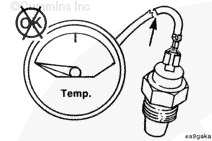
NOTE: Make sure the coolant temperature sensor is functioning correctly.
Shutters are designed to control airflow across the radiator. If the shutters fail to open when needed, the engine can run hot. Failure of the shutters to close can result in too much airflow and the engine running cold.
NOTE: Make sure that the air temperature sensor is functioning correctly. Check the air-operated shutter controls. Check for air leaks.
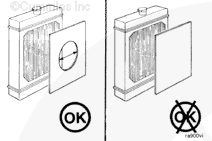
Winterfronts can be used on a charge air cooled engine, but must be designed to cover the frontal area of the cooling system partially. A minimum of 775 cm² [120 in²] of charge air cooled frontal area must be left open to airflow.
Hello, I'm Jack, a diesel engine fan and a blogger. I write about how to fix and improve diesel engines, from cars to trucks to generators. I also review the newest models and innovations in the diesel market. If you are interested in learning more about diesel engines, check out my blog and leave your feedback.
View all posts by Jack

 CAUTION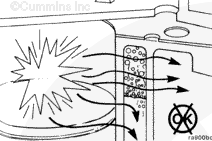


;)
;)
;)
;)
;)
;)
;)
;)
;)
;)
;)
;)
;)
;)
;)
;)
;)
;)
;)
;)
;)
;)
;)
;)
;)
;)
;)
;)
;)
;)
;)
;)
;)
;)
;)
;)
;)
;)
;)
;)
;)
;)
;)
;)
;)
;)
;)
;)
;)
;)
;)
;)
;)
;)
;)
;)
;)
;)
;)
;)
;)
;)
;)
;)
;)
;)