|
Spark Voltage on Multiple Cylinders – Data Valid but Above Normal Operational Range
|

Overview
| CODE | REASON | EFFECT |
| Fault Code: 1651 PID: None SPN: None FMI: 0/15 LAMP: None SRT: |
Spark Voltage on Multiple Cylinders – Data Valid but Above Normal Operational Range |
None – information for misfire. |
|
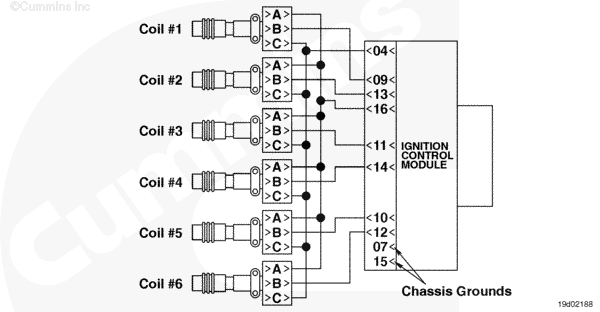
Ignition Timing Signal Circuit |
 |
Circuit Description
The ICM is a distributorless ignition module that provides a signal to the coils and delivers high voltage to the spark plugs. The ECM controls the ICM by providing ignition timing information. The ICM is capable of misfire and spark voltage detection.
Component Location
The ICM is located next to the ECM on the side of the engine.
Shop Talk
This fault code is for information
only and does
not light a lamp when it becomes active. The fault is designed to inform the technician that a potential problem with the spark plugs, ignition coils, ignition harness or ICM exists when the vehicle is in normal service or for misfire complaints. The most probable cause for this fault code to occur will be from an ignition coil or incorrectly gapped spark plug.
Troubleshooting Steps
| STEPS | SPECIFICATIONS | |
|---|---|---|
| STEP 1. | Check the status of engine misfire. | |
| STEP 1A. Check for engine misfire. | Engine misfiring? | |
| STEP 2. | Check the ignition coils. | |
| STEP 2A. Inspect the ignition coils and connector pins. | Dirty or damaged pins? | |
| STEP 2B. Check the spark plugs | Visible damage or spark plug gap less than 0.30 mm [0.012 inch]? | |
| STEP 3. | Check the ICM, ignition coils and ignition harness. | |
| STEP 3A. Inspect ICM and ignition harness connector pins. | Dirty or damaged pins? | |
| STEP 3B. Check for a pin to pin short circuit in the ignition harness. | Greater than 100k ohms? | |
| STEP 3C. Check the ignition coils. | More than two coils not firing? | |
| STEP 4. | Clear the fault code. | |
| STEP 4A. Disable the fault code. | Fault Code 1651 inactive? | |
| STEP 4B. Clear the inactive fault codes. | All fault codes cleared? | |
Guided Step 1 – Check status of engine misfire.
| Guided Step 1A – Check for engine misfires. | |
|---|---|
Conditions
ActionCheck for engine misfire.
|
|
|
Engine misfiring? |
|
| YES | NO |
| No Repair | No Repair |
Guided Step 2 – Check the ignition coils.
| Guided Step 2A – Inspect ignition coil and connector pins. | |
|---|---|
Conditions
ActionInspect the ignition harness and ignition coil connector pins of the misfiring cylinders for the following:
For general inspection techniques, refer to Component Connector and Pin Inspection, Procedure |
|
|
Dirty or damaged pins? |
|
| YES | NO |
|
A damaged connection has been detected in the ignition coil or ignition harness connectors. Repair or replace the harness, whichever has the damaged pins. |
No Repair |
| Guided Step 2B – Check the spark plugs. | |
|---|---|
Conditions
ActionCheck for spark plugs with too small a spark gap.
|
|
|
Visible damage or spark plug gap less than 0.30 mm [0.012 inch]? |
|
| YES | NO |
|
Replace all damaged spark plugs. Refer to Procedure |
No Repair |
Guided Step 3 – Check the ICM, ignition coils and ignition harness.
| Guided Step 3A – Inspect the ICM and ignition harness connector pins. | |
|---|---|
Conditions
ActionInspect the ignition harness and ICM connector pins for the following:
For general inspection techniques, refer to Component Connector and Pin Inspection, Procedure |
|
|
Dirty or damaged pins? |
|
| YES | NO |
|
A damaged connection has been detected in the ICM, ignition coils or ignition harness connector. Repair or replace the harness, whichever has the damaged pins. |
No Repair |
| Guided Step 3B – Check for a pin to pin short circuit in the ignition harness. | |
|---|---|
Conditions
ActionCheck for a pin to pin short.
Refer to the circuit diagram or wiring diagram for connector pin identification. For general resistance measurement techniques, refer to Resistance Measurements Using a Multimeter and Wiring Diagram, Procedure |
|
|
Greater than 100k ohms? |
|
| YES | NO |
| No Repair |
A pin to pin short circuit has been detected in the ignition harness. Repair or replace the ignition harness.
|
| Guided Step 3C – Check the ignition coils. | |
|---|---|
Conditions
ActionCheck the ignition coils of all cylinders.
Note: Coil |
|
|
More than two coils |
|
| YES | NO |
|
|
Guided Step 4 – Clear the fault codes.
| Guided Step 4A – Disable the fault code. | |
|---|---|
Conditions
ActionDisable the fault code.
|
|
|
Fault Code 1651 inactive? |
|
| YES | NO |
| No Repair | No Repair |
| Guided Step 4B – Clear the inactive fault codes. | |
|---|---|
Conditions
ActionClear the inactive fault codes.
|
|
|
All fault codes cleared? |
|
| YES | NO |
| No Repair | No Repair |
|
Repair complete
|
Appropriate troubleshooting steps
|

;)
;)