The aftertreatment diesel exhaust fluid contains urea. Do not get the substance in your eyes. In case of contact, immediately flood eyes with large amounts of water for a minimum of 15 minutes. Avoid prolonged contact with skin. In case of contact, immediately wash skin with soap and water. Do not swallow internally. In the event the catalyst reagent is ingested, contact a physician immediately.
WARNING
The exhaust system may remain hot for an extended length of time.
The aftertreatment nozzle is used to spray diesel exhaust fluid into the exhaust system.
It is made from stainless steel.
Care should be taken when handling the aftertreatment nozzle, to prevent damage or bending of the nozzle locating pin or diesel exhaust fluid intake connector.
Batteries can emit explosive gases. To reduce the possibility of personal injury, always ventilate the compartment before servicing the batteries. To reduce the possibility of arcing, remove the negative (-) battery cable first and attach the negative (-) battery cable last.
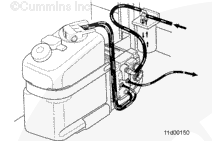
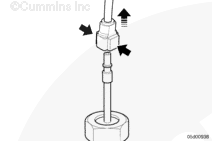
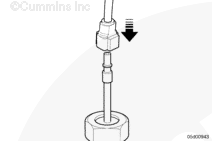
Disconnect the aftertreatment diesel exhaust fluid supply pipework from the aftertreatment nozzle and drain any excess aftertreatment diesel exhaust fluid into a suitable container. The fitting is a quick release fitting; to release, press both sides of the fitting.
The aftertreatment diesel exhaust fluid contains urea. Do not get the substance in your eyes. In case of contact, immediately flood eyes with large amounts of water for a minimum of 15 minutes. Avoid prolonged contact with skin. In case of contact, immediately wash skin with soap and water. Do not swallow internally. In the event the catalyst reagent is ingested, contact a physician immediately.
WARNING
Wear appropriate eye and face protection when using compressed air. Flying debris and dirt can cause personal injury.
To clean the nozzle, use only clean, very warm water (+ 40°C (104°F]).
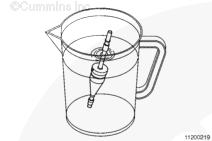
Immerse the aftertreatment nozzle in a suitable container of clean, warm, and demineralized water.
Connect an air line with a pressure of no more than 69 kPa [10 psi], and blow through the injector. When immersed in water, the different spray angles from each hole will be clearly visible.
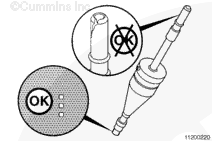
Visually inspect the tip of the aftertreatment nozzle.
All spray holes should be clearly visible.
Visually check the body of the injector for damage.
NOTE: It may be necessary to warm the aftertreatment nozzle in the exhaust system prior to testing for blockage. This helps to soften the normal buildup that can form in the nozzle holes while cold.
NOTE: If shaken, there may be a slight noise from the aftertreatment nozzle. This is normal.
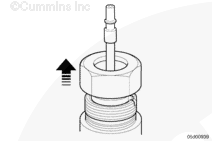
Install the aftertreatment nozzle into the exhaust system locating boss. Make sure the aftertreatment nozzle locating pin is located correctly in the exhaust system locating boss. Care must be taken not to damage the locating pin.
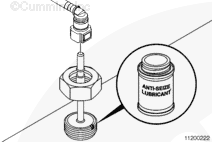
Apply high temperature anti-seize compound to the threads of the locating boss.
Batteries can emit explosive gases. To reduce the possibility of personal injury, always ventilate the compartment before servicing the batteries. To reduce the possibility of arcing, remove the negative (-) battery cable first and attach the negative (-) battery cable last.
Hello, I'm Jack, a diesel engine fan and a blogger. I write about how to fix and improve diesel engines, from cars to trucks to generators. I also review the newest models and innovations in the diesel market. If you are interested in learning more about diesel engines, check out my blog and leave your feedback.
View all posts by Jack
 WARNING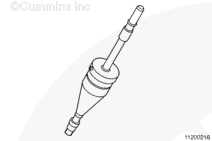






;)
;)
;)
;)
;)
;)
;)
;)
;)
;)
;)
;)
;)
;)
;)
;)
;)
;)
