|
Sensor Supply Voltage Number 1 Circuit – Shorted Low
|

Overview
| CODE | REASON | EFFECT |
| Fault Code: 352 PID: 232 SPN: 1079 FMI: 4 LAMP: Amber SRT: |
Sensor Supply Voltage Number 1 Circuit – Shorted Low. Low voltage detected on sensor supply number 1 circuit. |
Possible reduced performance. |
|
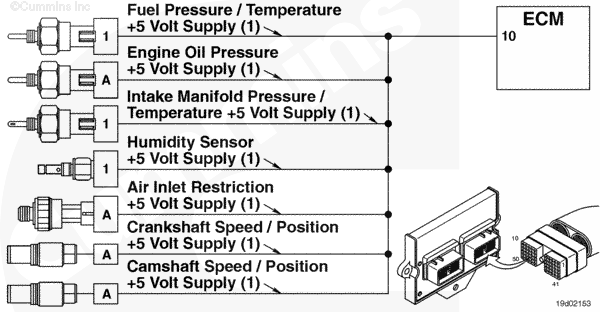
Sensor Supply Voltage Number 1 Circuit |
 |
Circuit Description
This circuit is the voltage supply for the intake manifold pressure/temperature sensor; the secondary fuel pressure/temperature sensor, the humidity sensor, air inlet restriction sensor, the camshaft position sensor, the crankshaft position sensor and the oil pressure sensor.
Component Location
The sensor supply voltage 5 Volt (1) circuit is contained in the wiring harness.
Shop Talk
The voltage supplies for the L Gas Plus engines are broken up into 1, 2, and 4.
Cautions and Warnings
 CAUTION CAUTION To reduce the possibility of damaging a new ECM, all other active fault codes must be investigated prior to replacing the ECM. |
|
CAUTION To reduce the possibility of pin and harness damage, use the following test lead when taking a measurement: |
Troubleshooting Steps
| STEPS | SPECIFICATIONS | |
|---|---|---|
| STEP 1. | Check the fault codes. | |
| STEP 1A. Check for an inactive fault code. | Fault Codes 352 inactive? | |
| STEP 2. | Check the sensors and sensor supply circuit. | |
| STEP 2A. Inspect the intake manifold pressure/temperature sensor and connector pins connected to sensor supply number 1. | Dirty or damaged pins? | |
| STEP 2A-1. Check the circuit response. | ||
| STEP 2B. Inspect the fuel pressure/temperature sensor and connector pins connected to sensor supply number 1. | Dirty or damaged pins? | |
| STEP 2B-1. Check the circuit response. | ||
| STEP 2C. Inspect the engine oil pressure/temperature sensor and connector pins connected to sensor supply number 1. | Dirty or damaged pins? | |
| STEP 2C-1. Check the circuit response. | ||
| STEP 2D. Inspect the humidity sensor and connector pins connected to sensor supply number 1. | Dirty or damaged pins? | |
| STEP 2D-1. Check the circuit response. | ||
| STEP 2E. Inspect the air inlet restriction pressure sensor and connector pins connected to sensor supply number 1. | Dirty or damaged pins? | |
| STEP 2E-1. Check the circuit response. | ||
| STEP 2F. Inspect the camshaft position sensor and connector pins connected to sensor supply number 1. | Dirty or damaged pins? | |
| STEP 2F-1. Check the circuit response. | ||
| STEP 2G. Inspect the Crankshaft position sensor and connector pins connected to sensor supply number 1. | Dirty or damaged pins? | |
| STEP 2G-1. Check the circuit response. | ||
| STEP 3. | Check the ECM and engine harness. | |
| STEP 3A. Inspect the ECM and engine harness connector pins. | Dirty or damaged pins? | |
| STEP 3B. Check for a pin to pin short circuit in the engine harness. | Greater than 100k ohms? | |
| STEP 3B-1. Check for a pin short circuit to ground. | ||
| STEP 3C. Check for an inactive fault code. | Fault Code 352 inactive? | |
| STEP 4. | Clear the fault codes. | |
| STEP 4A. Disable the fault code. | Fault Codes 352 inactive? | |
| STEP 4B. Clear the inactive fault codes. | All fault codes cleared? | |
Guided Step 1 – Check the fault codes.
| Guided Step 1A – Check for an inactive fault code. | |
|---|---|
Conditions
ActionUse INSITE™ electronic service tool to read the fault codes. |
|
|
Fault Codes 352 inactive? |
|
| YES | NO |
| No Repair | No Repair |
Guided Step 2 – Check the sensors and sensor supply circuit.
| Guided Step 2A – Inspect the intake manifold pressure/temperature sensor and connector pins connected to sensor supply number 1. | |
|---|---|
Conditions
Action
For general inspection techniques, refer to Component Connector and Pin Inspection, Procedure 019-361. |
|
|
Dirty or damaged pins? |
|
| YES | NO |
|
A defective connection has been detected in the sensor or harness connector. Repair the damaged pins. Repair or replace the engine harness, whichever has the damaged pins. |
No Repair |
| Guided Step 2A-1 – Check the circuit response. | |
|---|---|
Conditions
Action
|
|
|
Fault Code 352 active? |
|
| YES | NO |
| No Repair |
A defective sensor has been detected. Replace the intake manifold pressure/temperature sensor. Refer to Procedure 019-099. |
| Guided Step 2B – Inspect the fuel pressure/temperature sensor and connector pins connected to sensor supply number 1. | |
|---|---|
Conditions
Action
For general inspection techniques, refer to Component Connector and Pin Inspection, Procedure 019-361. |
|
|
Dirty or damaged pins? |
|
| YES | NO |
|
A defective connection has been detected in the sensor or harness connector. Repair the damaged pins. Repair or replace the engine harness, whichever has the damaged pins. |
No Repair |
| Guided Step 2B-1 – Check the circuit response. | |
|---|---|
Conditions
Action
|
|
|
Fault Code 352 active? |
|
| YES | NO |
| No Repair |
A defective sensor has been detected. Replace the fuel pressure/temperature sensor. Refer to Procedure 019-153. |
| Guided Step 2C – Inspect the engine oil pressure sensor and connector pins connected to sensor supply number 1. | |
|---|---|
Conditions
Action
For general inspection techniques, refer to Component Connector and Pin Inspection, Procedure 019-361. |
|
|
Dirty or damaged pins? |
|
| YES | NO |
|
A defective connection has been detected in the sensor or harness connector. Repair the damaged pins. Repair or replace the engine harness, whichever has the damaged pins. |
No Repair |
| Guided Step 2C-1 – Check the circuit response. | |
|---|---|
Conditions
Action
|
|
|
Fault Code 352 active? |
|
| YES | NO |
| No Repair |
A defective sensor has been detected. Replace the engine oil pressure sensor. Refer to Procedure 019-066. |
| Guided Step 2D – Inspect the humidity sensor and connector pins connected to sensor supply number 1. | |
|---|---|
Conditions
Action
For general inspection techniques, refer to Component Connector and Pin Inspection, Procedure 019-361. |
|
|
Dirty or damaged pins? |
|
| YES | NO |
|
A defective connection has been detected in the sensor or harness connector. Repair the damaged pins. Repair or replace the engine harness, whichever has the damaged pins. |
No Repair |
| Guided Step 2D-1 – Check the circuit response. | |
|---|---|
Conditions
Action
|
|
|
Fault Code 352 active? |
|
| YES | NO |
| No Repair |
A defective sensor has been detected. Replace the humidity sensor. Refer to Procedure 019-356. |
| Guided Step 2E – Inspect the air inlet restriction pressure sensor and connector pins connected to sensor supply number 1. | |
|---|---|
Conditions
Action
For general inspection techniques, refer to Component Connector and Pin Inspection, Procedure 019-361. |
|
|
Dirty or damaged pins? |
|
| YES | NO |
|
A defective connection has been detected in the sensor or harness connector. Repair the damaged pins. Repair or replace the engine harness, whichever has the damaged pins. |
No Repair |
| Guided Step 2E-1 – Check the circuit response. | |
|---|---|
Conditions
Action
|
|
|
Fault Code 352 active? |
|
| YES | NO |
| No Repair |
A defective sensor has been detected. Replace the air inlet restriction pressure sensor. Refer to Procedure 019-433. |
| Guided Step 2F – Inspect the camshaft position sensor and connector pins connected to sensor supply number 1. | |
|---|---|
Conditions
Action
For general inspection techniques, refer to Component Connector and Pin Inspection, Procedure 019-361. |
|
|
Dirty or damaged pins? |
|
| YES | NO |
|
A defective connection has been detected in the sensor or harness connector. Repair the damaged pins. Repair or replace the engine harness, whichever has the damaged pins. |
No Repair |
| Guided Step 2F-1 – Check the circuit response. | |
|---|---|
Conditions
Action
|
|
|
Fault Code 352 active? |
|
| YES | NO |
| No Repair |
A defective sensor has been detected. Replace the camshaft position sensor. Refer to Procedure 019-363. |
| Guided Step 2G – Inspect the crankshaft position sensor and connector pins connected to sensor supply number 1. | |
|---|---|
Conditions
Action
For general inspection techniques, refer to Component Connector and Pin Inspection, Procedure 019-361. |
|
|
Dirty or damaged pins? |
|
| YES | NO |
|
A defective connection has been detected in the sensor or harness connector. Repair the damaged pins. Repair or replace the engine harness, whichever has the damaged pins. |
No Repair |
| Guided Step 2G-1 – Check the circuit response. | |
|---|---|
Conditions
Action
|
|
|
Fault Code 352 active? |
|
| YES | NO |
| No Repair |
A defective sensor has been detected. Replace the crankshaft position sensor. Refer to Procedure 019-365. |
Guided Step 3 – Check the ECM and engine harness.
| Guided Step 3A – Inspect the ECM and engine harness connector pins. | |
|---|---|
Conditions
Action
For general inspection techniques, refer to Component Connector and Pin Inspection, Procedure 019-361. |
|
|
Dirty or damaged pins? |
|
| YES | NO |
|
A defective connection has been detected in the ECM or engine harness connector. Repair the damaged pins. Repair or replace the engine harness, whichever has the damaged pins. |
No Repair |
| Guided Step 3B – Check for a pin to pin short circuit in the engine harness. | |
|---|---|
Conditions
Action
Refer to the circuit diagram or wiring diagram for connector pin identification. For general resistance measurement techniques, refer to Resistance Measurements Using a Multimeter and Wiring Diagram, Procedure 019-360. |
|
|
Greater than 100k ohms? |
|
| YES | NO |
| No Repair |
A pin to pin short circuit on the sensor supply number 1 line has been detected in the engine harness. Repair the damaged pins. Repair or replace the engine harness, whichever has the damaged pins. |
| Guided Step 3B-1 – Check for a pin short circuit to ground. | |
|---|---|
Conditions
Action
|
|
|
More than 100k ohms? |
|
| YES | NO |
| No Repair |
A pin to ground short circuit on the sensor supply number 1 line has been detected in the engine harness. Repair the damaged pins. Repair or replace the engine harness, whichever has the damaged pins. |
| Guided Step 3C – Check for an inactive fault code. | |
|---|---|
Conditions
ActionUse INSITE™ electronic service tool to read the fault codes. |
|
|
Fault Codes 352 inactive? |
|
| YES | NO |
| No Repair |
Replace the ECM. Call for pre-authorization. Refer to Procedure 019-031. |
Guided Step 4 – Clear the fault codes.
| Guided Step 4A – Disable the fault code. | |
|---|---|
Conditions
Action
|
|
|
Fault Codes 352 inactive? |
|
| YES | NO |
| No Repair | No Repair |
| Guided Step 4B – Clear the inactive fault codes. | |
|---|---|
Conditions
Action
|
|
|
All fault codes cleared? |
|
| YES | NO |
| No Repair | No Repair |
|
Repair complete
|
Appropriate troubleshooting charts
|

;)
;)