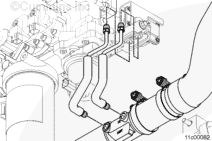
For engines beginning with ESN 14040552, the pressure sensor does not have to be removed to allow the removal of the EGR differential pressure sensor tubes.
When using solvents, acids, or alkaline materials for cleaning, follow the manufacturer’s recommendations for use. Wear goggles and protective clothing to reduce the possibility of personal injury.
WARNING
Wear appropriate eye and face protection when using compressed air. Flying debris and dirt can cause personal injury.
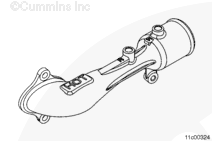
Inspect the mating orifices for the EGR crossover tubes.
If clogged, saturate the carbon deposit with a mineral-based solvent, or equivalent.
Carefully clean debris from the mouth of the tube, making sure not to damage the orifice.
When using solvents, acids, or alkaline materials for cleaning, follow the manufacturer’s recommendations for use. Wear goggles and protective clothing to reduce the possibility of personal injury.
WARNING
Wear appropriate eye and face protection when using compressed air. Flying debris and dirt can cause personal injury.
NOTE: If coolant is found in the EGR differential pressure sensor tubes, they must be replaced.
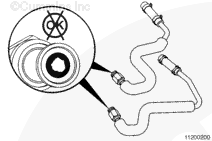
Check the inside of the tubes.
If a tube is partially clogged, saturate the inside of the tube with mineral based solvent, or equivalent.
Carefully clean the debris from the mouth of the tube. Make sure not to damage the tube.
If the tube is fully clogged or otherwise unable to be cleaned, the tube must be replaced.
Clean the tube with safety solvent.
Dry with compressed air.
Check the tubes, hose, and hose clamps for cracks or other damage.
Replace the tubes if the tubes or hose is damaged. Replace the hose clamps if damaged.
When using solvents, acids, or alkaline materials for cleaning, follow the manufacturer’s recommendations for use. Wear goggles and protective clothing to reduce the possibility of personal injury.
WARNING
Wear appropriate eye and face protection when using compressed air. Flying debris and dirt can cause personal injury.
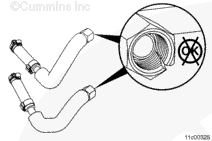
Inspect the mating orifices of the EGR crossover tubes.
If clogged, saturate the carbon deposit with a mineral-based solvent, or equivalent.
Carefully clean the debris from the mouth of the orifice, make sure not to damage the orifice.
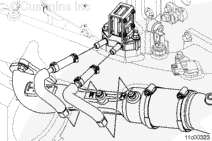
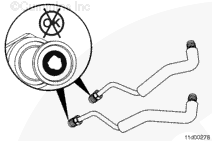
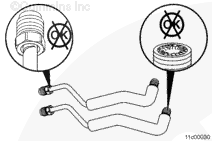
For engines beginning with ESN 14040552, the tubes must be installed so they do not cross over each other.
Apply a light lubricant (CRC 3-36, WD-40, or equivalent) to the tube threads and install the tubes. The lubricant is to be applied inside the tube nut, directing the spray on the threads and around the sleeve and flange area.
Torque Value: 17 n.m [150 in-lb]
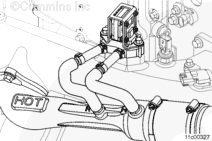
Position the insulation on the differential pressure sensor tubes so the tube nuts at the venturi connections are covered.
This insulation is designed to only cover the bottom portion of the tube which threads to the EGR tube. This location proves to be most effective and prevents heat soaking of the EGR differential pressure sensor.
The tubes must be installed so they do not cross each other.
Apply a light lubricant (CRC 3-36, WD-40, or equivalent) to the tube threads and install the tubes. The lubricant is to be applied inside the tube nut, directing the spray on the threads and around the sleeve and flange area.
Tighten the tube nuts at the EGR venturi connection.
Tighten the hose clamps at the differential pressure sensor adapter.
Torque Value: 1.5 n.m [13 in-lb]
Position the insulation on the differential pressure sensor tubes so the tube nuts at the venturi connection are covered.
The insulation on the pressure tubes is designed to only cover the bottom portion of the tube which threads into the EGR transfer tube. This is the most effective location and also reduces the possibility of heat soaking of the EGR differential pressure sensor.
If damage resulted in coolant, oil, excessive fuel or excessive black smoke entering the exhaust system, the aftertreatment system must be inspected. Refer to Procedure 014-013 in Section 14.
Hello, I'm Jack, a diesel engine fan and a blogger. I write about how to fix and improve diesel engines, from cars to trucks to generators. I also review the newest models and innovations in the diesel market. If you are interested in learning more about diesel engines, check out my blog and leave your feedback.
View all posts by Jack



 WARNING




;)
;)
;)
;)
;)
;)
;)
;)
;)
;)
;)
;)
;)
;)
;)
;)
;)
;)
;)
;)