The use of quality engine lubricating oils, combined with appropriate oil drain and filter change intervals, is a critical factor in maintaining engine performance and durability.
Cummins Inc. recommends engines using exhaust gas recirculation (EGR) must use a high quality 15W-40 multiviscosity heavy-duty engine oil that meets the requirements of Cummins Engineering Specification CES 20078 (such as Valvoline® Premium Blue® or Premium Blue® Extreme). American Petroleum Institute (API) specification CI-4 meets the CES 20078 requirement. The oil grades CC, CD, CE, CF or CG must not be used.
If oils meeting CES 20078 are not available, CES 20071, 20072, or 20077 can possibly be used for EGR equipped engines at reduced oil drain intervals. Consult the operation and maintenance manual for the particular engine model and duty cycle for more detailed recommendations.
Shortened drain intervals can possibly be required with monograde oils as determined by close monitoring of the oil condition with scheduled oil sampling. Use of single-grade oils can affect engine oil consumption control.
For further details and an explanation of engine lubricating oils for Cummins® engines, refer to Cummins® Engine Oil Recommendations, Bulletin 3810340.
Additional information regarding lubricating oil availability throughout the world is available in the Engine Manufacturing Association (EMA) Lubricating Oils Data Book for Heavy Duty Automotive and Industrial Engines. The data book can be ordered from:
Engine Manufacturer’s Association
Two North LaSalle Street
Suite 2200
Chicago, IL 60602 U.S.A.
Phone: (312) 644-6610
Fax: (312) 827-8737
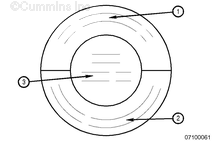
The API service symbols are shown in the accompanying illustration.
The upper half of the symbols display the appropriate oil categories.
The lower half contains words to describe oil energy-conserving features.
The center section identifies the SAE oil viscosity grade.
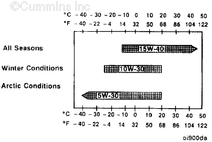
Oil viscosity must be chosen according to the typical climate conditions experienced by the user. Use of 15W-40 viscosity is recommended for the best engine durability at higher ambient temperature. For cold temperature conditions, 10W-30 or 5W-30 viscosity can be used for easier starting, improved oil flow, and improved fuel economy.
Special “break-in” engine lubricating oils are not recommended for new or rebuilt Cummins® engines. In general, use the same oil during break-in as that used in normal operation. To make sure the piston rings seat properly, use a high quality petroleum-based engine lubricating oil during the first engine oil drain period.
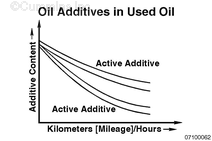
As the engine oil becomes contaminated, essential oil additives are depleted. Lubricating oils protect the engine as long as these additives are functioning properly. Progressive contamination of the oil between oil and filter change intervals is normal. The amount of contamination will vary depending on the operation of the engine, kilometers or miles on the oil, fuel consumed, and new oil added.
Extending oil and filter change intervals beyond the recommendations will decrease engine life due to factors such as corrosion, deposits, and wear.
See the oil drain chart in this section to determine which oil drain interval to use for your application.
The use of quality engine lubricating oils, combined with appropriate oil drain and filter change intervals, is a critical factor in maintaining engine performance and durability.
Cummins Inc. recommends the use of a high quality 15W-40 multiviscosity heavy-duty engine oil that meets the requirements of Cummins Engineering Specification CES 20071 or CES 20076 (such as Valvoline™ Premium Blue® or Premium Blue® 2000). American Petroleum Institute (API) specification CH-4 can be used as an alternative to CES 20071. Oils that meet API specification CG-4 can be used, but at a reduced drain interval according to the Oil Drain Intervals by Severity of Service mi [km] chart. The oil grades CC, CD, CE, or CF has been obsoleted by API and must not be used.
Shortened drain intervals can be required with monograde oils as determined by close monitoring of the oil condition with scheduled oil sampling. Use of single-grade oils may affect engine oil control.
Synthetic engine oils, API category III, are recommended for use in Cummins® engines operating in ambient temperature conditions consistently below -25°C [-13°F]. Above this temperature it is recommended the petroleum based multigrade lubricants be used. Synthetic 0W-30 oils that meet API category III can be used in operations where the ambient temperature never exceeds 0°C [32°F]. 0W-30 oils do not offer the same level of protection against fuel dilution as do higher multigrade oils. Higher cylinder wear can be experienced when using 0W-30 oils in high-load situations.
Additional information regarding lubricating oil availability throughout the world is available in the Engine Manufacturing Association (EMA) Lubricating Oils Data Book for Heavy Duty Automotive and Industrial Engines. The data book can be ordered from:
Engine Manufacturer’s Association
Two North LaSalle Street
Suite 2200
Chicago, IL 60602 U.S.A.
Phone: (312) 644-6610
Fax: (312) 827-8737
The API service symbols are shown in the accompanying illustration.
The upper half of the symbols display the appropriate oil categories.
The lower half contains words to describe oil energy-conserving features.
The center section identifies the SAE oil viscosity grade.
Oil viscosity must be chosen according to the typical climate conditions experienced by the user. Use of 15W-40 viscosity is recommended for the best engine durability at higher ambient temperature. For cold temperature conditions, 10W-30 or 5W-30 viscosity can be used for easier starting, improved oil flow, and improved fuel economy.
Special “break-in” engine lubricating oils are not recommended for new or rebuilt Cummins® engines. In general, use the same oil during break-in as that used in normal operation. Synthetic or partially synthetic engine lubricating oils, however, can not be used during break-in of a new or rebuilt engine. To make sure the piston rings seat properly, use a high quality petroleum-based engine lubricating oil during the first engine oil drain period.
As the engine oil becomes contaminated, essential oil additives are depleted. Lubricating oils protect the engine as long as these additives are functioning properly. Progressive contamination of the oil between oil and filter change intervals is normal. The amount of contamination will vary depending on the operation of the engine, kilometers or miles on the oil, fuel consumed, and new oil added.
Extending oil and filter change intervals beyond the recommendations will decrease engine life due to factors such as corrosion, deposits, and wear.
See the oil drain chart in this section to determine which oil drain interval to use.
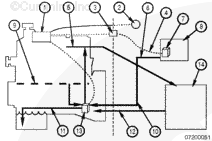
The integrated Centinel™ system is continuous oil replacement system of electromechanical design. The Centinel™ system extends oil and filter change intervals through continuous oil exchange. This is accomplished by injecting engine oil at a controlled rate, proportional to fuel consumed, into the fuel system for consumption. Makeup oil (fresh) is introduced into the engine at a rate equal to the oil consumed by Centinel™. The Centinel™ system also monitors the oil level in the makeup tank.
Control module
Maintenance/fluids lamp
OEM interface connector on the engine control module
The integrated Centinel™ system consists of an oil management valve, remote oil level switch, makeup tank, plumbing and wiring.
The control valve is mounted on the engine and is electronically controlled by the ECM. The ECM controls the timing and number of oil management pump piston strokes based on the engine’s duty cycle. By using the engine’s ECM, any integrated Centinel™ faults light the Maintenance (fluids) lamp on the dash (INSITE™ also reads these faults and Road Relay displays them). The lamp also illuminates for low oil level in the makeup tank. The oil control valve is plumbed to the engine oil rifle, block (or hand hole cover) and fuel drain connection. There is also a makeup port (1-1/16-12 UNF-2B; straight thread o-ring) in the oil control valve for plumbing from the OEM supplied makeup tank.
The makeup tank and plumbing is OEM supplied and mounted. In addition, the makeup tank has an OEM supplied remote oil level switch which is wired to the OEM interface connector on the engine control module (see appropriate wiring diagram). The makeup tank is plumbed to the oil management pump.
Hello, I'm Jack, a diesel engine fan and a blogger. I write about how to fix and improve diesel engines, from cars to trucks to generators. I also review the newest models and innovations in the diesel market. If you are interested in learning more about diesel engines, check out my blog and leave your feedback.
View all posts by Jack



;)
;)
;)
;)
;)
;)
;)
;)
;)
;)