|
Engine Speed/Position Sensor Circuit – Both Signals Lost
|

Overview
| CODE | REASON | EFFECT |
| Fault Code: 115 PID: P190 SPN: 190 FMI: 2 LAMP: Red SRT: |
Engine speed/position sensor circuit – both signals lost. |
Engine can possibly die or will not start. |
|
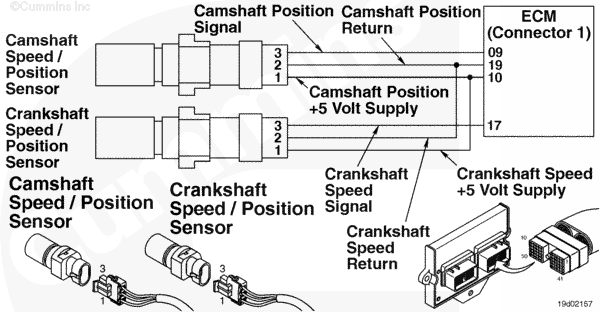
Engine Position Sensor Circuit |
 |
Circuit Description
The crankshaft and camshaft engine speed/position sensors provides engine speed and position information to the electronic control module (ECM). The sensor is powered by 5 volts. The sensor generates the signal by sensing movement of target teeth machined into a tone wheel that is mounted to the crankshaft.
Component Location
The crankshaft speed/position sensor is located on the intake side of the engine between number 5 and number 6 cylinders at the crankshaft level. The camshaft speed/position sensor in located on the intake side of the engine above the accessory drive. Refer to Procedure 100-002 for a detailed component location.
Shop Talk
When the intake manifold pressure indicates a vacuum, the engine will be running. Fault Code 115 can become active with the keyswitch on and the engine RPM is zero if the intake manifold pressure indicates a pressure that is different than expected. INSITE™ electronic service tool can be used to compare the intake manifold pressure sensor to the mixer inlet pressure sensor. These two sensors must both be equal and read atmospheric pressure (101.3 kPa [14.7 psia] at sea level) with the keyswitch on and the engine is not running. If these are not equal, it possibly indicates an in-range failure of the intake manifold pressure sensor. The engine will possibly not start if this condition exists.
This fault code is recorded when the ECM does not receive a signal from the crankshaft and camshaft speed sensor, or the signal it receives is degraded.
Possible causes of this fault code include: open circuit on the supply, signal, or return circuits in the sensor, engine harness, or ECM.
Short circuits to ground or return circuits in the sensor, engine harness, or ECM.
Short circuits to a voltage source in the sensor, engine harness, or ECM.
Damage to the sensor target teeth or tone wheel.
If this fault code occurs intermittently, look closely for causes of intermittent harness connections such as loose or worn pins in the engine harness connectors.
Cautions and Warnings
 CAUTION CAUTION To reduce the possibility of damaging a new ECM, all other active fault codes must be investigated prior to replacing the ECM. |
|
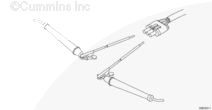
CAUTION To reduce the possibility of pin and harness damage, use the following test leads when taking a measurement: |
Troubleshooting Steps
| STEPS | SPECIFICATIONS | |
|---|---|---|
| STEP 1. | Check the fault codes. | |
| STEP 1A. Check for sensor supply fault codes. | Fault Code 352 or 386 active? | |
| STEP 1B. Check for an inactive fault code. | Fault Code 115 inactive? | |
| STEP 2. | Check the crankshaft speed/position sensor and circuit. | |
| STEP 2A. Inspect the crankshaft speed/position sensor connector pins. | Dirty or damaged pins? | |
| STEP 2B. Inspect the camshaft speed/position sensor connector pins. | Dirty or damaged pins? | |
| STEP 2C. Check the sensor supply voltage and return circuit. | 4.75 to 5.25 VDC? | |
| STEP 2D. Inspect the crankshaft speed/position sensor. | Damaged sensor tip? | |
| STEP 2E. Verify adequate crankshaft speed/position sensor air gap. | Distance is between 41.36 mm [1.36 in] and 42.65 mm [1.68 in]? | |
| STEP 3. | Check the ECM and engine harness. | |
| STEP 3A. Inspect the ECM and engine harness and ECM connector pins. | Dirty or damaged pins? | |
| STEP 3B. Check for an inactive fault code. | Fault Code 2119 inactive? | |
| STEP 3C. Check for an open circuit in the engine harness. | Less than 10 ohms? | |
| STEP 3D. Check for a pin to pin short circuit in the engine harness. | Greater than 100k ohms? | |
| STEP 3E. Check for a pin to pin short circuit in the engine harness. | Greater than 100k ohms? | |
| STEP 3F. Check for a pin short circuit to ground. | Greater than 100k ohms? | |
| STEP 3G. Check for an inactive fault code. | Fault Code 115 inactive? | |
| STEP 4. | Clear the fault codes. | |
| STEP 4A. Disable the fault code. | Fault Code 115 inactive? | |
| STEP 4B. Clear the inactive fault codes. | All fault codes cleared? | |
Guided Step 1 – Check the fault codes.
| Guided Step 1A – Check for sensor supply fault codes. | |
|---|---|
Conditions
Action
|
|
|
Fault Code 352 or 386 active? |
|
| YES | NO |
| No Repair | No Repair |
|
Fault Code 352 or 386
|
|
| Guided Step 1B – Check for an inactive fault code. | |
|---|---|
Conditions
Action
|
|
|
Fault Code 115 inactive? |
|
| YES | NO |
| No Repair | No Repair |
|
Procedure 019-362
|
|
Guided Step 2 – Check the crankshaft speed/position sensor and circuit.
| Guided Step 2A – Inspect the crankshaft speed/position sensor and connector pins. | |
|---|---|
Conditions
Action
For general inspection techniques, refer to Components Connector and Pin Inspection, Procedure 019-361. |
|
|
Dirty or damaged pins? |
|
| YES | NO |
|
A defective connection has been detected in the sensor or harness connection. Repair the damaged pins. Replace the engine harness, whichever has the damaged pins. |
No Repair |
| Guided Step 2B – Inspect the camshaft speed/position sensor and connector pins. | |
|---|---|
Conditions
Action
For general inspection techniques, refer to Components Connector and Pin Inspection, Procedure 019-361. |
|
|
Dirty or damaged pins? |
|
| YES | NO |
|
A defective connection has been detected in the sensor or harness connection. Repair the damaged pins. Replace the engine harness, whichever has the damaged pins. |
No Repair |
| Guided Step 2C – Check the sensor supply voltage and return circuit. | ||
|---|---|---|
Conditions
Action
Refer to the circuit diagram or wiring diagram for component pin identification. |
|
|
|
4.75 to 5.25 VDC? |
||
| YES | NO | |
| No Repair | No Repair | |
| Guided Step 2D – Inspect the crankshaft speed/position sensor. | |
|---|---|
Conditions
Action
|
|
|
Damaged sensor tip? |
|
| YES | NO |
|
A defective sensor has been detected. Replace the crankshaft speed/position sensor. Refer to Procedure 019-365. Inspect the crankshaft tone wheel/gear teeth for damage or spinning. Sensor clearance is between 41.36 mm [1.36 in] and 42.65 mm [1.68 in]. Refer to Procedure 001-071 in the Troubleshooting and Repair Manual, C8.3G, C Gas Plus and L Gas Plus Engines, Bulletin 3666206. |
No Repair |
| Guided Step 2E – Verify adequate crankshaft speed/position sensor air gap. | ||
|---|---|---|
Conditions
Action
|
|
|
|
Distance is between 41.36 mm [1.36 in] and 42.65 mm [1.68 in]? |
||
| YES | NO | |
| No Repair |
Inspect the crankshaft tone wheel/gear teeth for damage or spinning. Refer to Procedure 001-071 in the Troubleshooting and Repair Manual, C8.3G, C Gas Plus and L Gas Plus Engines, Bulletin 3666206. |
|
Guided Step 3 – Check the ECM and engine harness.
| Guided Step 3A – Inspect the ECM and engine harness connector pins. | |
|---|---|
Conditions
Action
For general inspection techniques, refer to Components Connector and Pin Inspection, Procedure 019-361. |
|
|
Dirty or damaged pins? |
|
| YES | NO |
|
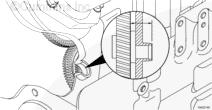
A defective connection has been detected in the ECM connector 1 or engine harness connector. Repair the damaged pins. Replace the engine harness.
|
No Repair |
| Guided Step 3B – Check for an inactive fault code. | |
|---|---|
Conditions
Action
|
|
|
Fault Code 115 inactive? |
|
| YES | NO |
|
None. The removal and installation of the connector corrected the failure. |
No Repair |
| Guided Step 3C – Check for an open circuit in the engine harness. | |
|---|---|
Conditions
Action
Note: Shake and wiggle the harness to determine an intermittent connection. Shake and wiggle the harness to determine an intermittent connection. Refer to the circuit diagram or wiring diagram for connector pin identification. For general resistance measurement techniques, refer to Resistance Measurements Using a Multimeter and Wiring Diagram, Procedure 019-360 |
|
|
Less than 10 ohms? |
|
| YES | NO |
| No Repair |
An open return current has been detected in the engine harness. Repair the damaged pins. Replace the engine harness, whichever has the damaged pins. |
| Guided Step 3D – Check for a pin to pin short circuit in the engine harness. | ||
|---|---|---|
Conditions
Action
Refer to the circuit diagram or wiring diagram for connector pin identification. For general resistance measurement techniques, refer to Resistance Measurements Using a Multimeter and Wiring Diagram, Procedure 019-360 |
|
|
|
Greater than 100k ohms? |
||
| YES | NO | |
| No Repair |
A pin to pin short circuit on the signal line has been detected in the engine harness. Repair the damaged pins. Replace the engine harness, whichever has the damaged pins. |
|
| Guided Step 3E – Check for a pin to pin short circuit in the engine harness. | ||
|---|---|---|
Conditions
Action
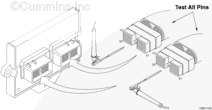
Refer to the circuit diagram or wiring diagram for connector pin identification. For general resistance measurement techniques, refer to Resistance Measurements Using a Multimeter and Wiring Diagram, Procedure 019-360 |
|
|
|
Greater than 100k ohms? |
||
| YES | NO | |
| No Repair |
A pin to pin short circuit on the supply line has been detected in the engine harness. Repair the damaged pins. Replace the engine harness, whichever has the damaged pins. |
|
| Guided Step 3F – Check for a pin short to ground. | |
|---|---|
Conditions
Action
Refer to the circuit diagram or wiring diagram for connector pin identification. For general resistance measurement techniques, refer to Resistance Measurements Using a Multimeter and Wiring Diagram, Procedure 019-360 |
|
|
Greater than 100k ohms? |
|
| YES | NO |
| No Repair |
A pin to ground short circuit on the signal line has been detected in the engine harness. Repair the damaged pins. Replace the engine harness, whichever has the damaged pins. |
| Guided Step 3G – Check for an inactive fault code. | |
|---|---|
Conditions
Action
|
|
|
Fault Code 115 inactive? |
|
| YES | NO |
|
None. The removal and installation of the connector corrected the failure. |
Troubleshooting procedures need to be repeated from the beginning. |
Guided Step 4 – Clear the fault codes.
| Guided Step 4A – Disable the fault code. | |
|---|---|
Conditions
Action
|
|
|
Fault Code 115 inactive? |
|
| YES | NO |
| No Repair | No Repair |
| Guided Step 4B – Clear the inactive fault codes. | |
|---|---|
Conditions
Action
|
|
|
All fault codes cleared? |
|
| YES | NO |
| No Repair | No Repair |
|
Repair complete
|
Appropriate troubleshooting charts
|

;)
;)
;)
;)
;)
;)
;)
;)