|
Battery Number 1 Voltage High – Data Valid but Below Above Operational Range – Moderately Severe Level
|

Overview
| CODE | REASON | EFFECT |
| Fault Code: 442 PID: P168 SPN: 168 FMI: 1/16 LAMP: Amber SRT: |
Battery Number 1 Voltage High – Data Valid but Above Normal Operational Range – Moderately Severe Level. ECM supply voltage is above the minimum system voltage level. |
Possible electrical damage to all electrical components. |
|
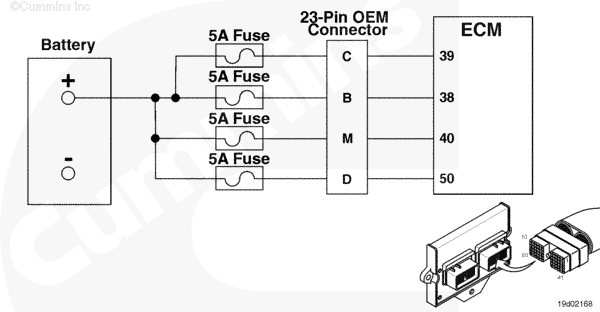
Unswitched Battery Supply Circuit |
 |
Circuit Description
There are four battery inputs into the OEM connectors that are unswitched battery supply to the electronic control module (ECM).
Component Location
The battery voltage circuit is located in the wiring harness.
Shop Talk
The engine will not communicate or start if the battery circuit is malfunctioning.
Cautions and Warnings
 CAUTION CAUTION To reduce the possibility of damaging a new ECM, all other active fault codes must be investigated prior to replacing the ECM. |
|
CAUTION To reduce the possibility of pin and harness damage, use the following test leads when taking a measurement: |
Troubleshooting Steps
| STEPS | SPECIFICATIONS | |
|---|---|---|
| STEP 1. | Check the fault codes. | |
| STEP 1A. Check for an inactive fault code. | Fault Code 442 inactive? | |
| STEP 2. | Check for a defective voltage source. | |
| STEP 2A. Determine if vehicle has a voltage regulator. | Voltage regulator installed? | |
| STEP 2B. Determine battery voltage. | Battery voltage between 11.5 and 15.0 VDC? | |
| STEP 2C. Determine voltage on the 12 VDC side of the OEM voltage regulator. | Voltage between 11.5 and 15.0 VDC? | |
| STEP 3. | Check the charging system. | |
| STEP 3A. Inspect the alternator for correct charging voltage. | Charging system performing properly and voltage between 11.5 VDC and 15.0 VDC? | |
| STEP 4. | Check the OEM a harness. | |
| STEP 4A. Inspect the OEM harness and connector pins. | Dirty or damaged pins? | |
| STEP 4B. Check the voltage at the 23 pin OEM connector. | Voltage between 11.5 VDC and 15.0 VDC? | |
| STEP 4C. Check for an inactive fault code. | Fault Code 442 inactive? | |
| STEP 5. | Clear the fault codes. | |
| STEP 5A. Disable the fault code. | Fault Code 442 inactive? | |
| STEP 5B. Clear the inactive fault codes. | All fault codes cleared? | |
Guided Step 1 – Check the fault codes.
| Guided Step 1A – Check for an inactive fault code. | |
|---|---|
Conditions
Action
|
|
|
Fault Code 442 inactive? |
|
| YES | NO |
| No Repair | No Repair |
Guided Step 2 – Check for a defective voltage regulator.
| Guided Step 2A – Determine if vehicle has a voltage regulator. | |
|---|---|
Conditions
Action
Note: If the vehicle has a 24 VDC or 36 VDC system, then it must have a voltage regulator to supply 12 VDC power to the unswitched battery pin in the ECM. |
|
|
Voltage regulator installed? |
|
| YES | NO |
| No Repair | No Repair |
| Guided Step 2B – Determine battery voltage. | |
|---|---|
Conditions
Action
|
|
|
Battery voltage between 11.5 VDC and 15.0 VDC? |
|
| YES | NO |
| No Repair |
A defective battery has been detected. Replace the defective battery or batteries. Refer to the OEM troubleshooting and repair manual. |
| Guided Step 2C – Determine the voltage on the 12 VDC side of the OEM voltage regulator. | |
|---|---|
Conditions
Action
|
|
|
Voltage between 11.5 VDC and 15.0 VDC? |
|
| YES | NO |
| No Repair |
A defective battery, battery circuit or voltage regulator has been detected. Refer to the OEM troubleshooting and repair manual. |
Guided Step 3 – Check the charging system.
| Guided Step 3A – Check the alternator for correct charging voltage. | |
|---|---|
Conditions
|
|
|
Charging system performing properly and voltage between 11.5 VDC and 15.0 VDC? |
|
| YES | NO |
| No Repair |
A defective charging system has been detected. Repair the charging system. Refer to Procedure 013-001 in the C8.3g (Natural Gas) Engines Troubleshooting and repair manual, Bulletin 3666206 or Procedure 013-001 in the B5.9G, B5.9LPG, B Gas Plus, and B LPG Plus Troubleshooting and Repair Manual, Bulletin 3666164. |
Guided Step 4 – Check the OEM harness.
| Guided Step 4A – Inspect the OEM harness connector pins. | |
|---|---|
Conditions
Action
Refer to the circuit diagram or wiring diagram for connector pin identification. For general inspection techniques, refer to Component Connector and Pin Inspection, Procedure 019-361. |
|
|
Dirty or damaged pins? |
|
| YES | NO |
|
A defective connection has been detected in the 23 pin OEM connector. Repair the damaged pins. Repair or replace the engine harness, whichever has the damaged pins. |
No Repair |
| Guided Step 4B – Check the voltage at the 23 pin OEM connector. | |
|---|---|
Conditions
Action
Refer to the circuit diagram or wiring diagram for connector pin identification. |
|
|
Voltage between 11.5 VDC and 15.0 VDC? |
|
| YES | NO |
| No Repair |
A high voltage source in the OEM harness has shorted to one of the unswitched battery supplies. Repair or replace the OEM wiring harness. Refer to the OEM troubleshooting and repair manual. |
| Guided Step 4C – Check for an inactive fault code. | |
|---|---|
Conditions
Action
|
|
|
Fault Code 442 inactive? |
|
| YES | NO |
| No Repair | No Repair |
Guided Step 5 – Clear the fault codes.
| Guided Step 5A – Disable the fault code. | |
|---|---|
Conditions
Action
|
|
|
Fault Code 442 inactive? |
|
| YES | NO |
| No Repair | No Repair |
| Guided Step 5B – Clear the inactive fault codes. | |
|---|---|
Conditions
Action
|
|
|
All fault codes cleared? |
|
| YES | NO |
| No Repair | No Repair |
|
Repair complete
|
Appropriate troubleshooting charts
|

;)
;)