|
Ignition Reference Signal Circuit – Shorted High
|

Overview
| CODE | REASON | EFFECT |
| Fault Code: 461 PID: S66 SPN: 725 FMI: 3 LAMP: Red SRT: |
Ignition Control Mode (Reference) Signal Circuit – Shorted High. High voltage detected at the ECM. |
Engine will die or not start. |
|
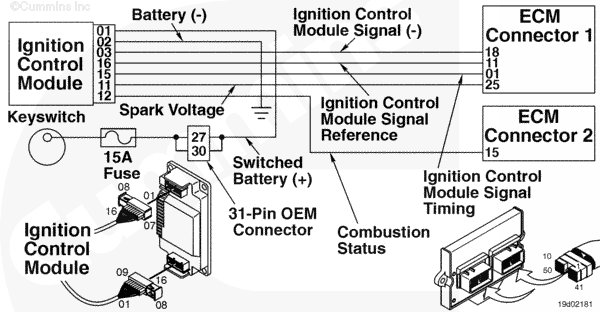
Ignition Reference Signal Circuit |
 |
Circuit Description
The ignition control module (ICM) is a distributorless ignition module that provides a signal to the coils and delivers high voltage to the spark plugs. The electronic control module (ECM) controls the ICM by providing ignition timing information.
Component Location
The ICM is located next to the ECM on the side of the engine.
Shop Talk
For the ICM to operate correctly, all connectors must be clean and tight.
Cautions and Warnings
 WARNING WARNING EXTREMELY HIGH VOLTAGE. Do not touch any ignition wiring or component while the engine is operating unless an insulated tool is being used to prevent electrical shock and damage to the equipment.
|
 CAUTION CAUTION To reduce the possibility of damaging a new ECM, all other active fault codes must be investigated prior to replacing the ECM. |
|
CAUTION To reduce the possibility of pin and harness damage, use the following test leads when taking a measurement: |
Troubleshooting Steps
| STEPS | SPECIFICATIONS | |
|---|---|---|
| STEP 1. | Check the fault codes. | |
| STEP 1A. Read the fault codes. | Fault Code 461 active? | |
| STEP 2. | Check the ignition control module. | |
| STEP 2A. Inspect the ICM and engine harness connector pins. | Dirty or damaged pins? | |
| STEP 2B. Read the fault codes. | Fault Code 461 active? | |
| STEP 3. | Check the engine harness. | |
| STEP 3A. Inspect the engine harness and ECM connector pins. | Dirty or damaged pins? | |
| STEP 3B. Check for an open circuit. | Less than 10 ohms? | |
| STEP 3C. Check for a short circuit from pin to pin. | Greater than 100k ohms? | |
| STEP 4. | Clear the fault codes. | |
| STEP 4A. Disable the fault code. | Fault Code 461 inactive? | |
| STEP 4B. Clear the inactive fault codes. | All fault codes cleared? | |
Guided Step 1 – Check the fault codes.
| Guided Step 1A – Read the fault codes. | |
|---|---|
Conditions
Action
|
|
|
Fault Code 461 active? |
|
| YES | NO |
| No Repair | No Repair |
Guided Step 2 – Check the ignition control module.
| Guided Step 2A – Inspect the ICM and engine harness connector pins. | |
|---|---|
Conditions
Action
Refer to the circuit diagram or wiring diagram for component pin identification. For general inspection techniques, refer to Component Connector and Pin Inspection, Procedure 019-361. |
|
|
Dirty or damaged pins? |
|
| YES | NO |
|
Repair the damaged pins. Repair or replace the engine harness, or replace the ICM, whichever has the damaged pins.
|
No Repair |
| Guided Step 2B – Read the fault codes. | |
|---|---|
Conditions
Action
|
|
|
Fault Code 461 active? |
|
| YES | NO |
| No Repair | No Repair |
Guided Step 3 – Check the engine harness.
| Guided Step 3A – Inspect the engine harness and the ECM connector pins. | |
|---|---|
Conditions
Action
Refer to the circuit diagram or wiring diagram for component pin identification. For general inspection techniques, refer to Component Connector and Pin Inspection, Procedure 019-361. |
|
|
Dirty or damaged pins? |
|
| YES | NO |
|
Repair the damaged pins. Repair or replace the engine harness, or replace the ECM, whichever has the damaged pins.
|
No Repair |
| Guided Step 3B – Check for an open circuit. | ||
|---|---|---|
Conditions
Action
Refer to the circuit diagram or wiring diagram for component pin identification. For general resistance measurement techniques, refer to the Resistance Measurements Using a Multimeter and Wiring Diagram, Procedure 019-360. |
|
|
|
Less than 10 ohms? |
||
| YES | NO | |
| No Repair |
Repair or replace the engine harness.
|
|
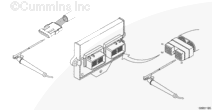
| Guided Step 3C – Check for a short circuit from pin to pin. | ||
|---|---|---|
Conditions
Action
Refer to the circuit diagram or wiring diagram for component pin identification. For general resistance measurement techniques, refer to the Resistance Measurements Using a Multimeter and Wiring Diagram, Procedure 019-360. |
|
|
|
Greater than 100k ohms? |
||
| YES | NO | |
| No Repair |
Repair or replace the engine harness. |
|
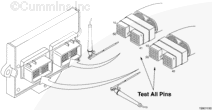
Guided Step 4 – Clear the fault codes.
| Guided Step 4A – Disable the fault code. | |
|---|---|
Conditions
Action
|
|
|
Fault Code 461 inactive? |
|
| YES | NO |
| No Repair | No Repair |
| Guided Step 4B – Clear the inactive fault codes. | |
|---|---|
Conditions
Action
|
|
|
All fault codes cleared? |
|
| YES | NO |
| No Repair |
Troubleshoot any remaining active fault codes. |
|
Repair complete
|
Appropriate troubleshooting charts
|

;)
;)
;)
;)
;)
;)