If natural gas leaks are present, do not store the vehicle inside or in any area that is covered. Severe personal injury can result from asphyxiation or explosion.
WARNING
Fuel is flammable. Keep all cigarettes, flames, pilot lights, arcing equipment, and switches out of the work area and areas sharing ventilation to reduce the possibility of severe personal injury or death when working on the fuel system.
Batteries can emit explosive gases. To reduce the possibility of personal injury, always ventilate the compartment before servicing the batteries. To reduce the possibility of arcing, remove the negative (-) battery cable first and attach the negative (-) battery cable last.
WARNING
Coolant is toxic. Keep away from children and pets. If not reused, dispose of in accordance with local environmental regulations.
WARNING
Do not remove the pressure cap from a hot engine. Wait until the coolant temperature is below 50°C [120°F] before removing the pressure cap. Heated coolant spray or steam can cause personal injury.
Disconnect the battery cables, negative (-) cable first.
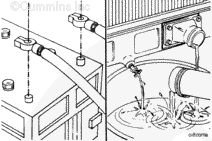
Drain the engine coolant. Refer to Procedure 008-018.
Some state and federal agencies have determined that used engine oil can be carcinogenic and cause reproductive toxicity. Avoid inhalation of vapors, ingestion, and prolonged contact with used engine oil. If not reused, dispose of in accordance with local environmental regulations.
WARNING
To reduce the possibility of personal injury, avoid direct contact of hot oil with your skin.
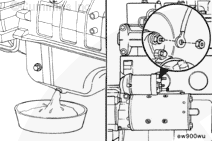
Drain the lubricating oil. Refer to Procedure 007-025.
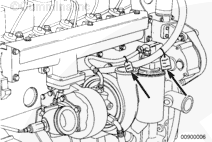
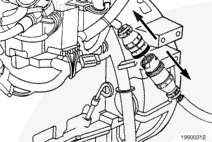
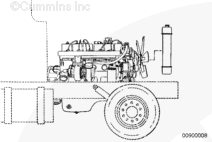
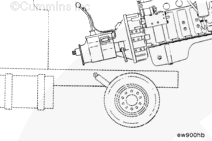
Disconnect the starter cable, engine ground straps, cab or chassis to engine hoses, tubing, electrical wires, wire harnesses, and hydraulic lines.
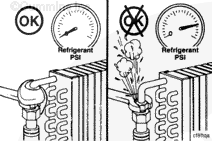
To protect the environment, liquid refrigerant systems must be properly emptied and filled using equipment that prevents the release of refrigerant gas into the atmosphere. Federal law requires capturing and recycling the refrigerant.
WARNING
If a liquid refrigerant system (air conditioning) is used, wear eye and face protection, and wrap a cloth around the fittings before removing. Liquid refrigerant can cause serious eye and skin injuries.
For environmental protection, federal regulations require that freon be recycled, and not vented into the atmosphere.
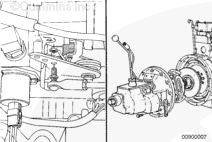
The engine lifting equipment must be designed to lift the engine and transmission safely as an assembly without causing personal injury. The dry weight of the standard 6B5.9G and 6B5.9LPG without accessories is 458 kg [1010 lb]. Refer to the equipment manufacturer’s specifications for the transmission weight.
NOTE: On applications where the rear engine mounts are attached to the transmission, it will, perhaps, be necessary to remove the engine and transmission as an assembly.
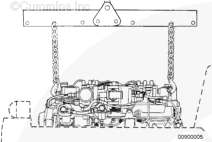
Use a stand or skid that contacts the engine mounts. The stand must hold the weight of the engine and provide permanent support to prevent the engine from falling.
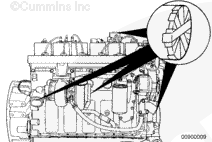
Use a properly rated hoist and engine lifting fixture, attached to the engine-mounted lifting brackets, to remove the engine.
NOTE: If the transmission is not removed, place a support under the transmission to prevent it from falling.
Hello, I'm Jack, a diesel engine fan and a blogger. I write about how to fix and improve diesel engines, from cars to trucks to generators. I also review the newest models and innovations in the diesel market. If you are interested in learning more about diesel engines, check out my blog and leave your feedback.
View all posts by Jack
 WARNING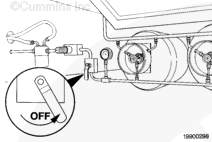




;)
;)
;)
;)
;)
;)
;)
;)
;)
;)
;)
;)
;)
;)
;)
;)
;)
;)
;)
;)
;)
;)
;)
;)
;)
;)