B5.9G, B5.9LPG – Troubleshooting and Repair Manual – 001-016   Crankshaft

General Information

TOC

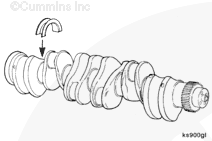
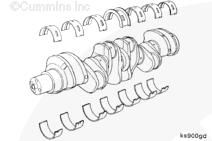
The crankshaft is a balanced, forged-steel unit. The engine has seven main bearings. The lower bearing shells are all the same. All of the upper bearing shells are also the same with the exception of the journal adjacent to the rear one. The next-to-last journal is fitted with a flanged upper bearing shell and is referred to as a thrust bearing. The flanges control the end thrust of the crankshaft.

 
SMALL | MEDIUM | LARGE


The crankshaft uses forged counterweights.

Oversize main bearings and thrust bearings are available for service. Cummins Inc. recommends regrinding all of the main or the connecting rod journals when one requires regrinding. Refer to the B Series Shop Manual, Bulletin 3666017.

SMALL | MEDIUM | LARGE
   

Preparatory Steps

TOC

 WARNING 
Some state and federal agencies have determined that used engine oil can be carcinogenic and cause reproductive toxicity. Avoid inhalation of vapors, ingestion, and prolonged contact with used engine oil. If not reused, dispose of in accordance with local environmental regulations.
 WARNING 
To reduce the possibility of personal injury, avoid direct contact of hot oil with your skin.

Drain the lubricating oil. Refer to Procedure 007-025.

Remove the fan pulley. Refer to Procedure 008-039.

Remove the vibration damper. Refer to Procedure 001-052.

Remove the front gear cover. Refer to Procedure 001-031.

Remove the lubricating oil pan. Refer to Procedure 007-025.

Remove the main bearings. Refer to Procedure 001-006.

Remove the rod bearings. Refer to Procedure 001-005.

SMALL | MEDIUM | LARGE
   

Remove

TOC

 WARNING 

This component weighs 23 kg [50 lb] or more. To reduce the possibility of personal injury, use a hoist or get assistance to lift this component.

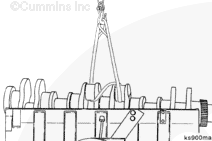
Nylon Lift Sling, Part Number 3375957

NOTE: Lift the crankshaft straight up to avoid damage to the crankshaft and cylinder block.

Install nylon lift sling, Part Number 3375957, around the number 3 and number 4 rod bearing journals.

Attach the sling to a hoist, and remove the crankshaft.

SMALL | MEDIUM | LARGE
   

Clean

TOC

Use a fine crocus cloth to polish the machined surfaces.

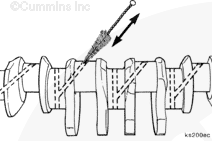
Use a bristle brush to clean the oil drillings.

SMALL | MEDIUM | LARGE
   

Inspect for Reuse

TOC

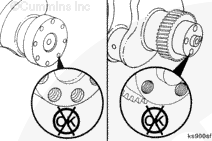
Inspect the threaded capscrew holes for damage.

Use one of the following methods to repair any threaded holes:

  • Chase the threads
  • Use the threaded insert kit, Part Number 3822709.

NOTE: If more than two threaded holes are damaged in one end, the crankshaft
must be replaced.

SMALL | MEDIUM | LARGE


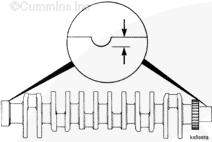
Measure the front and rear oil seal contact areas for a wear groove.

Crankshaft Front and Rear Oil Seal Wear Groove
mm in
0.25 MAX 0.010

Front and rear wear sleeves are available for a crankshaft that is worn beyond the limit.

SMALL | MEDIUM | LARGE


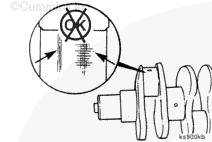
Inspect the crankshaft connecting rod and main journals for deep scoring, overheating, etc.

SMALL | MEDIUM | LARGE


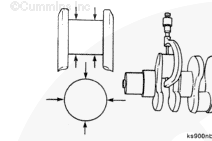
Use a micrometer to measure the connecting rod journal.

Connecting Rod Bearing Journal Diameter
mm in
Standard 68.987 MIN 2.716
Machined 0.25 mm 68.737 MIN 2.706
Machined 0.50 mm 68.487 MIN 2.696
Machined 0.75 mm 68.237 MIN 2.686
Machined 1.00 mm 67.987 MIN 2.677

Bearing Clearance = Connecting rod inside diameter with bearing installed minus crankshaft journal diameter.

Maximum Bearing Clearance: 0.117 mm [0.0046 in].

SMALL | MEDIUM | LARGE


Connecting Rod Bearing Journal
mm in
Out-of-Roundness   0.050 MAX 0.0020
Taper   0.013 MAX 0.0005

SMALL | MEDIUM | LARGE


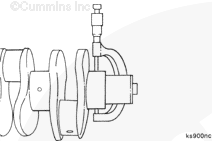
Main Bearing Journal Diameter
mm in
Standard 82.987 MIN 3.267
Machined 0.25 mm 82.737 MIN 3.257
Machined 0.50 mm 82.487 MIN 3.248

Bearing Clearance = Main bore diameter with bearing installed minus crankshaft main journal diameter.

Maximum Bearing Clearance: 0.13 mm [0.005 in].

Crankshaft Main Bearing Journal
mm in
Out-of-Roundness   0.05 MAX 0.0020
Taper   0.01 MAX 0.0004

SMALL | MEDIUM | LARGE


The following oversize service main and thrust bearings are available for crankshafts that have been machined undersize:

Thrust Size
  Oversize 0.000 0.25 mm 0.50 mm
Journal 0.000 X X X
Diameter 0.25 mm X X
0.50 mm X X
0.75 mm X
  1.00 mm X    
 
SMALL | MEDIUM | LARGE


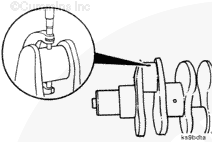
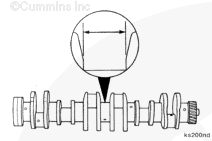
Measure the thrust face width.

Crankshaft Thrust Face Width (standard)
mm in
42.98 MIN 1.692
43.08 MAX 1.696

SMALL | MEDIUM | LARGE


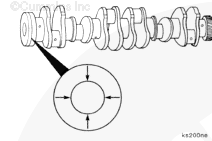
Measure the rear oil seal flange outside diameter.

Crankshaft Rear Oil Seal Flange Outside Diameter
mm in
129.98 MIN 5.117
130.03 MAX 5.119

SMALL | MEDIUM | LARGE


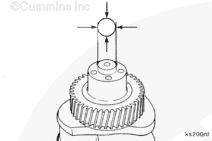
Measure the damper pilot outside diameter.

Crankshaft Damper Pilot Outside Diameter
mm in
18.924 MIN 0.745
19.00 MAX 0.748

SMALL | MEDIUM | LARGE
   

Install

TOC

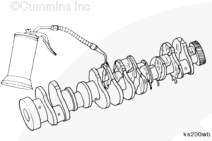
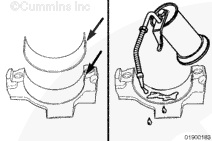
Use a clean gas engine lubricating oil to lubricate the crankshaft to prevent rust.

NOTE: If the crankshaft is not going to be used immediately, protect the part with a plastic cover to prevent dirt from sticking to the oil.

SMALL | MEDIUM | LARGE


Install the upper main bearings.

Refer to Procedure 001-006.

SMALL | MEDIUM | LARGE


Install the upper thrust bearing.

Refer to Procedure 001-006.

SMALL | MEDIUM | LARGE


 WARNING 
This component weighs 23 kg [50 lb] or more. To reduce the possibility of personal injury, use a hoist or get assistance to lift this component.

Use a hoist and nylon lift sling, Part Number 3375957.

Install the sling around the number 3 and number 4 connecting rod bearing journals.

Install the crankshaft.

SMALL | MEDIUM | LARGE


Install the lower main bearing.

Refer to Procedure 001-006.

SMALL | MEDIUM | LARGE


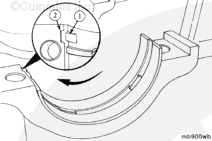
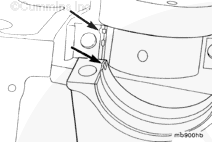
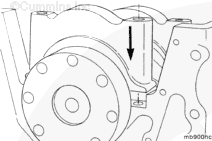
NOTE: The main bearing caps are numbered for location. Number 1 starts with the front of the cylinder block and the numbers must face the camshaft side of the engine.

When installed correctly, the main bearing tangs should both be on the same side.

SMALL | MEDIUM | LARGE


Position the main bearings and main bearing caps onto the crankshaft.

SMALL | MEDIUM | LARGE


The thrust bearing journal does not have tangs or slots. Care must be taken to make sure the number stamped on the main bearing cap is positioned to the camshaft side of the engine.

SMALL | MEDIUM | LARGE


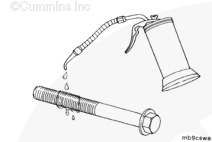
Lubricate the main bearing capscrew threads and underside of the capscrew head with clean gas engine lubricating oil.

SMALL | MEDIUM | LARGE


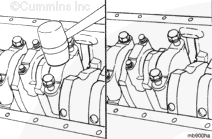
Tap the main bearing cap gently into position.

NOTE: Make sure the main bearing is still aligned with the cap.

When seated, the main bearing capscrews can be threaded in by hand.

SMALL | MEDIUM | LARGE


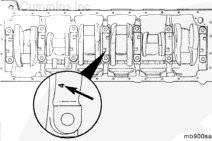
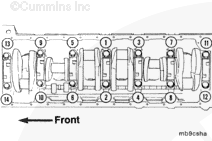
Tighten the main bearing capscrews evenly, following the illustrated sequence.

Torque Value: Step 1 60 n.m   [44 ft-lb]
  Step 2 90 n.m   [66 ft-lb]
  Step 3 Turn clockwise 90 degrees.

SMALL | MEDIUM | LARGE


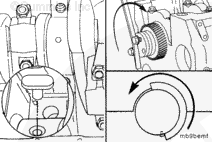
NOTE: The crankshaft must rotate freely after the main bearings have been installed.

Inspect the main bearing installations and the size of the main bearings if the crankshaft will not rotate freely.

SMALL | MEDIUM | LARGE


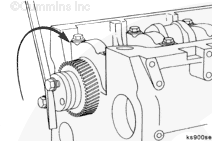
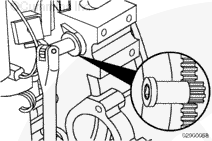
Barring Tool, Part Number 3824591

The barring tool inserts into the flywheel housing and engages the flywheel ring gear. The crankshaft can then be rotated by hand using a 1/2-inch-drive ratchet or breaker bar.

SMALL | MEDIUM | LARGE
   

Finishing Steps

TOC

 WARNING 

Some state and federal agencies have determined that used engine oil can be carcinogenic and cause reproductive toxicity. Avoid inhalation of vapors, ingestion, and prolonged contact with used engine oil. If not reused, dispose of in accordance with local environmental regulations.
 WARNING 

To reduce the possibility of personal injury, avoid direct contact of hot oil with your skin.

Install the rod bearings. Refer to Procedure 001-005.

Install the lubricating oil pan. Refer to Procedure 007-025.

Install the front gear cover. Refer to Procedure 001-031.

Install the vibration damper. Refer to Procedure 001-052.

Install the fan pulley. Refer to Procedure 008-039.

Fill the engine with clean gas engine lubricating oil. Refer to Section 7 for the correct lubrication oil specification.

SMALL | MEDIUM | LARGE


Operate the engine to normal operating temperature, and check for leaks.

SMALL | MEDIUM | LARGE
Last Modified:  27-Jun-2002