The specification for Cummins alternative fuel midrange engines are:
B5.9G/LPG Engines
• Conforms to CES20074; this should be identified on the supplier’s oil packaging. If you are not sure if the oil that you are currently using meets the Cummins specification, you should contact your supplier to obtain a copy of their letter of registration from Cummins that certifies that their oil meets the specification. For easy identification, the packaging of the oil should show CES20074 on it.
Special “break-in” oils are not recommended for use in new or rebuilt Cummins engines. Use the same lubricating oil that will be used in normal engine operation. Synthetic or partially synthetic engine oils, however, can not be used in a new or rebuilt engine during break-in. Use a standard petroleum-based oil for the first drain interval.
CAUTION
A sulfated ash limit of 0.5 percent has been placed on all engine lubricating oils recommended for use in Cummins alternate fueled engines. Higher ash oils can cause valve and/or piston damage and lead to excessive oil consumption and degradation of the catalyst.
For further details and discussion of engine lubricating oils for Cummins engines, refer to Cummins Engine Oil Recommendations, Bulletin 3810340.
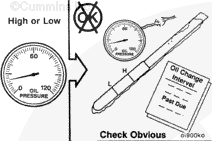
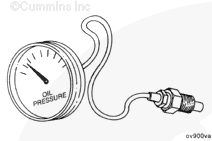
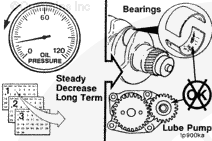
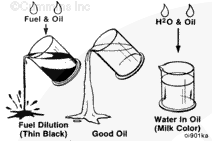
When diagnosing lubrication system malfunctions, check all obvious items related to oil pressure, such as gauges, high and low oil level, excessive oil contamination, and oil viscosity.
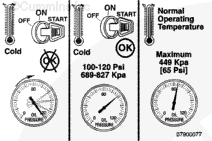
High oil pressure usually occurs after the engine is first started in cold weather. Cold start oil pressure typically will be approximately 552 to 689 kPa [80 to 100 psi]. If the pressure regulator plunger is operating properly, the oil pressure should drop back to approximately 449 kPa [65 psi]
when normal operating temperature is reached.
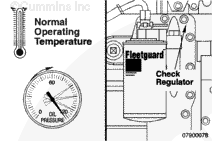
The engine will have high oil pressure at normal operating temperature if the regulator sticks in the closed position. Check the regulator for freedom of movement. Refer to Procedure 007-029.
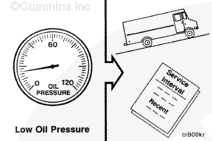
Low lubricating oil pressure (or no oil pressure) can be caused by several lubrication system-related malfunctions. To begin the investigation, determine
the engine operating conditions when the low pressure was first observed;
for example, following a service interval, at idle only, while operating on a steep grade.
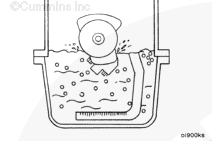
High oil level can cause low oil pressure. If the oil level is high enough for the connecting rods to dip into during operation, the oil can become aerated, resulting in low oil pressure.
Low lubricating oil level will not normally appear as low oil pressure. Typically, it will appear as an intermittent loss of oil pressure when rounding a corner or operating on a steep grade. This condition exists when the oil level is extremely low and the suction tube can not
pick up oil during all modes of operation.
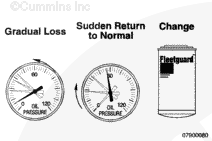
A plugged filter will cause a gradual loss of oil pressure by approximately 69 kPa [10 psi]. The pressure will return to normal when the filter bypass valve opens. If not corrected, this will result in severe engine wear, as the engine is running on unfiltered oil when the bypass valve is open.
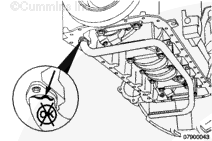
A loose suction tube, damaged gasket, or crack in the suction tube can cause a temporary loss of prime for the oil pump. The engine will have low
pressure or no oil pressure at starting, followed by normal oil pressure.
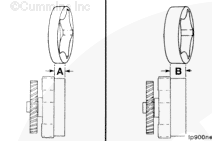
The capacity of the six-cylinder oil pump is greater than the four-cylinder. If low or high pressure occurs after changing the pump, verify that the correct pump was used. Refer to Procedure 007-031.
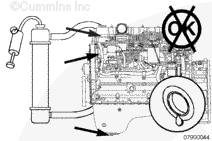
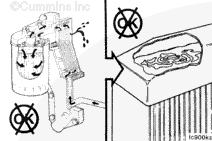
Since the lubricating oil cooler design does not require gaskets or seals to maintain the separation of oil and coolant, the element itself must leak to allow mixing of the fluids. Refer to Procedure 007-003.
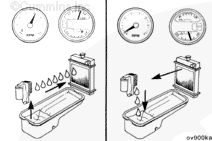
During operation, the lubricating oil pressure will be higher than coolant pressure. A leak in the lubricating oil cooler will show as lubricating oil
in the coolant.
However, following an engine shutdown, the residual pressure in the coolant system can cause coolant to seep through the leak path and into the lubricating oil.
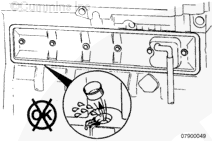
To check for leaks, pressurize the cooling system to 140 kPa [20 psi]. With the system pressurized, remove the following components and inspect for leaks:
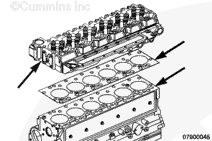
Valve covers (leaks indicate cracked head)
Lubricating oil drain plug (leaks indicate defective lubricating oil cooler, head gasket, or cracked head or block)
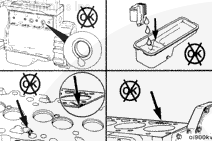
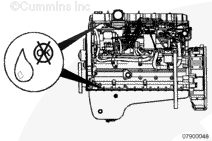
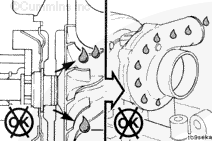
Various gaskets, seals, and plugs are used to contain the lubricating oil. Most leaks can be identified during routine inspection of the engine
and vehicle.
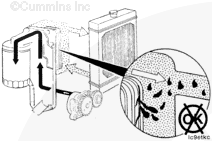
If the lubricating oil cooler element ruptures, the lubricating oil pressure will force lubricating oil into the coolant system. Lubricating oil
in the coolant should be visible when the radiator cap is removed. Refer to Procedure 007-003.
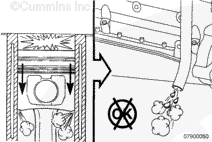
Inadequate sealing of the piston rings will result in excessive lubricating oil being blown into the closed-crankcase ventilation system and/or consumed by the engine. Refer to Procedure 014-002.
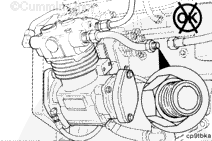
Lubricating oil can also be lost through a worn or malfunctioning air compressor. Look for carbon buildup in the air line from the compressor to
the air tank. Also, a failed air compressor head or head gasket can allow oil to leak into the coolant or coolant to leak into the oil during hot shutdown.
Hello, I'm Jack, a diesel engine fan and a blogger. I write about how to fix and improve diesel engines, from cars to trucks to generators. I also review the newest models and innovations in the diesel market. If you are interested in learning more about diesel engines, check out my blog and leave your feedback.
View all posts by Jack
 CAUTION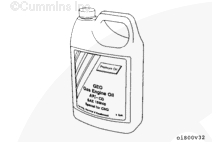




;)
;)
;)
;)
;)
;)
;)
;)
;)
;)
;)
;)
;)
;)
;)
;)
;)
;)
;)
;)
;)
;)
;)
;)
;)
;)
;)
;)
;)
;)
;)
;)
;)
;)
;)
;)
;)
;)
;)
;)
;)
;)
;)
;)
;)
;)
;)
;)