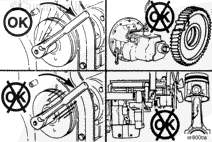
Use only the accessory driveshaft to rotate the crankshaft.
Rotate the crankshaft clockwise through two complete revolutions.
If the engine does not turn freely, the equipment can have a malfunction. Refer to the OEM service manual. The engine can have internal problems. Reference the appropriate procedure for inspection and replacement of internal engine components.
Do not remove the pressure cap from a hot engine. Wait until the coolant temperature is below 50°C [120°F] before removing the pressure cap. Heated coolant spray or steam can cause personal injury.
WARNING
Coolant is toxic. Keep away from children and pets. If not reused, dispose of in accordance with local environmental regulations.
WARNING
To reduce the possiblity of personal injury, avoid direct contact of hot oil with your skin.
WARNING
Some state and federal agencies have determined that used engine oil can be carcinogenic and cause reproductive toxicity. Avoid inhalation of vapors, ingestion, and prolonged contact with used engine oil. If not reused, dispose of in accordance with local environmental regulations.
This component or assembly weighs greater than 23 kg [50 lb]. To prevent serious personal injury, be sure to have assistance or use appropriate lifting equipment to lift this component or assembly.
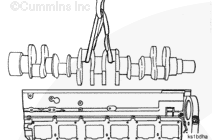
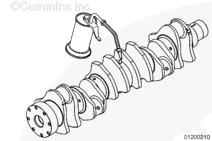
Use a lifting strap that will not damage the crankshaft.
Use a hoist and a lifting strap to remove the crankshaft.
When using solvents, acids, or alkaline materials for cleaning, follow the manufacturer’s recommendations for use. Wear goggles and protective clothing to reduce the possibility of personal injury.
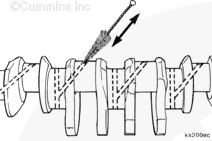
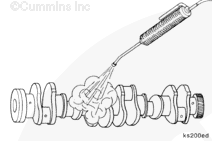
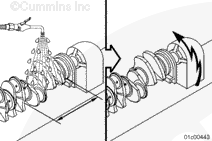
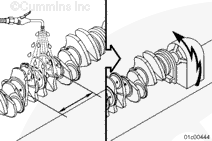
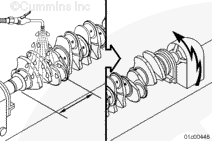
Use a bristle brush and solvent to clean all the crankshaft oil drillings.
When using solvents, acids, or alkaline materials for cleaning, follow the manufacturer’s recommendations for use. Wear goggles and protective clothing to reduce the possibility of personal injury.
WARNING
Wear appropriate eye and face protection when using compressed air. Flying debris and dirt can cause personal injury.
CAUTION
Do not use a thread chaser to clean the capscrew threads in the crankshaft, severe engine damage can result.
To clean the rolled threads, flush with solvent, and dry with compressed air.
If additional cleaning is required, brush with a nylon bristle brush.
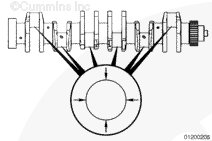
Measure the crankshaft connecting rod journal outside diameter.
Crankshaft Connecting Rod Journal Outside Diameter
mm
in
78.987
MIN
3.1097
79.013
MAX
3.1107
If the crankshaft connecting rod journal outside diameter is not within specifications, the crankshaft must be replaced.
NOTE: Bearings are available for both connecting rod and main bearings journals to accommodate 0.25 mm [0.010 in], 0.50 mm [0.020 in], 0.75 mm [0.030 in] and 1.00 mm [0.039 in] undersize bearings journals. Reference the Alternative Repair Manual, L10 and M11 Series Engines for further information.
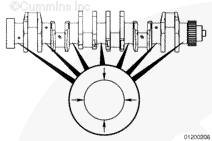
Measure the crankshaft main bearing journal outside diameter.
Crankshaft Main Bearing Journal Outside Diameter
mm
in
114.015
MIN
4.4888
114.055
MAX
4.4904
If the crankshaft main bearing journal outside diameter is not within specifications, the crankshaft must be replaced.
NOTE: Bearings are available for both connecting rod and main bearings journals to accommodate 0.25 mm [0.010 in], 0.50 mm [0.020 in], 0.75 mm [0.030 in] and 1.00 mm [0.039 in] undersize bearings journals. Refererence the Alternative Repair Manual, L10 and M11 Series Engines for further information.
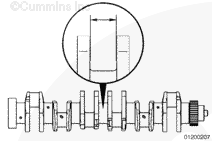
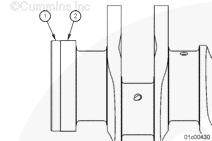
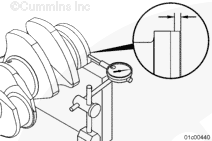
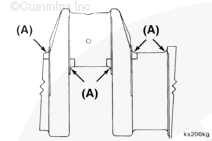
If the crankshaft thrust face width is not within specifications, the crankshaft must be replaced.
NOTE: There are 0.25 mm [0.010 in] oversize thrust bearings available. Reference the Alternative Repair Manual, L10 and M11 Series Engines for further information.
Measure the crankshaft rear oil seal flange outside diameter.
Crankshaft Rear Oil Seal Flange Outside Diameter
mm
in
164.965
MIN
6.4957
165.035
MAX
6.4974
If the crankshaft rear oil seal flange outside diameter is not within specifications, the crankshaft must be replaced.
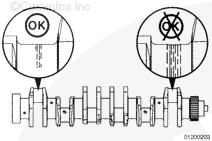
Check the crankshaft rear oil seal flange for nicks, burrs, and grooves.
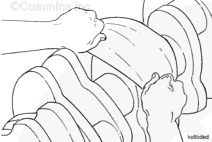
If a fingernail catches in a nick, burr, or groove, the crankshaft must be replaced. Damage to the sealing surface can result in a seal leak.
NOTE: If the rear oil seal flange requires repair, a wear sleeve can be installed. Installation of a wear sleeve usually does not require machining of the crankshaft. Reference the Alternative Repair Manual, L10 and M11 Series Engines for further information.
Measure the crankshaft front oil seal flange outside diameter.
Crankshaft Front Oil Seal Flange Outside Diameter
mm
in
84.970
MIN
3.3453
85.000
MAX
3.3465
If the crankshaft front oil seal flange outside diameter is not within specifications, the crankshaft must be replaced.
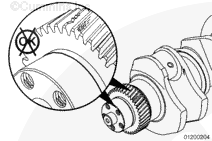
Check the crankshaft front oil seal flange for nicks, burrs, and grooves.
If a fingernail catches in a nick, burr, or groove, the crankshaft must be replaced. Damage to the sealing surface can result in a seal leak.
NOTE: If the front oil seal flange requires repair, a wear sleeve can be installed. Installation of a wear sleeve usually does not require machining of the crankshaft. Refererence the Alternative Repair Manual, L10 and M11 Series Engines for further information.
This component or assembly weighs greater than 23 kg [50 lb]. To prevent serious personal injury, be sure to have assistance or use appropriate lifting equipment to lift this component or assembly.
CAUTION
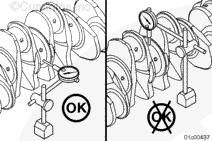
Measuring from the top of the main bearing journal will cause inaccurate alignment measurements because of crankshaft sag.
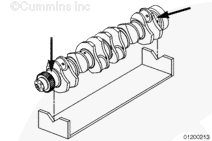
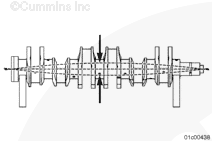
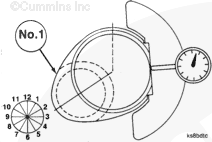
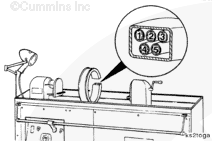
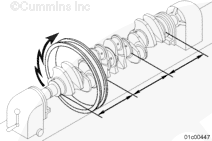
To check the crankshaft full length alignment, support the crankshaft on the number one and number seven main bearing journals.
To check the crankshaft bearing to bearing alignment, support the crankshaft on the number one and number seven main bearing journals.
NOTE: The dial indicator must be set up so the indicator is located on the side of the bearing journal being measured.
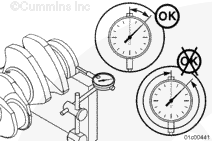
Rotate the crankshaft one complete revolution and record the total indicator runout (TIR) for each main bearing journal. The total indicator runout (TIR) of each journal must be within 0.05 mm [0.002 in] of the adjacent journal.
If the crankshaft total indicator runout (TIR) is not within specifications, the crankshaft must be replaced.
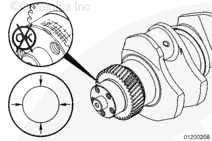
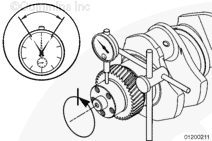
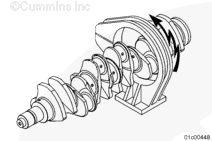
With the crankshaft supported on the number 1 and the number 7 main bearing journals, install a dial indicator within 6.4 mm [0.252 in] from the front end of the gear journal.
Rotate the crankshaft one complete revolution and record the total indicator runout (TIR).
Crankshaft Gear Journal Diameter Total Indicator Runout (TIR)
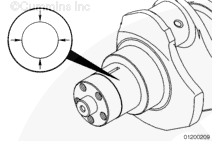
With the crankshaft supported on the number one and number seven main bearing journals, position a dial indicator within 6.4 mm [0.252 in] from the rear of the oil seal flange diameter.
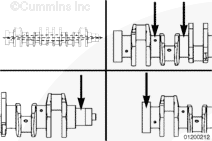
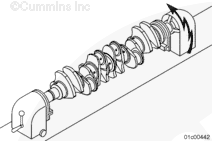
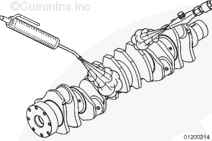
The crankshaft must be tested by the “continuous method”. The entire surface must be wetted with the magnetic bath solution before and during the flow of magnetic current through the crankshaft.
For the head shot (longitudinal magnetization) method, apply the magnetic bath solution to the crankshaft and use 3800 amperes with VDC or rectified VAC to magnetize the crankshaft.
NOTE: The head shot method passes the magnetizing current longitudinally through the crankshaft. The head shot produces a circular magnetic field which is most effective in detecting longitudinal defects in the crankshaft.
For the coil shot (circumferential magnetization) method, apply the magnetic solution and magnetize the crankshaft in a 514.5 mm [20.256 in] inside coil or equivalent. Use 3,600 to 4,000 ampere-turns with VDC or rectified VAC.
NOTE: The coil shot method passes the magnetizing current through a coil centered around the crankshaft axis. The coil shot produces a longitudinal magnetic field which is most effective in detecting circumferential defects.
Amepere-turn is the amperage flowing through the coil multiplied by the number of turns in the coil.
Do not mistake forging trim lines or flow lines for crack indications.
Acceptability of indications varies depending on their location on the crankshaft. Reference the table below.
Open Indication
Subsurface Indication
Circumferential Indication
Fillets
Indications larger than 1.50 mm [0.060 in] are not acceptable in fillets or the critical areas (see note).
Indications larger than 1.50 mm [0.060 in] are not acceptable in fillets or the critical areas (see note).
Connecting Rod Bearing Journals
Indications in the longitudinal direction beyond the individual maximum length or the total cumulative length of open longitudinal indications on any one connecting rod journal as indicated below are not acceptable.
Total cumulative length is 44.50 mm [1.752 in] max.
Individual length is 12.75 mm [0.502 in] max.
Subsurface circumferential indications are not acceptable.
Indications are not acceptable.
Main Bearing Journals
Indications in the longitudinal direction beyond the individual maximum length or the total cumulative length of open longitudinal indications on any one main bearing journal as indicated below are not acceptable.
Total cumulative length is 63.50 mm [2.500 in] max.
Individual length is 15.896 mm [0.626 in] max.
Subsurface indications no longer than 28.50 mm [1.122 in] are acceptable.
Indications are not acceptable.
Bearing Fillet Sidewalls
Longitudinal indications no longer 4.750 mm [0.1870 in] in or entering the fillet are acceptable.
Longitudinal indications no longer than 6.50 mm [0.256 in] are acceptable.
Indications of any kind are not acceptable.
Oil Drillings
Indications entering the oil hole or chamfer are not acceptable.
Indications in the longitudinal direction up to 12.50 mm [0.492 in] long but not closer than 3 mm [0.118 in] to the oil hole chamfer are acceptable.
Indication in the longitudinal direction closer than 3 mm [0.118 in] to the oil hole chamfer are not acceptable.
Indications entering the oil hole or chamfer are not acceptable.
Indications in the longitudinal direction not closer than 3 mm [0.118 in] to the oil hole chamfer and not more than 12.50 mm [0.492 in] long are acceptable.
Indications in the longitudinal direction closer than 3 mm [0.118 in] to the oil hole chamfer.
Indications are not acceptable.
Crankshaft Webs
Indications in the critical area are not acceptable (see note).
Indications that extend into the rod journal fillet are not acceptable.
Indications are not acceptable.
Indications in the critical area are not acceptable (see note).
Indications that extend into the rod journal fillet are not acceptable.
Indications that extend out to the cast surface are acceptable.
Indications that extend into the rod journal fillet are not acceptable.
Gear Journal Diameter
Indications that enter the crankshaft keyway are not acceptable.
Indications longer than 1.50 mm [0.060 in] are not acceptable.
Indication that extends over the face of the crankshaft or into the damper mounting capscrew holes is not acceptable.
Indications in the longitudinal direction no longer than 50 mm [1.97 in] are acceptable.
Indication that extends over the face of the crankshaft or into the damper mounting capscrew holes is not acceptable.
Indications are not acceptable.
Rear Oil Seal Flange Diameter
Indications are not acceptable.
Indications no longer than 1.50 mm [0.060 in] are acceptable as long as the indication does not extend across the oil seal diameter chamfer.
Indications are not acceptable.
NOTE: The critical area extends from the fillet side wall tangency to 3 mm [0.118 in] beyond the fillet journal tangency on both the connecting rod and main bearing journal fillets.
This component or assembly weighs greater than 23 kg [50 lb]. To prevent serious personal injury, be sure to have assistance or use appropriate lifting equipment to lift this component or assembly.
CAUTION
Use a lifting strap that will not damage the crankshaft. Do not drop the crankshaft on the bearings.
Hello, I'm Jack, a diesel engine fan and a blogger. I write about how to fix and improve diesel engines, from cars to trucks to generators. I also review the newest models and innovations in the diesel market. If you are interested in learning more about diesel engines, check out my blog and leave your feedback.
View all posts by Jack


 WARNING


 CAUTION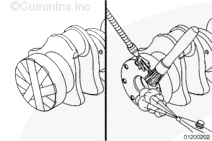



;)
;)
;)
;)
;)
;)
;)
;)
;)
;)
;)
;)
;)
;)
;)
;)
;)
;)
;)
;)
;)
;)
;)
;)
;)
;)
;)
;)
;)
;)
;)
;)
;)
;)
;)
;)
;)
;)
;)
;)
;)
;)
;)
;)
;)
;)
;)
;)
;)
;)
;)
;)
;)
;)
;)
;)
;)
;)
;)
;)
;)
;)
;)
;)
;)
;)
