|
Electronic Throttle Control Actuator Circuit – Shorted Low
|

Overview
| CODE | REASON | EFFECT |
| Fault Code: 176 PID: S58 SPN: 698 FMI: 4 LAMP: Red SRT: |
Electronic Throttle Control Actuator Circuit – Shorted Low. Low voltage detected on the throttle actuator signal pin at the ECM. |
Possible reduced performance. Engine can die or not start. |
|
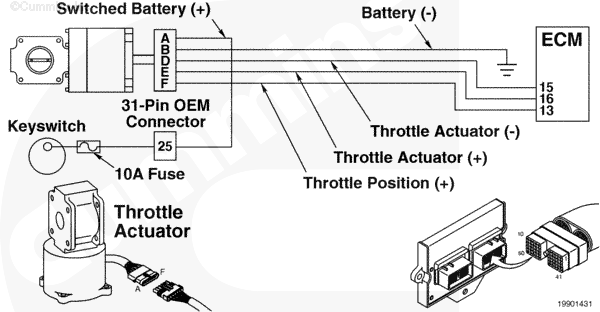
Electronic Throttle Control Actuator Circuit |
 |
Circuit Description
The electronic control module (ECM) controls the electronic throttle control actuator; it is both an input and output device.
Component Location
The electronic throttle control actuator is located after the fuel housing and before the intake manifold inlet.
Shop Talk
The electronic throttle control actuator is a pulse-width modulated component on Gas Plus technology. Within the actuator is the throttle position sensor circuit. This is a non repairable sensor and requires replacement of the actuator upon failure.
Cautions and Warnings
 CAUTION CAUTION To reduce the possibility of damaging a new ECM, all other active fault codes must be investigated prior to replacing the ECM. |
|
CAUTION To reduce the possibility of pin and harness damage, use the following test leads when taking a measurement: |
Troubleshooting Steps
| STEPS | SPECIFICATIONS | |
|---|---|---|
| STEP 1. | Check the fault codes. | |
| STEP 1A. Read the fault codes. | Fault Code 175 active? | |
| STEP 2. | Check the electronic throttle control actuator. | |
| STEP 2A. Inspect the electronic throttle control actuator and engine harness connector pins. | Dirty or damaged pins? | |
| STEP 2B. Read the fault codes. | Fault Code 175 active? | |
| STEP 3. | Check the engine harness. | |
| STEP 3A. Inspect the engine harness and the ECM connector pins. | Dirty or damaged pins? | |
| STEP 3B. Check for an open circuit. | Less than 10 ohms? | |
| STEP 3C. Check for a short circuit to ground. | Greater than 100k ohms? | |
| STEP 3D. Check for a short circuit from pin to pin. | Greater than 100k ohms? | |
| STEP 4. | Clear the fault codes. | |
| STEP 4A. Disable the fault code. | Fault Code 176 inactive? | |
| STEP 4B. Clear the inactive fault codes. | All fault codes cleared? | |
Guided Step 1 – Check the fault codes.
| Guided Step 1A – Read the fault codes. | |
|---|---|
Conditions
Action
|
|
|
Fault Code 176 active? |
|
| YES | NO |
| No Repair | No Repair |
Guided Step 2 – Check the electronic throttle control actuator.
| Guided Step 2A – Inspect the electronic throttle control actuator and engine harness connector pins. | |
|---|---|
Conditions
Action
Refer to the circuit diagram or wiring diagram for component pin identification. For general inspection techniques, refer to Component Connector and Pin Inspection, Procedure 019-361. |
|
|
Dirty or damaged pins? |
|
| YES | NO |
|
Repair the damaged pins. Repair or replace the engine harness, or replace the sensor, whichever has the damaged pins.
|
No Repair |
| Guided Step 2B – Read the fault codes. | |
|---|---|
Conditions
Action
|
|
|
Fault Code 175 active? |
|
| YES | NO |
| No Repair | No Repair |
Guided Step 3 – Check the engine harness.
| Guided Step 3A – Inspect the engine harness and the ECM connector pins. | |
|---|---|
Conditions
Action
Refer to the circuit diagram or wiring diagram for component pin identification. For general inspection techniques, refer to Component Connector and Pin Inspection, Procedure 019-361. |
|
|
Dirty or damaged pins? |
|
| YES | NO |
|
Repair the damaged pins. Repair or replace the engine harness, or replace the ECM, whichever has the damaged pins.
|
No Repair |
| Guided Step 3B – Check for an open circuit. | ||
|---|---|---|
Conditions
Action
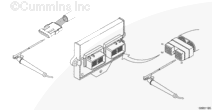
Refer to the circuit diagram or wiring diagram for component pin identification. For general resistance measurement techniques, refer to the Resistance Measurements Using a Multimeter and Wiring Diagram, Procedure 019-360. |
|
|
|
Less than 10 ohms? |
||
| YES | NO | |
| No Repair |
Repair or replace the engine harness.
|
|
| Guided Step 3C – Check for a short circuit to ground. | ||
|---|---|---|
Conditions
Action
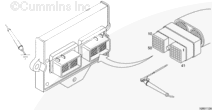
Refer to the circuit diagram or wiring diagram for component pin identification. For general resistance measurement techniques, refer to the Resistance Measurements Using a Multimeter and Wiring Diagram, Procedure 019-360. |
|
|
|
Greater than 100k ohms? |
||
| YES | NO | |
| No Repair |
Repair or replace the engine harness.
|
|
| Guided Step 3D – Check for a short circuit from pin to pin. | ||
|---|---|---|
Conditions
Action
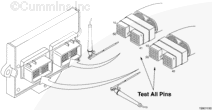
Refer to the circuit diagram or wiring diagram for component pin identification. For general resistance measurement techniques, refer to the Resistance Measurements Using a Multimeter and Wiring Diagram, Procedure 019-360. |
|
|
|
Greater than 100k ohms? |
||
| YES | NO | |
| No Repair |
Repair or replace the engine harness. |
|
Guided Step 4 – Clear the fault codes.
| Guided Step 4A – Disable the fault code. | |
|---|---|
Conditions
Action
|
|
|
Fault Code 176 inactive? |
|
| YES | NO |
| No Repair | No Repair |
| Guided Step 4B – Clear the inactive fault codes. | |
|---|---|
Conditions
Action
|
|
|
All fault codes cleared? |
|
| YES | NO |
| No Repair |
Troubleshoot any remaining active fault codes. |
|
Repair complete
|
Appropriate troubleshooting charts
|

;)
;)
;)
;)
;)
;)
;)
;)