Do not remove the pressure cap from a hot engine. Wait until the coolant temperature is below 50°C [120°F] before removing the pressure cap. Heated coolant spray or steam can cause personal injury.
WARNING
Coolant is toxic. Keep away from children and pets. If not reused, dispose of in accordance with local environmental regulations.
WARNING
Batteries can emit explosive gases. To reduce the possibility of personal injury, always ventilate the compartment before servicing the batteries. To reduce the possibility of arcing, remove the negative (-) battery cable first and attach the negative (-) battery cable last.
Do not remove the pressure cap from a hot engine. Wait until the coolant temperature is below 50°C [120°F] before removing the pressure cap. Heated coolant spray or steam can cause personal injury.
WARNING
Coolant is toxic. Keep away from children and pets. If not reused, dispose of in accordance with local environmental regulations.
WARNING
Batteries can emit explosive gases. To reduce the possibility of personal injury, always ventilate the compartment before servicing the batteries. To reduce the possibility of arcing, remove the negative (-) battery cable first and attach the negative (-) battery cable last.
Do not remove the pressure cap from a hot engine. Wait until the coolant temperature is below 50°C [120°F] before removing the pressure cap. Heated coolant spray or steam can cause personal injury.
WARNING
Coolant is toxic. Keep away from children and pets. If not reused, dispose of in accordance with local environmental regulations.
WARNING
Batteries can emit explosive gases. To reduce the possibility of personal injury, always ventilate the compartment before servicing the batteries. To reduce the possibility of arcing, remove the negative (-) battery cable first and attach the negative (-) battery cable last.
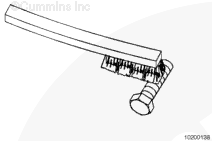
NOTE: Brush away any loose dirt from around the area of the air handling connections to avoid contamination of the interior of the engine.
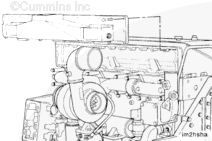
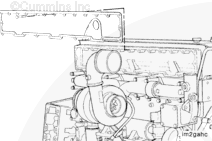
Remove the air intake piping from the air cleaner to the turbocharger compressor inlet. Refer to the OEM service manual. Cover any open points with caps from the Cummins® Vehicle Air Plumbing Clean Care Kit.
Remove the charge-air cooler piping from the air intake adapter to the turbocharger compressor outlet. Cover any open points with caps from the Air Handling Clean Care Kit.
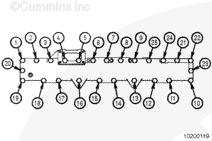
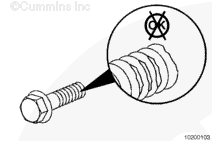
The air intake manifold has five different size capscrews. When removing the capscrews, note their location. It can be helpful to separate the capscrews according to size.
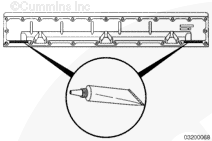
Remove the air intake manifold capscrews and manifold.
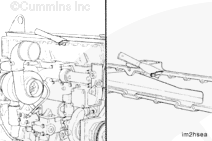
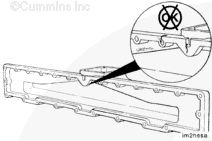
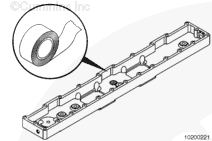
Inspect the air intake manifold for cracks or other damage. Replace the air intake manifold if damage is found.
When inspecting the air intake manifold for oil or debris from an air system failure, also inspect the intake ports in the rocker lever housing and cylinder head for oil and debris.
Inspect the intake manifold for cracks or other damage.
NOTE: When inspecting the intake manifold for oil or debris from an air system failure, also inspect the intake ports in the rocker housing and cylinder head for oil debris.
When inspecting the air intake manifold for oil or debris from the air system failure, also inspect the intake ports in the rocker lever housing and cylinder head for oil and debris.
Coolant is toxic. Keep away from children and pets. If not reused, dispose of in accordance with local environmental regulations.
WARNING
Batteries can emit explosive gases. To reduce the possibility of personal injury, always ventilate the compartment before servicing the batteries. To reduce the possibility of arcing, remove the negative (-) battery cable first and attach the negative (-) battery cable last.
Install the air intake connection to the air intake manifold and connect the intake manifold air temperature sensor connector to the engine harness. Refer to Procedure 010-080 in Section 10.
Do not remove the pressure cap from a hot engine. Wait until the coolant temperature is below 50°C [120°F] before removing the pressure cap. Heated coolant spray or steam can cause personal injury.
WARNING
Coolant is toxic. Keep away from children and pets. If not reused, dispose of in accordance with local environmental regulations.
WARNING
Batteries can emit explosive gases. To reduce the possibility of personal injury, always ventilate the compartment before servicing the batteries. To reduce the possibility of arcing, remove the negative (-) battery cable first and attach the negative (-) battery cable last.
Install the inlet air connection and the sensors from the air manifold.
Connect the air pipe from the charge air-cooler to the inlet air connection. Refer to the OEM service manual.
Coolant is toxic. Keep away from children and pets. If not reused, dispose of in accordance with local environmental regulations.
WARNING
Batteries can emit explosive gases. To reduce the possibility of personal injury, always ventilate the compartment before servicing the batteries. To reduce the possibility of arcing, remove the negative (-) battery cable first and attach the negative (-) battery cable last.
Hello, I'm Jack, a diesel engine fan and a blogger. I write about how to fix and improve diesel engines, from cars to trucks to generators. I also review the newest models and innovations in the diesel market. If you are interested in learning more about diesel engines, check out my blog and leave your feedback.
View all posts by Jack
 WARNING







;)
;)
;)
;)
;)
;)
;)
;)
;)
;)
;)
;)
;)
;)
;)
;)
;)
;)
;)
;)
;)
;)
;)
;)